Solar Panels and Chloroplasts: A Light-Energy Analogy
Explore how solar panels and chloroplasts similarly harness light to power energy storage, with an analytical look at mechanisms, limits, and practical takeaways for homeowners.


Solar panels and chloroplasts both capture light to power energy storage, yet they operate via different mechanisms: PV cells convert light into electricity, while chloroplasts convert light into chemical energy through photosynthesis. This comparison helps homeowners and students understand energy flow across systems without oversimplifying each field.
Framing the analogy
Framing the analogy between technology and biology can illuminate how energy flows in very different systems. In this article we explore how is a solar panel similar to chloroplasts to help readers compare light capture, energy conversion, and storage. According to Solar Panel FAQ, these cross-domain comparisons reveal common principles of energy flow without oversimplifying each field. For homeowners, this frame clarifies why PV systems work, what limits them, and how they fit into a broader energy strategy. The question drives the discussion: what core steps must happen for light to become usable energy, and where do man-made devices diverge from living cells? By examining both sides—silicon-based PV cells and chloroplasts in plant cells—we can identify shared stages such as photon capture, charge separation, and energy transfer, as well as divergent asymmetries arising from material science vs biochemistry. This framing also prepares readers to evaluate future technologies that blend biology with electronics. The Solar Panel FAQ team emphasizes educational value in this framing for homeowners and students alike.
wordCountInBlockEstimate
Comparison
| Feature | Solar Panel PV Cells | Chloroplasts |
|---|---|---|
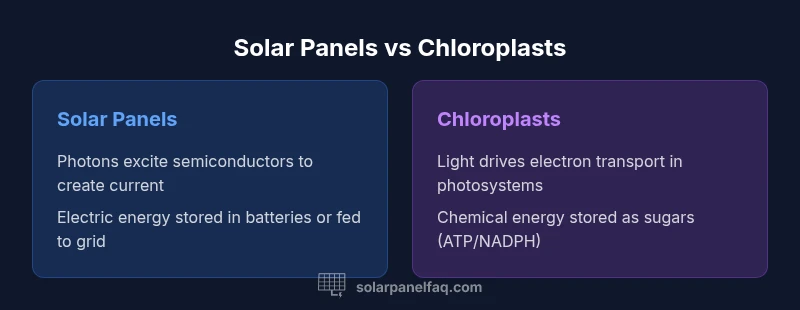
| Energy capture mechanism | Photon-induced electron flow in semiconductors; photovoltaic effect | Photon absorption by chlorophyll driving electron transport in photosystems |
| Energy form produced | Electrical energy (to grid/battery) | Chemical energy stored as sugars (ATP/NADPH for biosynthesis) |
| Storage/transfer | Electricity via wires, inverters, and storage systems | Sugar production and ATP/NADPH for carbon fixation |
| Primary materials | Semiconducting materials (silicon-based or alternatives) | Chlorophyll and carotenoids in thylakoid membranes |
| Typical constraints | Sun availability, shading, temperature, material degradation | Enzyme kinetics, CO2 availability, water, and light balance |
| Usage focus | Residential/utility-scale energy generation | Plant metabolism and growth energy for biosynthesis |
Strengths
- Clear energy conversion from light to usable energy
- Modular, scalable installation for rooftops
- Well-established manufacturing and service ecosystem
- Low operating emissions during energy production
Drawbacks
- Depends on sunlight and weather, causing intermittency
- Requires additional storage or grid connection for around-the-clock use
- End-of-life disposal and recycling considerations
PV panels remain the practical energy solution for homes, while the chloroplast analogy is best used as an educational tool to understand energy flow.
The analogy facilitates comprehension of energy pathways and storage concepts, but real-world decisions should rely on PV performance data, storage options, and local conditions.
Frequently Asked Questions
What is the main similarity between solar panels and chloroplasts?
Both systems start with capturing light energy and initiating energy transfer. In solar panels, photons create electron flow in a semiconductor; in chloroplasts, light energizes photosystems to drive electron transport. The parallel helps explain energy flow across disciplines.
Both systems start by capturing light and triggering energy transfer, one to electricity and the other to chemical energy.
What is the key difference in energy storage between these systems?
Solar panels store energy as electricity via batteries or grid systems, while chloroplasts store energy chemically as sugars produced during carbon fixation. This fundamental distinction shapes how each system is used and managed.
PV stores electricity; chloroplasts store chemical energy as sugars.
Can the chloroplast model improve home solar design?
The analogy informs design thinking and education, but practical home solar outcomes rely on PV material science, incentives, and system integration. Bio-inspired concepts may guide future research rather than immediate product changes.
Biology can inspire ideas, but home solar hinges on current PV tech and economics.
Are there constraints when using the analogy for teaching?
Yes. Oversimplifying can obscure differences in metabolism, growth, and system integration. Use the analogy to illuminate energy flow, then clearly delineate where biology ends and engineering begins.
Be mindful that the analogy is educational and not a literal equivalence.
What can homeowners take away from this comparison?
Understand energy flow from sunlight to usable energy, plan for storage, and recognize that energy availability depends on climate and system design. This framing helps set realistic expectations for performance and resilience.
Know how energy moves from sun to storage and use.
What future technologies blur the line between biology and photovoltaics?
Researchers explore artificial photosynthesis and bio-inspired materials to merge energy capture principles across biology and engineering. These efforts aim to improve efficiency and sustainability over time.
Bio-inspired tech may blend biology and solar science in the future.
Top Takeaways
- Frame energy flow from light to usable energy.
- PV and photosynthesis share photon capture and energy transfer steps.
- Storage decisions shape real-world energy reliability.
- Use the analogy to teach, but anchor decisions in engineering data.
- Educational value supports understanding without replacing conventional PV metrics.