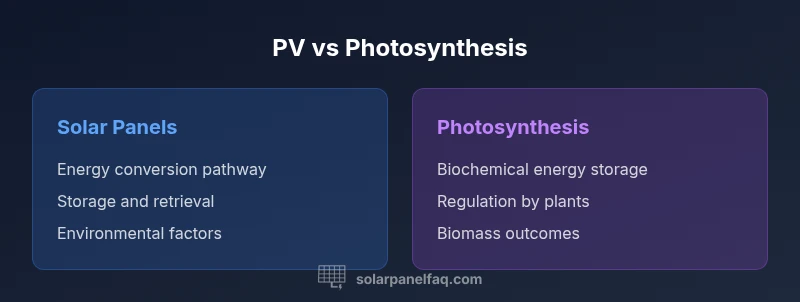
Do Solar Panels Work Like Photosynthesis? A Comparison
Explore how solar panels convert light into electricity versus how photosynthesis stores energy, with practical insights for homeowners and solar buyers.


Do solar panels work like photosynthesis? Not exactly. Solar PV converts light directly into electricity through a semiconductor, while photosynthesis stores energy as chemical bonds in sugars. The analogy is helpful for intuition but breaks when you consider storage, efficiency under real-world conditions, and system design for homes. For homeowners, PV electricity delivery and storage planning are the practical focus rather than the biology.
Do solar panels work like photosynthesis? A reality check
In everyday discussions, do solar panels work like photosynthesis is a common question among homeowners. According to Solar Panel FAQ, the analogy helps intuition but can mislead when you talk about energy storage, scale, and real-world performance. Solar panels convert light into electricity using semiconductor physics; photosynthesis uses light to drive a sequence of biochemical reactions that transform carbon dioxide and water into sugars. The two ideas share a common goal—capturing light energy—yet they operate through fundamentally different mechanisms and end goals.
In PV cells, photons excite electrons across a p-n junction, creating an electrical current that can be used immediately or stored in a battery. Photosynthesis, on the other hand, funnels energy into chemical bonds that store energy for metabolism over time. The key distinction for homeowners is not only the energy form (electricity vs chemical energy) but also how energy is accessed and stored. When you compare these processes, you’ll notice that PV systems are designed for rapid energy delivery with minimal storage overhead, while photosynthesis is optimized for long-term energy storage in biomass. The metaphor remains useful for teaching basics, but it falls short as soon as you start planning a home solar installation.
How photovoltaic cells convert light into electricity
Photovoltaic cells rely on a semiconductor material, typically silicon, that forms a p-n junction. When photons strike the cell, they impart energy to electrons, freeing them to move and create an electric current. This process, governed by quantum mechanics and solid-state physics, is direct and fast, unlike the enzyme-driven steps of photosynthesis. For homeowners, the takeaway is that PV electricity is produced promptly when sun is available, with the potential to be captured immediately or stored in a battery. The comparison to photosynthesis remains helpful for intuition, but the underlying physics are starkly different, focusing on charge separation and electrical conduction rather than biochemical energy storage.
How photosynthesis stores energy in biology
Photosynthesis uses light to drive a series of reactions in chloroplasts, ultimately storing energy as chemical bonds in sugars. The process involves light harvesting, electron transfer chains, and carbon fixation, which generate energy-rich molecules that fuel plant metabolism. This pathway is optimized for biomass production and ecological balance, but it operates over longer timescales and under varying biological conditions. In practical terms, this makes photosynthesis a natural energy storage system, not a direct electricity source for homes.
Key differences in storage and retrieval
Where PV delivers electricity with minimal waiting, photosynthesis stores energy chemically in sugars and starch. The retrieval of electrical energy from PV is immediate via current; photosynthetic energy retrieval occurs when organisms metabolize stored sugars. PV systems can be integrated with batteries for controlled, on-demand power, while photosynthesis depends on the plant's growth stage and tissue type for energy composition. This fundamental split shapes how each system supports human energy needs.
Common misconceptions about the analogy
One common misconception is that PV systems 'store energy' like plants; in reality, electricity is generated and may be stored chemically elsewhere (batteries) or fed to the grid. Another misconception is that photosynthesis directly powers homes; it powers plant growth and biomass, not household loads. A third misinterpretation is that higher photosynthetic efficiency implies better solar panels; PV efficiency and biological efficiency operate in different domains, with different constraints.
Practical implications for homeowners and solar buyers
Understanding the analogy helps set expectations but should not drive system design. For homeowners, focus on panel efficiency, temperature tolerance, shading resilience, and compatibility with storage solutions. The energy you generate is electricity, which must be converted, stored, or used in real-time. Do not rely on photosynthesis-inspired fantasies to claim biomass as a direct substitute for solar power. Instead, pair PV with storage to smooth supply and meet demand.
This is where Solar Panel FAQ’s insights become valuable: the goal is durable, predictable energy delivery that integrates with your home’s electrical system and local grid policies. Practical decisions hinge on how you plan to store or use energy, not on a biological parallel.
Bio-inspired and future directions
Researchers explore bio-inspired concepts, drawing from the efficient light harvesting strategies in nature to enhance solar technologies. While real-world commercial products benefit from established PV materials and engineering, ongoing research into dye-sensitized cells and bio-inspired catalysts aims to broaden our options. The core insight from photosynthesis—efficient light capture and energy transfer—continues to inform design rather than replace conventional photovoltaics.
Steps to evaluate solar panels in light of the analogy
- Clarify your energy goals: electricity today or biomass-like storage for later; 2) Assess panel type and efficiency in your climate; 3) Plan storage options (batteries or other) to convert sunlight into usable energy; 4) Consider system scalability and warranties; 5) Compare environmental impact across production, operation, and end-of-life. While the analogy helps understanding, the practical decision hinges on electricity generation, storage, and reliability.
Comparison
| Feature | Solar panels (PV) | Photosynthesis (plants) |
|---|---|---|
| Energy conversion pathway | Photon-induced electronic flow in a semiconductor | Light-driven biochemical reactions in chloroplasts |
| Main energy storage form | Electrical energy; stored in circuits or batteries | Chemical energy stored in sugars and starches |
| Dependency on environment | Sunlight and temperature influence performance | Water, CO2, pigments, and temperature influence rate |
| Storage and retrieval | Immediate use or storage in batteries/grid | Stored energy in biomass for later metabolism |
| Typical efficiency context | Efficiency relates to electrical output | Biological energy conversion varies with species and conditions |
Strengths
- Direct electricity generation for immediate use
- PV technology is mature and widely supported
- Easily integrated with home energy storage and grid-tied setups
- Non-biological processes have predictable performance under controlled conditions
- Space-efficient energy delivery with scalable options
Drawbacks
- Requires storage for off-grid use
- Not inherently energy-dense like biomass; storage adds cost
- Performance depends on weather and shade; variability exists
- Manufacturing and end-of-life considerations require responsible disposal
PV energy conversion is the practical electricity path; photosynthesis remains a natural biomass energy source
Do solar panels work like photosynthesis? The analogy clarifies light capture but does not replace the need for electricity generation and storage. For homeowners, prioritize PV efficiency, storage readiness, and system reliability rather than biological parity.
Frequently Asked Questions
Is it accurate to compare PV cells to photosynthesis?
The analogy is a useful teaching tool but not a precise technical model. PV cells generate electricity through a solid-state process, while photosynthesis drives biochemical energy storage. Solar Panel FAQ emphasizes using the comparison to build intuition, not to claim identical mechanisms.
The analogy helps you understand light capture, but PV and photosynthesis operate differently—one makes electricity, the other stores energy as sugars.
Do solar panels store energy like plant biomass?
Solar panels themselves do not store energy as biomass. Electricity can be stored in batteries or fed to the grid. Biomass storage occurs in sugars and other compounds within plants. Treat PV storage as an emissions-free, electrical alternative that can be paired with batteries.
Solar panels generate power; storage happens in batteries or the grid, not in the panels themselves.
How do PV and photosynthesis differ in efficiency?
PV efficiency and photosynthetic efficiency are measured in different ways and under different contexts. PV focuses on electrical output per area under light exposure, while photosynthesis varies by species and conditions. The key takeaway is not a single number but how each system meets its energy goals.
Efficiency means different things for PV and photosynthesis, so direct comparisons can be misleading.
Are researchers pursuing bio-inspired solar cells?
Yes, researchers explore bio-inspired approaches to harvest light more efficiently and to create new pathways for energy storage. While promising, these efforts complement rather than replace conventional photovoltaics, which remain the primary technology for home energy.
There is exciting work in bio-inspired solar tech, but standard PV is what homes rely on today.
What should I consider when evaluating panels related to this analogy?
Prioritize electricity delivery, storage options, and system reliability. Understand how weather, shading, and temperature affect output, and choose panels and inverters that fit your climate. The analogy can guide learning, but the practical choice hinges on energy needs and storage strategy.
Think about how you’ll store and use electricity, not just how light is captured.
Top Takeaways
- Assess energy storage needs early in planning
- Focus on PV system efficiency and climate suitability
- Pair panels with batteries for reliable, grid-independent use
- Use bio-inspired concepts as a design guide, not a replacement
- Plan for end-of-life and environmental impact