Direct Solar Panel Use Without Battery: A Practical Guide
Learn how to use a solar panel directly without a battery. This educational guide covers safety, load matching, regulators, wiring, and real-world tips for DC-only applications.


You can use a solar panel directly without a battery to power DC loads, but only for short periods and with carefully matched voltage. This method requires the load to consistently draw within the panel's current and voltage range, a proper protection diode, and, preferably, a controller for stable operation.
Why using a solar panel directly without a battery can be appealing
For some small, DC-only loads, skipping a battery can reduce cost and complexity. If you’re asking how to use solar panel directly without a battery, the answer is that it’s feasible for short-term, low-power tasks. The key is matching the load to the panel’s voltage and current under typical sunlight, and protecting the circuit from voltage spikes and reverse current. Solar Panel FAQ emphasizes that this approach should only be attempted with a clear understanding of the load’s power needs, the panel’s electrical characteristics, and the risks of sun variability. Always verify that your load draws within the panel’s continuous operating range and be prepared to stop when sun conditions decline.
How solar panels generate power and what changes when you skip storage
Solar panels produce a current proportional to light exposure. When you connect a load directly, you effectively place the load in parallel with the panel’s voltage. Unlike a system with a battery, there’s no buffer for transient changes caused by clouds, shading, or temperature. As a result, voltage can fluctuate, and the load may experience drops or spikes. Solar Panel FAQ notes that the direct-use approach works best with simple, DC devices that tolerate modest voltage variation and have relatively stable current demands. A diode is essential to prevent backflow, and a regulator or controller can keep voltage within safe limits for sensitive loads.
Safety considerations and practical limits when bypassing a battery
Directly powering devices from a solar panel carries safety concerns. High open-circuit voltage in some panels can exceed load ratings, while dips in sunlight can cause voltage to drop below the device’s minimum operating voltage. Exceeding a device’s input range can shorten life or cause immediate damage. Always use a proper protection diode and evaluate the panel’s Voc and Vmp under your local sun conditions. Solar Panel FAQ recommends avoiding high-energy AC devices and motors that require stable power. Never rely on direct connection for critical systems without a contingency plan.
When is direct-use appropriate? Practical scenarios and load types
Direct-use setups are most practical for small DC systems, such as LED lighting, low-draw controllers, or hobbyist projects that tolerate voltage drift. For anything beyond a tiny DC load, consider storage or regulation to avoid damaging equipment. The Solar Panel FAQ approach is to treat direct-use as a learning exercise or a temporary test rather than a long-term power solution. If your goal is reliability, plan for battery storage, a MPPT controller, or a robust DC-DC regulator to maintain a steady voltage.
Design options: regulating voltage versus direct-to-load approaches
Two primary options exist when avoiding battery storage: (1) a DC-DC regulator or buck converter that clamps the output to a safe voltage for the device, and (2) a dedicated solar charge controller designed for direct-to-load or “unregulated” DC applications. Regulators help, but they don’t substitute for a buffer if sun quality varies significantly. Solar Panel FAQ highlights that a simple diode and resistor approach is insufficient for most loads and can waste power or cause unsafe voltages. The more robust path is to combine a regulator with a fuse and proper wiring.
Step-by-step example: wiring a panel to a DC motor with a regulator (illustrative)
This section provides a safe, non-operational example for educational purposes. Start by calculating your motor’s voltage and current under typical loads. Install a fast-recovery diode to block backflow, then add a small DC-DC regulator set to the motor’s nominal voltage. Use a fuse rated just above the expected current and wire in a switch for controlled start/stop. Test under steady sun to observe voltage stability. Remember, this is best for learning rather than daily operation, and any motor should be monitored for overvoltage.
Maintenance, monitoring, and troubleshooting direct-use configurations
Regularly inspect wiring for insulation wear and secure connections. Monitor panel output with a multimeter: Voc, Vmp, and load voltage should remain within safe ranges for the device. If voltage droops under shade or cloud cover, reassess the load’s tolerance and consider adding a buffer or regulator. Troubleshooting common issues includes checking for loose connections, incorrect diode orientation, and oversights in fuse sizing. Solar Panel FAQ recommends documenting sun conditions and load behavior to identify when direct-use is no longer viable.
Tools & Materials
- Solar panel (sized for your load)(Choose a panel with Voc and Vmp suitable for the target load)
- Blocking diode(Rated for panel current to prevent backflow)
- DC-DC buck regulator or simple regulator circuit(Sets safe operating voltage for the load)
- Fuse and holder(Protects wiring and device from overcurrent)
- Wiring and connectors(Use appropriate gauge for current)
- Multimeter(Measure Voc, Vmp, and load voltage)
- Switch for on/off control(Optional for easy testing)
- Test load (DC device)(e.g., LED array or small motor)
- Insulation tape or heat shrink(Secure and insulate connections)
Steps
Estimated time: 45-90 minutes
- 1
Identify load and panel specs
Determine the load’s nominal voltage and current, and read the panel’s Voc and Vmp in sun. This ensures you don’t exceed the device or the panel’s safe operating range.
Tip: Document the numbers and keep the panel in direct sun during testing for accurate readings. - 2
Install protection and safety devices
Wire a blocking diode in series with the panel to prevent backflow. Add a fuse close to the regulator input. These protect both the panel and load.
Tip: Verify diode orientation with a multimeter before energizing. - 3
Choose and install a regulator
Select a DC-DC buck regulator rated for at least the panel current and adjustable to the load voltage. Mount securely and connect input and output terminals per regulator documentation.
Tip: Set the regulator to your device’s rated voltage before connecting the load. - 4
Make the wiring connections
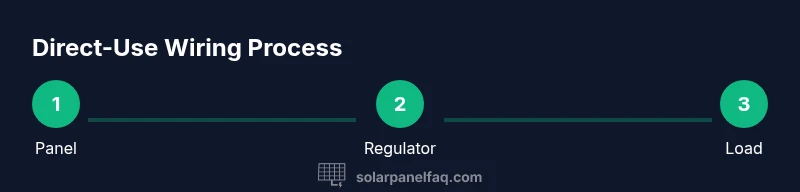
Connect panel → diode → fuse → regulator input, then regulator output to the load. Use proper gauge wire and secure terminals.
Tip: Double-check polarity and route wires away from heat sources or moving parts. - 5
Test under sun and monitor
Power the load and observe voltage stability with the multimeter. Ensure no overvoltage or excessive current occurs.
Tip: Test during bright sun first; gradually test under partial sun to assess behavior. - 6
Document performance and plan for limits
Record the load voltage and current under different sun conditions. Decide if a battery or larger regulator would be more reliable for future use.
Tip: If performance varies widely, consider adding storage or a higher-capacity regulator.
Frequently Asked Questions
Can I run an AC device directly from a solar panel without a battery?
No. Solar panels output DC power and often at voltages that vary with sunlight. AC devices require an inverter and stable power, which a battery-less direct connection cannot reliably provide.
Direct AC power from a solar panel without storage is not reliable or recommended; use a battery or inverter for AC devices.
What happens if the load draws more current than the panel can supply?
The voltage will drop and the load may fail to start or run poorly. In extreme cases the panel could overheat or wiring could heat up. Avoid such conditions by matching load to panel capabilities.
If the load tries to pull more current than the panel can supply, you’ll see voltage drop and potential device trouble.
Do I still need a charge controller without a battery?
A regulator or controller helps prevent overvoltage to the load due to sun Variations. It is highly recommended for any non-trivial direct-use setup.
A regulator is recommended to keep voltage within safe limits for the device.
Is direct-use safe for long-term operation?
Direct-use without storage is generally not suitable for long-term operation. For reliable operation, add storage or a robust regulation strategy.
For reliable long-term use, add storage or a more robust regulation system.
What loads are best suited for direct-use without a battery?
Low-power DC loads with tolerance for voltage variation, such as LED indicators or small hobby motors, under supervised conditions.
Best suited are small DC devices that can tolerate some voltage fluctuation.
Watch Video
Top Takeaways
- Practice direct-use only for small DC loads.
- Always protect with a diode and fuse.
- Use a regulator to limit voltage to the load.
- Expect voltage variation with sun changes; plan for it.
- Battery storage offers reliability for most real-world use.