How Solar Panels Are Made: A Practical Manufacturing Guide
Learn how solar panels are manufactured, from silicon wafers to finished modules, with materials, processes, safety, and testing. This educational guide explains the full flow and what it means for performance, reliability, and purchasing decisions.


From silicon wafers to finished modules, this guide explains how solar panels are made, highlighting key materials, processes, and quality checks. You’ll learn the typical production steps, factory safety, and how panel specs translate to real-world performance. By the end you’ll grasp the full manufacturing flow and practical notes for evaluating suppliers.
How Solar Panel Is Made: Overview
From the raw materials to the finished module, solar panels are built through a sequence of highly engineered steps designed to convert sunlight into electricity efficiently and safely. According to Solar Panel FAQ, the basic manufacturing flow starts with the raw materials and strict quality controls that set the foundation for long-term reliability. The largest visible components—the glass cover, aluminum frame, and backsheet—matter for durability and weather resistance, but the real heart is the solar cells and their interconnections.
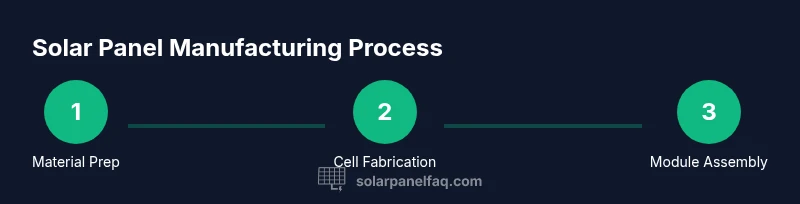
This section shares the high-level stages that typically occur in modern facilities:
- Materials selection and supplier qualification
- Wafer production or cell creation
- Module assembly, lamination, and encapsulation
- Final testing, labeling, and packing
Each stage introduces trade-offs between cost, efficiency, and lifetime. For homeowners, these choices influence panel efficiency, temperature coefficients, and resistance to humidity. The manufacturing flow also determines uniform quality across batches, which translates into predictable performance for home systems. While the underlying technology is complex, the overall flow can be understood as a sequence of inputs, transformations, and outputs—inputs (materials) are transformed by process steps into outputs (cells and modules) that are then packaged for installation. In practice, suppliers’ process controls, material sourcing, and process automation are critical to achieving high yield and consistent performance. The Solar Panel FAQ team emphasizes that the most meaningful differences among panels often come from cell efficiency and module reliability rather than cosmetic features.
Raw materials and supplier considerations
The supply chain for solar panels includes several key materials: silicon wafers (or alternatives like thin-film substrates in some technologies), glass for the front cover, EVA or other encapsulants, a backsheet for insulation, aluminum frames for mounting, and junction boxes and connectors. Each material contributes to durability, light transmission, and electrical performance. Silicon wafers, the core of most crystalline panels, require tight crystal quality and purity. The type of silicon (mono-crystalline vs poly-crystalline) affects efficiency and cost.
Supplier qualification matters: manufacturers audit material purity, traceability, and environmental compliance before committing to long-term supply contracts. Many buyers benefit from understanding where materials come from and how they are processed. For example, high-transparency front glass improves light capture, while low-iron glass reduces color tint and improves performance. Encapsulants like EVA protect cells during assembly and in-field operation, but their aging properties affect long-term reliability. The backsheet provides insulation and UV protection, and laminates must resist delamination under temperature fluctuations.
In practice, the best practice is to review a supplier’s materials data sheets, quality certifications, and test results. For homeowners evaluating products, look for third-party certifications, warranties, and supply chain transparency statements. The Solar Panel FAQ analysis shows that panel performance can depend on even small variations in materials or coating thickness, particularly under high humidity, extreme temperatures, or prolonged UV exposure. The result is a panel that maintains efficiency over its expected lifetime, with predictable degradation rates. While many customers focus on upfront price, the hidden value lies in material quality, long-term reliability, and the ability to source components responsibly.
Tools & Materials
- Safety goggles(Mandatory during all steps in a classroom or demonstration setting.)
- Static wrist strap(Prevents static damage to sensitive components.)
- Gloves (nitrile/latex)(Protect hands and avoid contamination of materials.)
- Calipers or micrometer(Useful for illustrating tolerances in a classroom demo.)
- Basic hand tools (screwdrivers, pliers)(For simple assembly demonstrations only.)
- Soldering iron (optional)(Only for illustrating connections in a controlled environment.)
- Dust mask or respirator(Important when handling powders or resins in demonstrations.)
- Safety footwear(Keep feet protected in workshop settings.)
Steps
Estimated time: Several weeks to months
- 1
Outline materials and safety requirements
Begin by listing the major material groups (glass, encapsulant, backsheet, cells, frame) and document safety protocols. Clarify tolerances, environmental controls, and waste handling. This planning reduces risk during later stages and ensures alignment with industry standards.
Tip: Set clear safety roles for all participants and post standard operating procedures. - 2
Prepare silicon feedstock and wafers (high-level overview)
In industry, silicon is refined into ingots, then sliced into wafers. This step is a high-level overview appropriate for education, emphasizing that purity and crystal quality drive cell performance.
Tip: Discuss the difference between mono- and poly-crystalline silicon and how each affects efficiency. - 3
Fabricate cells with diffusion/doping basics
Cells are prepared by creating p-n junctions and applying anti-reflective coatings. The explanation focuses on conceptual diffusion and contact formation, not on detailed process conditions, to avoid unsafe replication.
Tip: Explain that doping, passivation, and contact patterning determine electrical performance. - 4
Apply contacts and anti-reflective coatings
Cells receive metallic contacts and ARC layers to improve light absorption and electrical connectivity. This stage is illustrated at a high level to show how materials interact rather than how to execute the steps.
Tip: Highlight how coatings reduce reflection loss and improve efficiency. - 5
Assemble modules with lamination and encapsulation
In module assembly, cells are interlinked, then encapsulated with protective layers and sealed. Lamination bonds the stack and protects against moisture, UV, and mechanical stress.
Tip: Discuss the role of EVA or other encapsulants in long-term reliability. - 6
Attach frame, junction box, and perform initial checks
Add framing and wiring to form a finished module. Initial checks verify physical integrity, wiring continuity, and basic safety before testing.
Tip: Show how proper alignment minimizes distortion and microcracks. - 7
Quality testing and packaging
Conclude with high-level testing concepts such as insulating tests, performance checks, and packaging for shipment. Emphasize that exact test protocols are industry-specific.
Tip: Encourage asking for independent test data and certifications.
Frequently Asked Questions
What are the main stages of solar panel manufacturing?
The main stages are material sourcing, cell fabrication, module assembly with lamination, and final testing. Each stage has specific quality checks to ensure reliability and performance.
The main stages are sourcing materials, making cells, assembling modules, and testing for reliability.
Which materials influence panel performance the most?
The most influential materials are silicon for the cells, the glass front, encapsulants, and the backsheet. Their purity, optical properties, and aging behavior drive efficiency and long-term durability.
Cell silicon, front glass, encapsulants, and backsheet largely determine performance and lifetime.
Why is lamination important in solar modules?
Lamination seals and protects the cells from moisture, UV exposure, and mechanical stress. It helps maintain electrical integrity and prevents delamination during temperature cycling.
Lamination protects cells from moisture and heat, keeping the module reliable.
Is solar panel manufacturing environmentally friendly?
Manufacturing involves energy use and chemical handling, but modern facilities implement waste management, recycling, and emissions controls to minimize environmental impact.
Manufacturing uses energy and chemicals, but controls limit environmental impact.
What should buyers consider besides price?
Look for certifications, warranties, supply chain transparency, and independent test data. These factors impact reliability, service life, and performance under real conditions.
Check certifications and warranties; they matter as much as price.
Watch Video
Top Takeaways
- Understand the four broad stages: materials, cells, modules, testing.
- Material quality drives long-term reliability and performance.
- Quality control occurs at multiple checkpoints across the process.
- Module assembly combines cells with lamination and framing.
- Environmental safety and end-of-life considerations matter.