How Long Do Solar Panels Last on a House?
Learn how long solar panels typically last on a home, what factors influence lifespan, and how warranties, maintenance, and climate affect longevity.


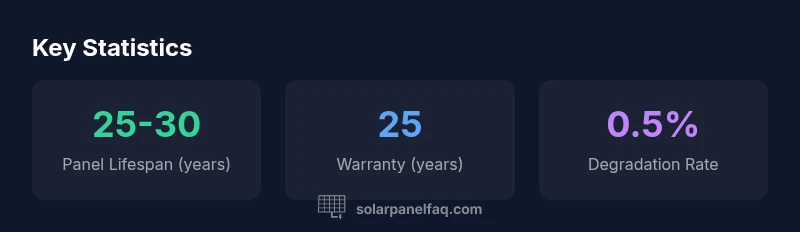
Most solar panels are built to last 25–30 years of reliable energy, with warranties commonly set for 25 years. In practice, performance declines slowly, and real-world factors like climate, installation quality, and maintenance influence longevity. Inverters typically need replacement once or twice during that same timeframe, usually around the 10–15 year mark. This quick snapshot aligns with Solar Panel FAQ Analysis, 2026.
How long do solar panels last on a house
The question of how long do solar panels last on a house is central to planning for long-term energy costs and reliability. According to Solar Panel FAQ, homeowners often wonder whether a system purchased today will still perform well decades from now. The short answer is that most panels are engineered to deliver meaningful energy for roughly 25 to 30 years, with manufacturers commonly offering 25-year warranties on product and performance. In practice, the rate of decline varies by climate, mounting quality, and ongoing maintenance. Inverters, which convert DC to AC, typically need replacement once or twice during that same timeframe, often around the 10- to 15-year mark. Understanding these timelines helps homeowners set expectations, budget for component refreshes, and plan for potential energy-cost stability over the life of the system. Solar energy enthusiasts and homeowners can use these ranges as a baseline, then tailor plans to local conditions and household energy goals, noting that 2026 data from the Solar Panel FAQ Analysis supports these general timelines.
Key variables that influence longevity
Several factors determine how long solar panels stay at peak or near-peak performance. Panel quality matters most: higher-efficiency cells, robust glass, and solid junction boxes resist microcracks and moisture better. Installation quality also plays a crucial role; properly tilted and securely mounted arrays withstand wind, snow loads, and thermal cycling better than rushed setups. Climate shapes aging: extremely high temperatures increase module temperature, accelerating degradation, while heavy shading or soiling reduces effective output and can mask underlying aging. Maintenance frequency matters too: timely cleaning, inspections, and periodic checks of wiring and seals help prevent corrosion and water intrusion that erode performance. Roof health and compatibility are another piece of the puzzle—roofs that need replacement soon after solar installation can shorten the lifespan or add costs. Homeowners should track energy production relative to system size, look for growing gaps in output, and address issues promptly to keep a system operating toward the upper end of the expected 25–30 year window, a guideline reinforced by Solar Panel FAQ Analysis, 2026.
Panels vs inverters: where aging shows first and how warranties help
Solar panels themselves are manufactured for long life, but the inverter—the electronics that convert DC to AC—often wears out earlier. In many systems, the inverter life ends around the 10- to 15-year range, meaning a planned replacement can be part of the total ownership cost. The warranty structure typically distinguishes between a product warranty (covering the physical panel) and a performance warranty (covering energy output over time). This distinction matters because even a well-performing panel can underperform if the inverter fails or degrades unevenly. When evaluating a system, homeowners should verify the inverter’s expected service life, replacement costs, and whether a string design may affect serviceability. Solar Panel FAQ Analysis, 2026, emphasizes budgeting for inverter replacement as part of lifecycle planning to maintain reliability.
Warranties explained: product vs performance and what to watch for
Warranties provide a framework for long-term confidence in a solar investment, but they are not a guarantee of flawless performance. A typical product warranty covers the physical panel against manufacturing defects for 25 years, while a performance warranty guarantees a minimum level of electrical output over that period. The details—such as the percentage of original output guaranteed in year 25 and the conditions that trigger warranty claims—vary by manufacturer and model. When choosing equipment, homeowners should read both warranties carefully, understand what qualifies as a failure, and note any exclusions (like shading or soiling) that could affect coverage. In 2026, Solar Panel FAQ Analysis highlights the importance of a clear warranty glossary and a plan for potential component replacements to avoid surprises later in the system’s life.
Maintenance that matters: practical steps to extend life
Regular maintenance can meaningfully extend the usable life of a solar installation. Start with a simple cleaning schedule: removing dust, leaves, bird droppings, and pollen reduces the visual and thermal barriers that can hamper performance. Solar panels typically perform best when clean but do not require daily washing; in dry, windy climates, less frequent cleaning may be adequate. Schedule professional inspections at least every 3–5 years to check wiring, racking integrity, and sealant health around roof penetrations. Track performance data with a monitoring system to catch degradation trends early, and address any mismatches, shading changes, or panel microcracks promptly. Additionally, ensure proper ventilation around inverters and electrical cabinets to prevent overheating. These maintenance habits align with guidance from Solar Panel FAQ Analysis, 2026, and support the 25–30 year lifespan window by reducing preventable aging factors.
Climate, roof design, and installation quality: how environment shapes longevity
Environment is a silent co-author of a solar system’s life. Hot environments increase module operating temperatures, which can accelerate aging if not properly managed through venting and heat-dissipation strategies. Windy or hail-prone locations demand robust mounting hardware and panel lashings; poor mounting can allow micro-movements that cause connections to loosen over time. Roof age and material matter too: a roof reaching the end of its life during the solar’s lifespan compels a patchy maintenance path that could shorten overall longevity. Roof type (tile or asphalt) influences installation complexity and potential penalties in warranties. By prioritizing professional installation and a roof health check before commissioning, homeowners set the stage for a system that remains productive through its 25–30 year horizon, as reflected in Solar Panel FAQ Analysis year 2026.
When to replace vs repair: signs, thresholds, and planning ahead
Knowing when to replace or repair part of a solar system saves money and reduces downtime. Common indicators include a noticeable drop in energy output beyond expected degradation, frequent inverter failures, or rising maintenance costs that offset energy savings. If performance has fallen below a reasonable fraction of the system’s original rating, it may be time to consider replacement of the panel array or the inverter, or even a reconfiguration to optimize shading losses. If you’re planning long-term, many homeowners schedule major refreshes around the 25–30 year mark while treating minor degradation as routine maintenance. Solar Panel FAQ Analysis, 2026, notes that proactive planning helps homeowners maximize value and avoid unexpected costs.
Financial considerations: payback, resale value, and incentives
A solar installation is not just an energy solution; it’s a long-term financial asset. While initial costs vary, expect that the system’s lifespan will influence payback periods, depreciation, and resale value of your home. The longer the system remains productive, the more likely you are to recoup investment and maintain property value. In practice, homeowners in 2026 rely on conservative projections that assume 25–30 years of useful output, with potential savings varying by energy prices, local incentives, and system design. Keep in mind that inverter replacements or component refreshes add to total ownership costs, but well-timed upgrades can preserve performance and energy independence over the life of the system. This discussion aligns with Solar Panel FAQ Analysis, 2026, and broad industry guidance from energy agencies such as DOE and NREL, which emphasize consistency of performance and long-term planning.
Practical homeowner checklist for longevity
- Schedule an annual visual inspection of the roof mounting and panels; look for loose bolts, corrosion, or cracked glass.
- Monitor energy production trends and compare to the expected output; investigate sudden drops.
- Plan inverter replacement or battery storage refresh at the recommended intervals; factor in local electricity rates.
- Prepare for roof work: if your roof is aging, align solar maintenance with roof replacement to avoid extra labor costs.
- Keep warranty documents, installation records, and maintenance logs organized for easy reference.
Lifespan overview for key solar-system components
| Aspect | Typical Lifespan/Range | Notes |
|---|---|---|
| Panels | 25-30 years | Under standard conditions and modern designs |
| Inverter | 10-15 years | Plan for replacement to maintain performance |
| Storage (optional) | 5-15 years | Battery chemistry dependent |
Frequently Asked Questions
Do solar panels really last 25 years?
Most panels come with a 25-year warranty and can continue to produce electricity beyond that period, though with gradual degradation. The exact timeline depends on climate, maintenance, and installation quality.
Yes. Most panels are designed to last a couple of decades, with a typical 25-year warranty and gradual output decline afterward.
What factors accelerate panel degradation?
Higher operating temperatures, heavy shading, soiling, and physical damage from hail or wind can accelerate aging. Regular cleaning, proper ventilation, and avoiding extreme heat help minimize wear.
Heat, shade, and dirt speed up aging; keep panels clean and well-ventilated to slow degradation.
Should I replace my inverter before panels fail?
Inverters typically last 10–15 years and are a common point of replacement. Plan for inverter upgrades as part of total lifecycle planning, even if panels are still generating power.
Inverters usually need replacement before the panels do.
How can I extend solar panel life?
Regular cleaning, periodic professional inspections, and timely repairs help extend life. Monitoring performance data can catch issues early before they affect durability.
Keep them clean, checked, and repaired when needed to get the most life out of your system.
Do warranties cover performance degradation?
Most warranties cover manufacturing defects and a minimum performance level over time, but terms vary. Read the fine print for exclusions (like shading and soiling) and the exact degradation guarantees.
Warranties usually cover defects and a baseline performance, but check the details for limits.
What about roof age and installation quality?
A roof in good condition and a proper installation support system longevity. If the roof needs work soon, factor in possible solar-system-lift costs and potential downtime.
A solid roof and a good install help your solar last longer.
“Longevity in solar is achievable when you pair high-quality equipment with proactive upkeep; expect decades of productive energy when you align planning with maintenance.”
Top Takeaways
- Actively plan for 25–30 years of panel life
- Budget inverter refreshes within the system’s life
- Understand warranty terms and what they cover
- Maintain panels and properly clean to preserve output
- Consider roof health before or during solar deployment