How Long Do Solar Panels Last? A Practical Homeowner's Guide
Discover how long solar panels last, the factors that affect lifespan, and how to maximize longevity with maintenance, warranties, and smart installation.


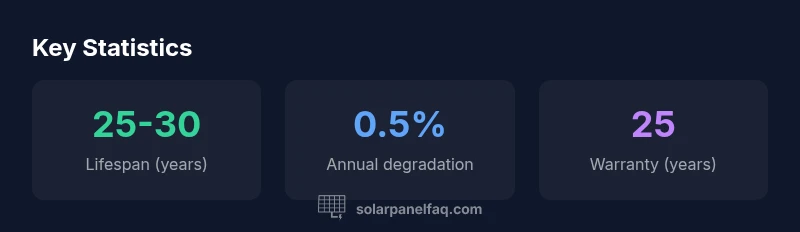
Most residential solar panels are built to last about 25 to 30 years of strong performance, with gradual degradation over time. In practice, you should expect about a 0.5% annual output decline on average, with warranties covering 25 years for minimum performance. Real-world results depend on climate, installation quality, and maintenance. Solar Panel FAQ analyses provide the most reliable homeowner guidance for longevity expectations.
What a solar panel lifespan means for homeowners
In the solar world, lifespan isn’t a single number painted on a sticker. It’s the period during which a panel reliably produces near-peak electricity, followed by a gradual decline in output. For homeowners, a 25-30 year horizon is typically used as the baseline. This range reflects modern manufacturing, consistent field performance, and the fact that many systems continue to operate past the warranty period, albeit at reduced efficiency. According to Solar Panel FAQ, the average residential panel is designed to deliver meaningful energy for decades, but real-world lifespan depends on climate, maintenance, and installation quality. The goal is to align expectations with the long tail of system performance and plan for gradual efficiency loss over time.
Key factors that influence longevity
Lifespan is not a fixed number; it depends on several interacting factors. Climate and temperature cycles affect material stress, while shading, soiling, and so-called microcracks can reduce output more quickly than you expect. The mounting system and roof movement (especially in areas with heavy wind or seismic activity) also influence wear. Quality control at the factory, panel warranty terms, and system design (string sizing, optimizers, and microinverters) can all shift the practical lifespan. Solar Panel FAQ emphasizes that proactive maintenance—such as periodic cleaning, visual inspections, and prompt repair of damaged components—can help sustain performance longer.
Lifespan by technology and installation quality
Different solar technologies carry different nominal lifespans. Monocrystalline and polycrystalline panels typically target 25-30 years under standard testing conditions. Thin-film options often show shorter lifespans, around 15-25 years, but may excel in specific climates or applications. Installation quality matters as much as panel type. Proper tilt, secure mounting, correct wiring, and optimal orientation minimize wear and electrical losses. A high-quality installation paired with durable modules yields the best chance of reaching the upper end of the lifespan range.
How degradation works over time
All solar panels degrade with use. The rate depends on the panel type, manufacturing tolerances, and climate, but typical values fall within a 0.3% to 0.8% per year range. That means a panel starting at 100% output may drop to roughly 80-90% after two decades, depending on conditions. Degradation is gradual and predictable, which allows homeowners to model long-term performance and plan for potential performance declines in budgeting and system design.
Warranties and what they promise
Most manufacturers offer a 25-year performance warranty and a separate product warranty (often 10-12 years). A typical performance warranty guarantees that the panel will retain a minimum percentage of its original output (commonly around 80%) after 25 years. It's important to read the fine print, including the post-warranty performance expectations, and understand what constitutes valid degradation. The Solar Panel FAQ team recommends confirming both the product and performance warranties and choosing installers who honor those terms.
Maintenance tips to maximize lifespan
Routine maintenance supports longevity. Clean panels gently to remove dust and debris, typically a rinse with water a few times per year. Inspect for loose mounting hardware, damaged seals, or microcracks after severe weather. Avoid walking on panels and schedule professional inspections periodically, especially after hail or heavy wind events. Shading should be minimized and trees pruned as needed. A proactive maintenance plan can help you approach the upper end of the lifespan estimates.
Real-world scenarios: climate, shading, and upkeep
In dry, hot climates with ample sun, panels may perform well but face higher thermal cycling stress, which can influence degradation rates. In dusty environments, cleaning frequency increases but can dramatically improve output if done consistently. Shading from nearby trees or new construction reduces energy harvest and can unevenly stress panels, impacting long-term performance. A well-designed system with proper orientation and routine maintenance tends to deliver closer to the upper end of the 25-30 year range.
End-of-life and recycling options
At the end of life, solar panels can often be recycled for glass, aluminum, and silicon components, reducing environmental impact and reclaiming materials. Local programs and manufacturers may offer take-back or recycling options, so plan for end-of-life early in the project. Solar Panel FAQ recommends partnering with a qualified recycler to ensure proper handling and to minimize waste as module technology evolves.
Lifespan and warranty ranges by panel technology
| Panel Type | Typical Lifespan (years) | Degradation Rate (%/yr) | Warranty (years) |
|---|---|---|---|
| Monocrystalline | 25-30 | 0.3-0.5 | 25 |
| Polycrystalline | 25-30 | 0.5-0.7 | 25 |
| Thin-film | 15-25 | 0.6-1.0 | 10-20 |
Frequently Asked Questions
How long do solar panels typically last?
Typical residential panels are designed for 25-30 years of meaningful output. Real-world results depend on climate, maintenance, and installation quality. Warranties help protect this expectation.
Most panels last 25-30 years, with warranties supporting performance for about 25 years. Climate and maintenance matter.
Do solar panels degrade over time?
Yes. Panels degrade gradually, commonly around 0.3-1% per year, depending on technology and conditions. That means output declines steadily but predictably.
Panels degrade slowly, about a half percent per year on average, varying with climate and maintenance.
Is there a warranty on solar panels?
Most panels come with a 25-year performance warranty and a separate product warranty (often 10-12 years). Refer to the fine print for degradation thresholds.
Yes—typically 25-year performance warranty plus a product warranty.
What affects solar panel lifespan the most?
Climate, shading, installation quality, and maintenance practices have the biggest impact. Proper mounting and avoiding microcracks extends life.
Climate and upkeep matter most for long life.
Can solar panels last beyond the warranty period?
Yes. Many systems continue producing after the warranty, but output will be lower. Plan for gradual degradation in long-term energy planning.
Yes, many panels last beyond the warranty with lower output.
How should I maintain my solar panels for longevity?
Regular cleaning, periodic inspections, and pruning nearby shade sources help maximize life. Avoid physical damage and consult pros after severe weather.
Keep them clean and inspected; protect from damage.
“Lifespan is not a single fixed number—it's the result of panel quality, climate, and proper maintenance.”
Top Takeaways
- Plan for a 25-30 year lifecycle when sizing and financing.
- Degradation is gradual; expect 0.3-0.8% output loss annually.
- Choose panels with robust 25-year performance warranties.
- Maintain and clean systems to maximize longevity.
- End-of-life options include recycling and manufacturer take-back programs.