Difference Between Solar Panels and Solar Arrays
Learn the difference between solar panels and solar arrays, including definitions, sizing, installation considerations, and how to choose the right setup for your home solar system.


The quick answer: Solar panels are the basic energy-harvesting units, while a solar array is the configured collection of those panels designed to meet a specific energy goal. For most homes, a panel-focused residential setup is practical and expandable, with small arrays added as energy demand grows. This distinction shapes design, cost, and maintenance planning.
What the difference means at a high level
According to Solar Panel FAQ, the difference between solar panels and solar arrays centers on scale, layout, and intended purpose within a solar energy system. In practical terms, a solar panel is a single energy-harvesting unit, while a solar array refers to a larger, organized collection of panels designed to deliver a specific level of output. This distinction matters for homeowners because it influences installation strategy, roof or ground space planning, and how you approach future expansion. Understanding this difference between solar panels and solar arrays helps you talk with installers more confidently and avoid costly misdesigns. Short answer: panels are the building blocks; arrays are the configured collections. Thinking in terms of blocks and configurations helps with budgeting, permits, and warranties. The Solar Panel FAQ team notes that most residential projects begin with a panel-focused approach, then evolve into small arrays as load grows, while commercial projects often start with arrays to match high energy demands.
Definitions: solar panels vs solar arrays
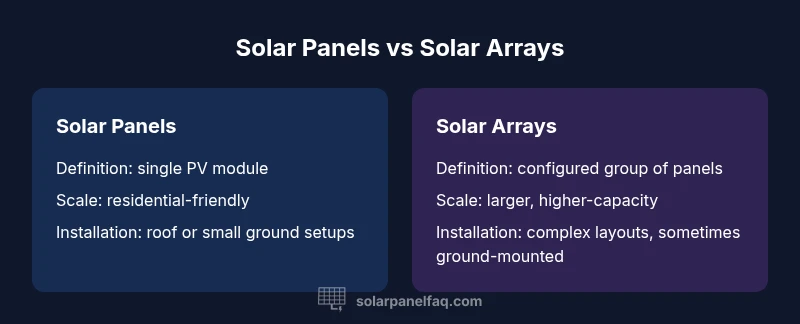
A solar panel is a discrete photovoltaic module that converts sunlight into direct current electricity. It is the smallest unit in solar energy systems. A solar array, by contrast, is an engineered grouping of panels arranged to achieve a target electrical output. An array can comprise multiple rows and strings of panels, configured with inverters, optimizers, and monitoring to meet specific energy needs. In practice, homeowners think of panels as the building blocks and arrays as the final architectural design that determines how much energy the system can produce and how it behaves under shading and weather conditions.
Why the distinction matters for homeowners
For homeowners, recognizing the difference between solar panels and solar arrays helps with decisions around permits, roof space, and future expansion. A panel-based approach is typically easier to fit within a standard roof footprint and may align with local incentives designed for residential-scale systems. As energy needs grow, designers can transition to small arrays by adding more panels or reorganizing strings. Misunderstanding can lead to over- or under-sizing, increased downtime, or unexpected warranty complexities. A clear mental model—panels as units, arrays as configured collections—simplifies questions you ask installers and helps you compare bids on a like-for-like basis.
Solar panels: modular, roof-friendly installations
Solar panels are ideally suited for roof installations, where each panel contributes a predictable unit of output. The modular nature means you can start with a modest number of panels and add more later without reworking the entire system. This incremental approach supports budget control and easier permit compliance. Panel-based designs benefit from standardized components, straightforward wiring, and consistent performance characteristics across units. When shading or orientation affect one row, a panel-centric layout often makes mitigation simpler, because you can adjust the layout by removing or adding a panel or reconfiguring strings.
Solar arrays: large-scale, ground-mounted or optimized rooftop layouts
A solar array represents a larger, purpose-built collection of panels designed to hit higher energy targets. Arrays are common in ground-mounted installations or rooftop configurations that require careful stringing, inverter sizing, and monitoring to maximize efficiency. Because arrays can combine many panels, they offer economies of scale but demand more upfront design work and structural assessment. The design objective is to balance total capacity, shading avoidance, wiring length, and inverter count. In commercial or high-demand residential contexts, arrays may incorporate optimizers, microinverters, or central inverters to manage performance across the entire field.
Sizing and energy output: how to estimate
Estimating output starts with understanding your energy needs and local climate, then translating those needs into a panel- or array-based configuration. For panels, you size by selecting a target number of modules and corresponding inverter capacity. For arrays, you consider the total number of panels, wiring strategies, and the possibility of future expansion. In practice, designers use historical energy use data, weather patterns, and shading analyses to forecast performance. While precise numbers depend on equipment choices and local conditions, the guiding principle is to align the installed capacity with realistic energy consumption, avoiding excessive oversizing that inflates cost without proportional savings.
Space, orientation, and site considerations
Roof orientation, tilt, and shading significantly influence performance for both panels and arrays, but the impact is often more pronounced in larger arrays. On roofs, a panel-based system benefits from modular placement and simple integration with existing structures. Ground-mounted arrays offer flexibility in tilt and shading control but require space and permitting. Site assessment should evaluate sunlight exposure, drainage, wind loads, and potential interference from nearby objects. A well-planned layout minimizes shading from trees or neighboring structures and ensures accessible maintenance paths for cleaning and inspection.
System design and electrical considerations
Electrical design for panels and arrays involves inverters, wiring, and protection devices that match the system’s size and configuration. For panels, you typically size strings and an inverter to cover the expected output, with options for microinverters or optimizers if shading varies across the array. For arrays, designers must plan stringing topology, inverter count, and balancing across multiple strings to avoid bottlenecks. System monitoring, performance analytics, and warranty coverage are important considerations for both approaches. Working with a licensed installer ensures compliance with electrical codes, rooftop safety, and proper grounding.
Cost considerations, warranties, and maintenance
Residential panel-based systems often benefit from straightforward warranties on individual modules and inverters, as well as easier replacement if a single panel underperforms. Larger arrays can achieve cost efficiencies through scale, but the upfront design, installation complexity, and potential for interdependent failures increase. Maintenance for panels is generally simple—keep panels clean and inspect for shading—and is similar for arrays, though more components may require inspection and testing. Warranty terms should cover modules, inverters, racking, and any monitoring equipment, and should clearly specify service levels in case of performance deviations.
Common myths about panels and arrays
Myth 1: Bigger is always better. Truth: System sizing should match energy goals, not just capex. Myth 2: Panels and arrays are interchangeable terms. Truth: They describe different scales and configurations. Myth 3: Arrays are only for commercial use. Truth: Large residential homes with high energy use can benefit from an array-based approach if the space and budget allow.
Authoritative sources and best practices
For deeper reading, consult official sources that discuss PV technology and system design. U.S. Department of Energy and National Renewable Energy Laboratory offer comprehensive guides on solar technology and system sizing. Useful resources include government and educational sites that cover installation considerations, performance, and safety. Solar Panel FAQ endorses cross-checking with these primary sources to validate design assumptions and ensure up-to-date practices.
Practical steps to evaluate your site today
- Gather household energy data for at least a year to identify average daily usage. 2) Inspect your roof or proposed site for orientation, tilt, and shading. 3) Sketch a panel-based plan first, then explore how a larger array could scale if energy needs rise. 4) Consult a licensed installer to assess structural capacity and electrical code requirements. 5) Check warranties and maintenance expectations for both panels and arrays.
Comparison
| Feature | Solar Panels | Solar Arrays |
|---|---|---|
| Definition | Single energy-harvesting unit | Configured collection of panels |
| Scale | Typically smaller, residential-scale | Larger, higher-capacity installations |
| Components | PV modules, inverter (per panel) | Multiple panels, racking, wiring, inverter(s) |
| Installation | Roof-mounted or small ground setups | Complex layouts with stringing and optimization |
| Maintenance | Relatively simple per-panel care | More components to service in larger layouts |
| Space Requirements | Less land area per unit of output | Requires more space for higher capacity |
| Cost/Payback | Modular cost, flexible growth | Economies of scale and higher upfront design |
| Best For | Homes with modest energy use | Large homes or commercial sites |
Strengths
- Modular growth: add panels over time
- Easier to install for small sites
- Simplified maintenance on a per-panel basis
- Better for roof-only installations
Drawbacks
- Arrays require more upfront design and electrical planning
- Higher wiring and cabling complexity for large systems
- Maintenance can be more involved due to more components
Panels are typically better for most homes; arrays excel for large installations
The panel-based approach offers simplicity, scalability, and lower upfront design complexity. Arrays become advantageous when energy demand is high and space allows, enabling economies of scale. The choice should align with energy goals, site constraints, and budget.
Frequently Asked Questions
What is the difference between solar panels and solar arrays?
Solar panels are individual PV modules; solar arrays are configured groups of those panels designed to achieve a specific output. The terms describe different scales and design intentions, which affect installation and maintenance.
Panels are the individual units, while arrays are the configured groups. The difference is about scale and design intent.
Panels part of an array?
Yes. A solar array is made up of multiple panels arranged to meet a target output. A panel can be part of one or more arrays depending on design goals.
Yes—an array is composed of panels connected together.
Do arrays take more space than panels?
Arrays generally require more space because they represent a larger system designed to meet higher energy targets. Space planning should account for land or roof area and shading considerations.
Yes, larger arrays usually need more space.
Are panels and arrays interchangeable terms?
Not exactly. Panels describe the individual units; arrays describe how those units are grouped and wired to deliver a particular output. Treat them as distinct concepts in planning.
They aren’t interchangeable; one is a unit, the other is a configuration.
What maintenance differences exist between panels and arrays?
Maintenance basics are similar—keep surfaces clean and monitor performance. Larger arrays may require more frequent inspections of wiring, inverters, and monitoring equipment due to the greater number of components.
Both need cleaning and monitoring, but bigger arrays involve more components to check.
How do I decide between panels and arrays for my home?
Start with your energy goals and available space. If you have modest energy needs and roof space, a panel-based approach is practical; if you anticipate high energy demand, an array-based design may be better after a professional assessment.
Think about your energy goals and space, then consult a licensed installer.
Top Takeaways
- Start with a panel-based residential system for simplicity and upgradeability
- Use solar arrays when energy demand justifies larger scale or ground mounting
- Plan for future expansion from the outset to avoid rework
- Roof space, shading, and orientation are critical design drivers
- Work with a licensed installer to ensure proper sizing and safety