Solar Panel vs Solar Array: Which Is Right for You?
Compare solar panels and solar arrays to decide which setup best meets your energy goals, roof space, and budget. This in-depth analysis covers energy output, costs, installation, and practical guidance for homeowners and buyers.


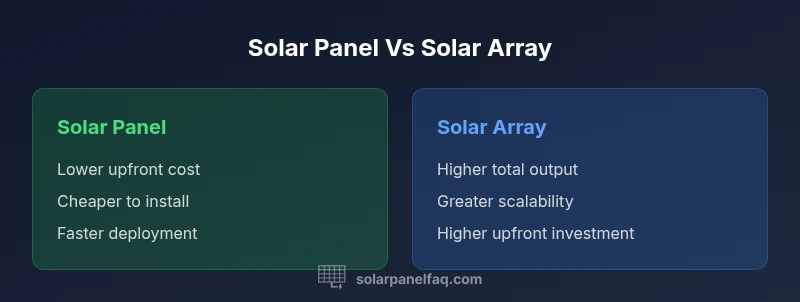
When choosing between a solar panel and a solar array, the array generally delivers more total energy and better scalability for higher consumption. It also comes with higher upfront costs and more complex installation. A single panel is simpler, cheaper, and quicker to install, making it suitable for small roofs or modest energy needs. Your decision should weigh energy goals, roof space, and budget.
Why the distinction matters: solar panel vs solar array
A solar panel is a single photovoltaic module that converts sunlight into electricity. A solar array, by contrast, is a structured collection of panels wired together to form a complete system. The distinction matters because it directly affects total energy output, scalability, roof space requirements, and installation complexity. For homeowners, this choice shapes long-term energy goals, the speed of payoff, and the overall planning process. According to Solar Panel FAQ, start by defining your energy goals before weighing a solar panel vs solar array. Consider how quickly you want to reduce grid dependence, your roof space, and the complexity you’re willing to manage. This framing helps you avoid oversizing your system or underprovisioning for future needs.
- Define your energy goals: daily usage, seasonal variation, and potential increases.
- Assess roof space and orientation to determine scalable capacity.
- Consider maintenance expectations, warranties, and service requirements.
In practice, many homeowners begin with a panel-level assessment and then map out a scalable path to an array if energy targets justify it.
How solar panels and solar arrays generate power
Photovoltaic cells within solar panels convert sunlight into direct current (DC) electricity. An inverter then converts DC to alternating current (AC) for home use. A single panel contributes a portion of overall system output, while an array combines multiple panels to achieve a higher total capacity. The system’s performance depends on panel efficiency, inverter type, wiring configuration, and shading. Arrays can use string inverters, microinverters, or power optimizers to maximize performance under real-world conditions. For homeowners evaluating a solar panel vs solar array, it’s essential to understand how each configuration handles variation in sunlight across the day and year, and how that translates into usable energy.
What constitutes an 'array' and common configurations
An array is not a random handful of panels; it’s a designed configuration that connects many panels to achieve the desired power output. Common configurations include string inverters that aggregate panels into a single DC-to-AC conversion point, and microinverters or power optimizers installed at the panel level to mitigate shading on one panel affecting the entire string. Arrays vary from roof-mounted layouts to ground-mounted installations. Choice of mounting, wiring topology, and inverter technology all influence efficiency, maintenance, and future expansion. For the solar panel vs solar array decision, mapping potential layouts early helps in budgeting and scheduling.
- Roof- or ground-mounted layouts
- String inverters vs microinverters or optimizers
- Expansion paths for future energy goals
- Shading-aware designs and module-level optimization
Efficiency and performance: scale effects
Efficiency is not just about the per-panel rating; it’s also about how the system performs when scaled. A single panel may achieve good efficiency in isolation, but as you add panels to form an array, overall system efficiency depends on the balance of modules, wiring losses, and inverter management. Arrays are more sensitive to shading, orientation, and temperature effects across modules. The benefit of larger arrays lies in higher energy production and a more stable supply during peak sun hours, while the trade-off is increased complexity and potential marginal gains per additional panel. When evaluating a solar panel vs solar array, consider how many panels fit your roof and how your energy goals change with time.
Cost considerations: upfront vs long-term value
Upfront costs for a single solar panel are lower than for a full array, but long-term value depends on energy needs, future expansion plans, and available incentives. A solar array can lower the levelized cost per watt when you plan to meet higher energy demands, but the broader system may require more equipment, permitting, and labor. Financing options, tax credits, and utility programs can significantly affect total project cost and payback period. When weighing a panel vs an array, run a simple cost-per-watt comparison for your current needs and a scenario where you add capacity later. This helps align purchasing decisions with your budget and energy goals.
Space requirements and roof suitability
Roof space and orientation are critical when deciding between a single solar panel and a solar array. A small roof or constrained space may limit how many panels you can install, making a single panel practical for modest energy use. If you have ample roof area and a clear exposure to sun, an array can deliver the energy you need with room to grow. Consider potential shading from nearby trees, roof pitch, and structural load. The decision should balance available space, structural capacity, and the anticipated rate of energy growth over the next decade.
System design trade-offs: when to choose each option
Choose a single solar panel when you have limited roof space, modest energy needs, or want a quick, low-cost installation. Opt for a solar array when your energy goals are ambitious, roof space is ample, and you plan future expansion. Arrays support higher energy production, greater redundancy, and easier optimization for shading, but require more planning and careful system design. For many homeowners, a phased approach—start with a panel or two and scale into an array—offers flexibility and manageable risk.
Maintenance, warranties, and reliability
Maintenance considerations include cleaning, inspection, and inverter service. Panels typically have long lifespans with warranties that cover performance over many years, while inverters may have shorter service lives and replacements. Arrays involve more components, which can mean more points of potential failure, but modern systems are designed for reliability with module-level monitoring and diagnostics. When comparing a solar panel vs solar array, factor in maintenance expectations, access for servicing, and the availability of qualified technicians in your area.
Environmental implications
Both solar panels and solar arrays reduce reliance on fossil fuels and lower net greenhouse gas emissions over their lifetimes. The environmental footprint of a system depends on manufacturing processes, transportation, and end-of-life recycling. A larger array may offer greater emissions savings if it displaces more grid electricity, but manufacturing and installation energy should be considered. Solar Panel FAQ emphasizes evaluating lifetime environmental impact alongside energy performance when making a choice.
Real-world case studies: typical homeowner scenarios
Case studies illustrate how a single panel can meet minimal daytime loads in smaller homes or apartments with generous daytime solar use, while larger households with high daytime electricity consumption benefit from a full array. For a tight urban roof, a panel may suffice as a starting point, with a plan to expand. In rural or sun-dense regions, a full array often yields more pronounced energy independence and faster payback, provided the budget and space support it. Real-world outcomes depend on usage patterns, efficiency, and local incentives.
How to estimate needs: rough calculation method
Estimate needs by reviewing utility records for average daily energy consumption and peak usage. Determine your available roof space and preferred installation style. Use a simple method: estimate watts per panel, multiply by the number of panels, and compare to your daily energy goal. Consider potential future changes in energy usage and plan for scalable configurations. Always consult a licensed installer to confirm feasibility and compliance with local codes when deciding between a single solar panel vs a full solar array.
Getting started: next steps and questions to ask installers
Begin with a needs assessment, then request a system design that shows panel counts, inverter choice, mounting method, shading analysis, and expansion options. Ask about warranties, maintenance requirements, certification, and permitting timelines. Request a simple cost estimate and a payback projection under current incentives. Finally, compare proposals for a clear path from a single panel to a scalable array, ensuring a practical balance of cost, performance, and risk.
Comparison
| Feature | Solar Panel | Solar Array |
|---|---|---|
| Output potential (per unit vs total) | Lower per panel output | Higher total output when scaled |
| Upfront cost and installation | Lower upfront cost | Higher upfront cost due to multiple components |
| Installation complexity | Simpler, faster install | More complex, longer installation and permitting |
| Roof space efficiency | Less space used per unit of energy | Greater energy per available space when expanded |
| Best for | Limited space or modest energy goals | High energy goals or scalable systems |
Strengths
- Easier and cheaper upfront installation
- Fewer components to manage and maintain
- Quicker project timelines
- Lower risk of oversizing beyond current needs
- Simple budgeting for small-scale projects
Drawbacks
- Limited energy output without expansion
- Less flexibility to meet growing energy goals
- Higher long-term costs if expansion is needed
- Potential underutilization of roof space if underbuilt
For larger energy goals, the solar array wins on value over time
If you anticipate growing energy needs or have ample roof space, an array offers better long-term value. A single solar panel remains a sensible option for tight budgets or limited space, but it may require a staged path to reach higher energy targets.
Frequently Asked Questions
Which option yields more energy overall: solar panel vs solar array?
An array yields more energy when scaled to meet higher demands. A single panel can meet limited loads, but overall output grows with additional panels. The choice depends on current needs and future plans.
An array scales energy output as you add more panels, while a single panel is limited in total production.
Is a solar panel enough for small homes?
For very small homes or limited daytime usage, a single panel may suffice. Most households, even modest ones, benefit from at least a small array or staged expansion.
A single panel can work for tiny energy needs, but many homes eventually require more capacity.
What are the cost differences between panel and array setups?
A single panel has a lower upfront cost, but a full array increases total energy output and can reduce cost per watt as you scale. Financing, incentives, and installation fees also influence the total cost.
Panels are cheaper upfront; arrays cost more initially but may save more long-term with higher energy production.
How do shading and orientation affect performance?
Shading reduces output, and the impact is greater on larger arrays unless mitigated by modern optimizers or microinverters. Proper layout and placement can minimize losses for both options.
Shading hurts arrays more if not mitigated; design around shading with smart inverters or layout.
How should I decide between a panel and an array?
Evaluate roof space, current and future energy needs, budget, and the desired speed of payoff. A phased approach can let you start with a panel and scale to an array over time.
Look at space, energy goals, and budget; consider starting small and expanding later.
What about warranties and maintenance?
Panels typically carry long-term warranties, while inverters and other components have separate terms. Regular maintenance, cleaning, and monitoring help ensure longevity for both options.
Panels usually come with long warranties; keep up with maintenance for reliability.
Top Takeaways
- Assess energy goals before choosing between panel and array
- Consider roof space and shading when planning expansion
- Plan for future growth to maximize long-term value
- Compare cost per watt and payback across scenarios
- Consult licensed installers for accurate designs