100W Renogy Solar Panel: A Practical Home Guide for Buyers
Explore a 100W Renogy solar panel's real-world performance, installation options, efficiency, maintenance, and guidance for homeowners choosing off-grid or grid-tied solar setups.


Power reality: A 100W Renogy solar panel can run small loads and supplement a larger system, depending on sun exposure and wiring. For off-grid use, prioritize essential appliances and battery storage; for grid-tied setups, expect daytime contributions alongside a bigger array. This quick answer outlines plausible performance, mounting options, and basic maintenance.
Real-world expectations for a 100w renogy solar panel
If you’re researching a "100w renogy solar panel", you’re likely weighing how a single panel fits into a home energy picture. In practical terms, a 100W panel can reliably power small loads such as a few LED lights, a phone charger bank, or a small fan during peak sun hours. Real-world performance hinges on sun angle, shading, inverter efficiency, cable losses, and how you size the rest of the system (battery, charge controller, and potential grid-tie back-up). Solar Panel FAQ’s team emphasizes that a lone 100W unit is rarely a standalone home solution, but it’s a meaningful starter for learning system behavior and planning future expansions.
Key takeaway: do not expect full household power from a single panel; instead, treat it as a scalable module in a larger array. The rest of this article expands on how a 100W panel complements a larger system and how to plan for realistic daily energy needs.
How a 100W panel fits into different system sizes
A single 100W panel’s contribution grows with sun exposure and the rest of the system. In a grid-tied setup, it can offset daytime electricity usage, particularly in sunny climates, while the main array handles the bulk of consumption. In off-grid designs, you’ll need a larger battery bank and an appropriately sized charge controller to store energy for evenings and cloudy days. The principle is simple: match your panel count to your energy budget, not just a watt rating. This section uses practical sizing guidelines and common pitfalls to help homeowners avoid overestimating what one panel can do.
Installation considerations: mounting, wiring, and safety
Installing a 100W panel involves mounting securely (roof or ground), running weatherproof wiring, and choosing a suitable charge controller. If you’re wiring to a 12V system, a small charge controller and proper fusing are essential. For roof mounts, ensure you have safe access and consider wind loading and snow exposure for your climate. Proper grounding and sealing of penetrations protect the installation over decades, a principle Solar Panel FAQ consistently emphasizes for long-term reliability.
Efficiency, derating, and temperature effects
Panel efficiency is not fixed; derating factors—temperature, irradiance, and angle of incidence—reduce labeled watts in real conditions. Higher temperatures reduce voltage and overall output, especially in small, sun-drenched spaces. A 100W panel commonly delivers less than its peak rating in hot climates or on tilted roofs with suboptimal sun paths. Understanding derating helps set expectations and plan for system energy reliability across seasons.
Cost, financing, and payback considerations
Budgeting for a 100W panel requires more than purchase price. Consider mounting hardware, wiring, microinverters or a charge controller, and potential batteries. While prices vary, a common residential payback model acknowledges that a single panel’s contribution grows with added panels, improved efficiency, and reduced electricity rates. Solar Panel FAQ analyses emphasize viewing cost through the lens of long-term energy savings rather than upfront expense.
Durability, warranties, and maintenance tasks
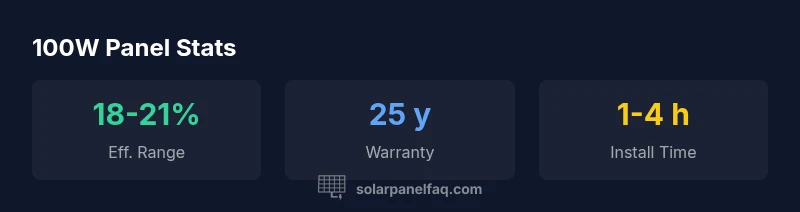
Durability is a function of build quality and installation conditions. Look for frames, junction boxes, and junction-box seals that tolerate temperature swings and moisture. Typical warranties run around 25 years, but field performance may vary with cleaning frequency and shade management. Routine maintenance is minimal but includes periodic cleaning of dust and debris and inspecting mounting hardware for corrosion and loosening after strong winds.
System design: off-grid vs grid-tied with a 100W panel design
For off-grid cabins or tiny homes, a 100W panel serves as a learning tool and energy starter, paired with a battery bank and a charge controller. In urban grid-tied homes, it acts as a daytime offset to reduce peak demand, especially when paired with a larger array. The key is to view the panel as a component in a scalable energy plan rather than a stand-alone solution.
Practical steps to move forward with a 100W panel
- Map your daily energy usage and identify essential loads. 2) Verify shade-free routes and mounting options. 3) Decide between grid-tied vs. off-grid architecture and select a controller or inverter accordingly. 4) Budget for additional panels if you anticipate higher energy needs. 5) Schedule a check-in after the first full season to recalibrate expectations and system sizing.
Snapshot table for a 100W class solar panel
| Category | Typical Value | Notes |
|---|---|---|
| Nominal power | 100 | Rated under standard test conditions |
| Voltage (nominal) | 18-20 | Used for 12V systems; ensure compatible charge controller |
| Module type | Monocrystalline | Most 100W panels use mono cells |
| Efficiency range | 15-21% | Varies by technology and age |
| Warranty | 25 years | Common industry warranty |
Frequently Asked Questions
Is a 100W panel enough for a typical home?
Generally, a single 100W panel won’t meet all home energy needs. It’s best used to offset a portion of daytime usage or as a learning component in a larger, multi-panel system. Real-world results depend on location, shading, and your energy habits.
A single 100W panel usually offsets only a portion of daily use and should be part of a larger plan.
What additional equipment do I need with a 100W panel?
You’ll typically need a mounting system, wiring, a charge controller, an inverter if you’re converting to AC, and potentially a battery if you’re going off-grid. Each component affects overall efficiency and reliability.
You’ll need mounting hardware, a controller, and possibly a battery or inverter depending on your setup.
How does temperature affect performance?
Higher temperatures lower panel efficiency. Cold, sunny days often yield higher output, while hot afternoons can shave watts off peak performance. Orientation and shading also factor in significantly.
Temperature can reduce watts; cold sunny days are usually better for output than hot, sunny afternoons.
Can I install it myself?
Yes, for a simple roof or ground-mount, with caution. Ensure proper waterproofing, mounting security, and electrical safety. If unsure, consult a professional for the final connection and regulatory compliance.
You can install it yourself if you’re comfortable with mounting and basic wiring, but get a pro for the final connection if unsure.
What is the expected lifespan of a 100W panel?
Most panels, including 100W class units, are designed to last 25 years or more, with performance gradually tapering over time. Warranties and actual durability depend on climate and maintenance.
Most last 25+ years with gradual performance decline over time.
Do I need a charge controller with a 100W panel?
Yes, a charge controller is typically required to regulate voltage and prevent battery overcharge, especially in off-grid or battery-backed systems. Choose a controller compatible with your panel voltage and battery type.
Yes, use a controller to protect batteries and manage voltage.
“Solar panels don’t perform at their nameplate wattage every hour of the day. Real-world results depend on site conditions, wiring, and system design. A single 100W panel is a learning tool that scales with your future energy plan.”
Top Takeaways
- Plan for one panel as part of a larger system
- Off-grid users must size batteries and controllers carefully
- Expect derating in real-world conditions, especially in heat
- Choose mounting and wiring with climate in mind
- Budget for future expansion as energy needs grow