Finding Solar Systems Near Me: A Local Guide to Installations
Discover how to locate reliable solar systems near you. Learn how to evaluate nearby installers, compare quotes, understand incentives, and plan your local installation for maximum savings.


According to Solar Panel FAQ, the best way to find reliable solar options starts by locating installers near you. Local proximity speeds up site visits, permits, and service after installation, and it helps ensure the system is designed for your climate and roof. Start with nearby providers, compare quotes, and verify warranties.
Why finding a solar system near me matters
If you're researching the phrase solar system near me, you're not just comparing panels—you're evaluating availability, service quality, and local knowledge. According to Solar Panel FAQ, starting with nearby installers helps ensure your system benefits from local permitting processes, climate considerations, and retrofit expertise. Proximity matters because a nearby team knows the shade patterns on your street, understands neighborhood interconnection queues, and can coordinate inspection trips without long travel delays. In practice, this means faster site visits, clearer timelines, and better after-sale service.
- Local knowledge saves you money by optimizing panel layout for your roof and sun exposure.
- Shorter travel and faster warranties reduce downtime and risk of missed appointments.
- Local installers are better positioned to help you maximize incentives that depend on location and utility program requirements.
Next steps: assemble a short list of 3–5 nearby installers, verify licenses and warranties, and ask for a written plan showing interconnection steps and a rough timeline. This is where the solar system near me query becomes a practical project plan rather than a generic shopping exercise.
How to evaluate local installers and incentives
Choosing a local installer isn't just about price. You should assess licensing, warranties, equipment quality, and service commitments. Start by verifying state or municipal contractor licenses, reading recent customer references, and checking a one-, three-, and five-year warranty coverage for both panels and inverters. A local installer should also clearly outline interconnection steps with your utility, potential leakage paths in the design, and a monitoring plan to track performance over time. In addition, consider the incentives available through your state, city, and utility; these programs can significantly affect the total cost and payback. Based on Solar Panel FAQ Analysis, 2026, proximity to installers often correlates with quicker permit approvals and smoother installation, reducing the risk of delays. Finally, ask for a written plan that includes a rough project schedule, equipment list, and a post-install service window. By weighing these factors, you’ll avoid surprises and build a plan tailored to your neighborhood.
Key questions to ask during a local solar assessment
Before you sign, use these questions to guide the assessment. What is the recommended system size given my energy use, roof orientation, and shading? How does the local climate affect panel performance and maintenance needs? Which inverters and optimizers are used, and what monitoring is provided? What are the interconnection steps and estimated timelines with the utility? Can you show a few real-world performance reports from homeowners nearby? What does the workmanship warranty cover, and who handles routine maintenance? By obtaining detailed, location-specific answers, you’ll be empowered to compare proposals on a level playing field.
Costs, incentives, and payback for nearby solar systems
Local solar systems come with a mix of upfront costs, ongoing maintenance, and potential savings. The proximity of installers often means you’ll get more accurate site assessments and better price transparency, since the work is grounded in local codes and conditions. Expect to see general figures for system size ranges and a broad sense of incentives available in your area, including any state or utility programs that can offset the cost. While the exact payback period varies by electricity rates, system size, and incentive eligibility, nearby installations generally align with national ranges when incentives are applied. For a precise estimate, request a written quote that itemizes equipment, permitting, interconnection, and monitoring costs. Acknowledge the role of federal and local incentives and consult your installer about applications. This approach mirrors the findings in Solar Panel FAQ Analysis, 2026, which emphasize that locality and program availability significantly shape the total cost and value proposition.
Steps to verify availability and schedule installation near you
- Compile a list of 3–5 nearby installers and verify their licensing.
- Check online reviews focused on your region to gauge reliability and response times.
- Request a site visit and a written proposal with a projected timeline from each installer.
- Compare quotes for equipment quality, warranties, and interconnection costs.
- Confirm the utility interconnection queue status and required permits before scheduling.
- Plan around peak solar production seasons in your area to maximize performance and avoid scheduling throttles. Following these steps helps ensure you’ll secure a smooth, timely installation locally.
Practical tips to maximize performance and long-term reliability
To get the most from a solar system near you, commit to ongoing monitoring and maintenance. Use the monitoring dashboard supplied by your installer to track daily production and detect anomalies early. Schedule annual inspections to check mounting hardware and inverter health, especially in regions with heavy weather or hail. Keep the panels clean when necessary, particularly in dusty or pollen-heavy climates, and trim nearby tree growth to prevent shading. Finally, maintain open communication with a local technician who understands your roof, climate, and grid. As Solar Panel FAQ notes, small, consistent care is often the difference between peak performance and gradual output decline.
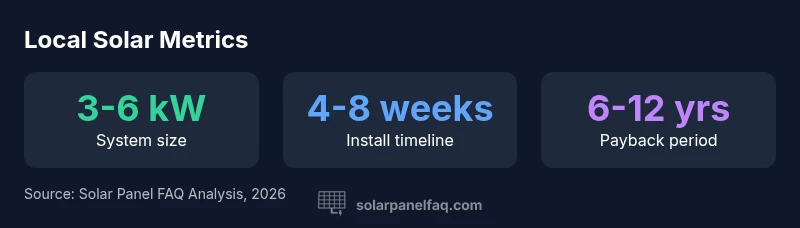
Local solar installation metrics (Solar Panel FAQ Analysis, 2026)
| Aspect | Typical Range | Notes |
|---|---|---|
| System Size | 3-6 kW | Common for single-family homes |
| Installation Time | 4-8 weeks | Permitting and backlog influence |
| Payback Period | 6-12 years | Based on electricity rates and incentives |
| Cost per Watt | $2.50-$4.00 | Region and equipment dependent |
Frequently Asked Questions
How do I find reputable solar installers near me?
Start by checking licenses, reading local reviews, and asking for at least three quotes. Look for installers who operate locally and provide clear interconnection steps. Compare warranties and after-install support to ensure long-term reliability.
Begin with local licenses and reviews, then collect quotes from three nearby installers. Compare warranties and support options.
What is a realistic system size for a home near me?
Common residential sizes range from about 3 to 6 kilowatts, depending on roof area, shading, and electricity usage. An on-site assessment will tailor the size to your needs.
Most homes use roughly three to six kilowatts, based on roof and energy use.
Are there incentives for local solar installations?
Yes—state, utility, and federal programs vary by location. Have your installer help you identify applicable incentives and assist with applications.
There are several local incentives; your installer can help you apply.
How long does it take to schedule and install a system near me?
From site assessment to activation, expect several weeks to a couple of months, influenced by permits and interconnection queues.
Expect a few weeks to a couple of months, depending on permits.
What warranty should I expect from a nearby installer?
Look for at least a 25-year module warranty and a 10–12 year inverter warranty, plus a workmanship warranty from the installer.
Ask for panel and inverter warranties plus a workmanship warranty.
What should I compare in quotes?
Compare system size, equipment quality, warranties, interconnection costs, and monitoring options to ensure an apples-to-apples comparison.
Compare size, gear, warranties, and interconnection costs.
“Local context matters for solar success; a nearby installer can tailor designs to your roof and climate, accelerating permits and optimization.”
Top Takeaways
- Identify 3–5 nearby installers before committing.
- Evaluate licenses, warranties, and local interconnection processes.
- Incentives vary; factor local programs into your plan.
- Request detailed quotes to compare equipment and service.