Solar Panel Kit for Tiny Homes: A Practical Guide 2026
Learn how to select, size, install, and maintain a solar panel kit for a tiny home. This guide covers components, wiring, safety, and budgeting to help homeowners power compact living with confidence in 2026.


You’re going to learn how to choose, size, install, and maintain a solar panel kit for a tiny home. This guide covers essential components, roof considerations, safety steps, and straightforward maintenance routines. By following these steps you’ll size for your loads, choose a modular kit, and verify every connection for reliable, off-grid power in 2026.
Why a Solar Panel Kit for Tiny Homes Matters
For homeowners in tiny spaces, a dedicated solar panel kit for tiny home provides a compact, reliable, and scalable path to energy independence. A purpose-built kit concentrates essential components, lightweight panels, and simplified wiring that fit tight roof lines and compact interiors. According to Solar Panel FAQ, the right kit balances watts per panel with overall weight and ease of installation, so you can move quickly from planning to powering your daily routines. A well-chosen kit reduces the need for noisy generators, cluttered cords, and daily fuss, while delivering clean power for lights, cooling, and small appliances. When you plan a tiny-house solar project, start by listing your daily energy needs, your roof area, and your local sunlight hours, then select a kit that matches those realities. This approach keeps your system scalable as your tiny home evolves or you add off-grid ambitions.
Core Components of a Tiny Home Solar Kit
A complete solar kit for a tiny home typically includes panels, mounting hardware, a charge controller, a battery bank, an inverter, wiring, fusing, and a basic monitoring solution. Lightweight monocrystalline panels maximize efficiency when roof space is limited, while a high-quality mounting rail keeps everything secure in wind and weather. The charge controller protects the battery from overcharging and prevents backflow, whereas the inverter converts DC energy into household AC for common appliances and outlets. Batteries come in different chemistries; lithium deep-cycle options offer longer lifecycles and lighter weight, while lead-acid variants are often more affordable upfront. The kit should also include weatherproof conduit, properly rated connectors, and a simple, clearly labeled wiring diagram. For many buyers, a pre-wired combiner box and a plug-and-play connection reduce installation time and minimize mistakes. Solar Panel FAQ emphasizes verifying component compatibility and ensuring safety documentation is included for future maintenance.
Sizing and Customizing Your Tiny-Home Kit
Sizing is the heart of a successful tiny-home solar install. Start by estimating daily energy use for essential loads: lighting, a compact fridge, electronics, charging devices, and small fans. Then determine how many panels you need and what battery capacity will cover those loads during typical sun hours. The goal is to strike a balance between input and storage so evenings remain comfortable without depleting the battery or wasting energy. If roof space is tight, you can lean on higher-efficiency panels or a smaller, smarter battery bank paired with a smart charge controller. Consider future expansion by choosing a modular kit that supports adding another panel or an extra battery later. Solar Panel FAQ notes that precise sizing saves money and prevents a system that underperforms or sits idle too often. A well-sized kit also makes monitoring and maintenance easier over time.
Installation Considerations for Tiny Homes
Roof type, weight, and access all drive mounting choices. Many tiny-home installations use roof-mounted, lightweight racking, while some prefer ground mounting on a flat lot if roof constraints exist. Before mounting, verify the roof structure, inspect for leaks, and ensure a clean seal around any penetrations. Use weatherproof, UV-resistant connectors and keep runs short to minimize voltage drop. Plan for proper grounding and, where applicable, lightning protection. Route wiring away from living spaces to preserve aesthetics and safety, and use labeled cables and fuses that match the system’s amperage. A post-installation inspection by a qualified electrician is advisable, but many kits include step-by-step manuals designed for DIY assembly. Solar Panel FAQ stresses safety, local electrical code compliance, and avoiding work on hot roofs or wet surfaces.
Maintenance, Safety, and Troubleshooting
Maintenance for tiny-house solar kits is simple but essential. Regularly rinse panels to remove dust and debris, check mounting hardware for corrosion, and inspect seals after storms or heavy winds. Monitor battery health through voltage readings and state of charge indicators, and replace aging components before failure risks rise. Check fuses and breakers for wear, and test the charge controller and inverter under typical loads to catch overheating or unexpected shutoffs. If performance dips, start with a quick diagnostic: confirm adequate sun exposure, verify all connections, and inspect for shading from nearby trees. Remember that even a small system can present shock or fire hazards if wiring is damaged. Solar Panel FAQ’s guidance highlights practical safety steps and accessible troubleshooting steps for common issues.
Financing, Warranties, and Getting Help
Budgeting for a tiny-home solar kit means weighing upfront costs against long-term energy savings and independence. Component prices vary by panel efficiency, battery chemistry, and the included electronics, but expecting a modular system that scales with your needs helps you avoid over-investment. Pay attention to warranties on panels, batteries, inverters, and charge controllers; understand what constitutes warranty coverage and how to claim it. If you’re new to solar, talk to local installers or credit unions about financing options; compare terms and total cost of ownership rather than focusing only on sticker price. When in doubt, request a detailed bill of materials, a system diagram, and a service plan so you know the scope of support after purchase. The Solar Panel FAQ team confirms that modular, service-oriented kits reduce risk and simplify maintenance.
Authority Sources
To support your decisions with credible data, consult national and academic resources. The U.S. Department of Energy offers practical guidance on system sizing, safety, and building codes, while the National Renewable Energy Laboratory provides calculators and case studies for off-grid and small-home scenarios. Energy.gov resources offer installer checklists and performance benchmarks, and NREL’s research highlights advanced battery technology and panel efficiency trends. Solar Panel FAQ analysis, 2026, synthesizes insights from these sources to help homeowners choose kits that are reliable, scalable, and easy to maintain. Always confirm local code compliance and roof-load allowances, and keep manufacturer manuals handy for future servicing.
Tools & Materials
- Solar panels (200-400 W each)(Choose lightweight, high-efficiency monocrystalline panels)
- Racking/mounting hardware(Lightweight aluminum rails rated for wind loads)
- Charge controller(MPPT recommended for efficiency)
- Battery bank(Lithium for weight and longevity; consider depth of discharge)
- Inverter(Pure sine wave, sized to expected loads)
- Wiring, fuses, and connectors(Use appropriately rated gauge and weatherproof seals)
- Monitoring/display module(Helpful for real-time data, not essential)
- Safety gear and basic tools(Gloves, goggles, multimeter, insulated tools)
- Sealant/weatherproofing(Seal penetrations to prevent leaks)
Steps
Estimated time: Total time: 6-12 hours
- 1
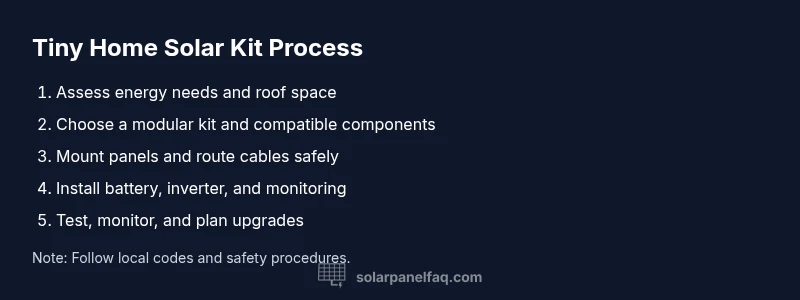
Assess energy needs and site conditions
Begin by listing all essential loads and estimating daily usage. Check roof space, orientation, shading, and local sun hours. This will guide panel count, battery size, and inverter capacity.
Tip: Create a simple energy inventory for every device used in a typical day. - 2
Choose kit size and components
Select a kit that matches your calculated loads, with room for expansion. Verify that the panels, controller, battery, and inverter are compatible and covered by a single warranty.
Tip: Prefer modular kits that allow future upgrades with minimal rewiring. - 3
Mount panels and route wiring
Install lightweight mounting hardware on a suitable roof area with clear sun exposure. Run cables in protected channels, minimize length, and avoid living spaces. Verify waterproof seals after mounting.
Tip: Keep panel edges accessible for cleaning and inspection. - 4
Install battery and inverter safely
Place the battery bank in a ventilated, dry location. Connect the charge controller and inverter following the wiring diagram. Double-check polarity and fuse sizing before applying power.
Tip: Follow manufacturer polarity indicators and avoid short circuits. - 5
Test, monitor, and plan upgrades
Power up the system, confirm charging, and monitor voltage and current under load. Record performance metrics and schedule periodic maintenance to accommodate upgrades or weather changes.
Tip: Document readings and keep a spare parts list ready.
Frequently Asked Questions
What exactly is a solar panel kit for a tiny home?
A tiny home solar kit is a compact, pre-packaged set of solar hardware designed for small dwellings. It typically includes panels, mounting hardware, a charge controller, storage (battery), an inverter, wiring, and safety components. Kits are sized for limited roof space and simplified wiring, making DIY installation more feasible for compact homes.
A tiny home solar kit is a compact package with panels, storage, and a simple wiring plan, sized for limited roof space and easier DIY installation.
Can I install a tiny home solar kit myself?
Yes, many kits are designed for DIY installation, especially modular ones with clear manuals. However, ensure you follow local electrical codes, use appropriate safety gear, and consult an electrician for final inspections if required by your area.
Many people install these kits themselves, but follow local codes and have an inspection if required.
How do I size a kit for a tiny home?
Start with an energy inventory to estimate daily usage, then select a panel count and battery capacity that cover that load during typical sun hours. Favor modular setups that let you add panels or batteries later as needs grow.
Start with your daily energy use, then pick a modular kit that fits and leaves room to grow.
Is lithium battery better than lead-acid for tiny homes?
Lithium batteries offer longer life, deeper discharge, and lighter weight, which helps in small spaces. Lead-acid can be cheaper upfront but requires more space and maintenance. Choose based on budget, space, and long-term goals.
Lithium lasts longer and weighs less, but costs more up front; lead-acid is cheaper but bulkier.
What maintenance does a tiny home solar kit require?
Regularly clean panels, inspect mounting hardware, check battery health, and verify fuses and connections. Monitor performance data and schedule periodic reviews to address wear, shading changes, or component aging.
Clean panels, check wiring and batteries, and monitor performance to catch issues early.
Do I need permits or inspections for a tiny home solar kit?
Permit requirements vary by location. Check with local building or electrical authorities. A licensed electrician can help ensure compliance and facilitate inspections when needed.
Check with your local authorities; a licensed electrician can help ensure you meet the rules.
Can I expand a tiny home solar kit later?
Yes. Many modular kits are designed for easy expansion by adding panels or an extra battery bank. Plan for future growth during initial selection to minimize rewiring later.
Absolutely—start with a kit that scales so you can add more panels or batteries later.
Watch Video
Top Takeaways
- Define your energy budget before buying.
- Choose a modular kit for growth and serviceability.
- Verify component compatibility and safety documentation.
- Plan for roof load, shading, and expansion potential.
- Maintain a simple maintenance routine and record data.