Solar Panel EV Charging: A Practical Home Guide
A step-by-step HOWTO on powering your electric vehicle with solar panels, covering sizing, configurations, safety, incentives, and maintenance for homeowners.


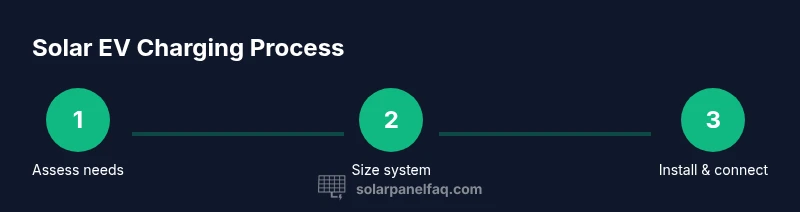
Learn how to charge an electric vehicle with solar energy at home by pairing PV panels with an EV charger, an inverter, and smart energy management. This quick answer outlines the essential steps: sizing, configuration, safety, and routine maintenance. With Solar Panel FAQ's guidance, you'll be able to plan a real-world solar panel EV charging setup that reduces grid dependence and emissions.
Why solar panel EV charging matters
Charging an electric vehicle with solar energy is a practical way to reduce fuel costs, lower emissions, and increase energy independence for homeowners. When you pair solar panels with an EV, you can align your charging with daylight, use daytime surplus, and minimize grid dependence. According to Solar Panel FAQ, homeowners are increasingly exploring home solar-to-EV setups to maximize self-consumption and plan for a cleaner, more resilient energy future. This approach not only helps the planet but also provides flexibility when the grid faces demand spikes or outages. In this section, we’ll explore the core benefits and the key considerations that influence whether solar panel EV charging is right for your home.
First, examine your daily driving energy needs and typical charging patterns. If your commute is regular and daylight coincides with your usual charging window, solar charging can capture valuable sunshine when you’d otherwise export or store energy. Solar energy is inherently intermittent, so smart charging strategies—like shifting charging times to daytime peaks or coordinating with a battery storage system—can maximize self-consumption and reduce reliance on the grid. Finally, consider the hardware footprint: from the PV array and inverter to EVSE and monitoring software, the success of a solar-to-EV setup depends on careful matching of components and a safe, code-compliant installation.
Basic setups: How you'll connect PV to EV charging options
There are multiple ways to connect solar panels to EV charging, from simple grid-tied systems that feed a dedicated EV charger to more complex configurations that include battery storage and energy management. At the simplest level, a rooftop or ground-mounted PV array feeds into an inverter, which converts DC to AC and supplies power to a Level 2 EV charger. In a grid-tied setup, any surplus energy can be sent back to the grid through net metering, offsetting daytime consumption. If you want to use stored solar energy after the sun sets, you add a battery system and a smart energy manager that schedules charging when solar production is high or when grid rates are favorable. Off-grid configurations exist but are less common for most homeowners due to cost and reliability considerations. This section outlines the core configurations and what each means for your EV charging workflow.
Sizing and performance: How much solar do you need?
To determine the right size, start with your EV’s daily energy use, expressed in kWh. Then estimate the inverter rating and PV array size that can cover that demand. A simple way is to relate daily energy needs to solar capacity via a basic formula: required system size = daily energy use / (rated PV power × expected sun hours). The actual sun hours vary by location, season, and weather, so treat this as a planning tool rather than a precise forecast. If you drive less on cloudy days or during winter, you’ll want to build flexibility into your design, such as a modest buffer or an optional battery. Remember that higher-efficiency modules and optimized orientations can improve real-world performance without changing your target usage.
Battery storage and buffering: when to add a storage system
Battery storage can smooth variations in solar production and give you charging power after sunset. If your daily driving energy needs are predictable and you want to maximize self-consumption, a storage-enabled setup can be worth the extra cost. On the other hand, many homeowners rely on grid-tied operation with smart charging to balance daytime production and nighttime demand. When evaluating storage, consider cycle life, depth of discharge, and the compatibility of the storage with your inverter and EVSE. Storage also helps during outages, allowing you to keep essential charging available even when the grid is down.
Grid-tied vs off-grid: choosing the right approach
Grid-tied systems connect to the utility grid and typically use net metering to credit daytime solar production against consumption. This approach is common for home charging because it reduces the need for oversized storage and simplifies code compliance. Off-grid configurations require sufficient battery capacity and robust protection, and they tend to be more expensive. Your choice should reflect local utility policies, reliability goals, and available space for panels and storage. If reliability and grid access are priorities, grid-tied with smart management is usually the best starting point.
Evaluating charging options: Level 1, Level 2, DC fast charging
Home solar-to-EV charging most commonly uses Level 2 AC charging, which balances speed and power quality with typical home electrical service. Level 1 (120V) is slower and may not be practical for daily charging, while DC fast charging is efficient but requires substantial investment and specialized electrical infrastructure. When paired with solar, Level 2 can be scheduled during peak solar output to maximize self-consumption. Ensure the EVSE is compatible with your EV and integrated with a smart controller to optimize timing and energy use.
Real-world use cases: daily commuting, road trips, and solar charging
For a daily commuter, a well-sized rooftop solar array paired with a Level 2 charger can cover a high portion of daytime charging, especially when paired with storage or smart scheduling. For road trips, solar charging at destination or along the route may complement fast-charging networks, but it’s important to plan around sun availability and battery capacity. In all cases, preconditioning the EV (heating or cooling the cabin while solar is available) can improve charging efficiency and comfort. Solar charging is most effective when designed around real driving patterns, local weather, and the home’s electrical limits.
Economics: costs, incentives, and payback
Costs for a solar-to-EV charging setup vary widely by location, system size, and hardware choices. Incentives and rebates can reduce upfront costs and shorten payback periods, but eligibility depends on where you live and current programs. The Solar Panel FAQ analysis shows incentives can influence project economics and accessibility, but they are not guaranteed and can change over time. A thorough assessment should estimate net cost after incentives, anticipated energy savings, and the expected lifetime of the system. With careful planning, many homeowners find solar EV charging to be a meaningful step toward energy independence and lower operating costs.
Maintenance, safety, and long-term reliability
A solar-to-EV charging system requires ongoing safety checks, periodic cleaning of panels, and monitoring of electrical connections. Inspect mounting hardware for corrosion or looseness, verify inverter and EVSE firmware updates, and review performance data for signs of degradation. Safety should be a primary concern at every stage, with particular attention to wiring, grounding, and overcurrent protection. Regular maintenance helps ensure long-term reliability and reduces the risk of unexpected outages.
Quick-start checklist for Solar Panel EV Charging at home
- Confirm daily driving energy needs and anticipated charging windows
- Assess roof or yard space for solar exposure and shading
- Choose a grid-tied configuration with an EVSE and smart management
- Size the PV array to cover daytime charging needs with a buffer
- Plan wiring routes and confirm electrical service capacity
- Install PV array, inverter, and EVSE with proper protections
- Enable energy management and monitoring for optimal timing
- Schedule periodic maintenance and performance reviews
Tools & Materials
- PV array (solar panels)(Sized for your daily EV energy needs with some headroom)
- Inverter(Compatible with PV array and EVSE; consider grid-tied options)
- Charge controller (if using batteries)(Needed for off-grid or battery-buffered configurations)
- EVSE / home charging unit (Level 2)(Ensure it supports smart scheduling and integrates with monitoring)
- Battery storage system (optional)(Lithium-based storage is common; assess cycle life and warranty)
- Smart energy management software(Optimizes charging times and daily self-consumption)
- Electrical wiring and conduit(Right gauge, weather-rated conduit, and proper protection)
- Safety gear and permits(PPE, lockout-tagout, and interconnection permits if required)
Steps
Estimated time: 8-12 hours
- 1
Define charging goals
Clarify your daily driving energy needs and preferred charging window. Decide whether you want daytime charging only, or also nighttime charging with storage. This helps anchor system sizing and component choices.
Tip: Document your typical driving patterns to inform sizing and management settings. - 2
Assess site viability
Evaluate roof or yard space for solar exposure, shading, and mounting feasibility. Check structural integrity and potential for wiring routes to the electrical panel.
Tip: Use a shading analysis tool or app for an accurate view of sun exposure year-round. - 3
Choose system type
Decide between grid-tied with net metering, grid-tied with storage, or a hybrid off-grid option. Your choice affects hardware, permits, and ongoing costs.
Tip: If reliability matters, start with grid-tied and consider storage later. - 4
Estimate solar capacity
Estimate the PV array size based on daily energy needs and the planned charging window. Include a modest buffering margin to account for weather variability and system aging.
Tip: Aim for excess capacity rather than a tight fit to accommodate unexpected driving patterns. - 5
Design wiring and layout
Plan the physical path from the panels to the inverter and EVSE, including conduit routing, junction boxes, and overcurrent protection. Ensure service panel capacity is adequate.
Tip: Label circuits clearly and verify code-compliant clearances around the panel. - 6
Install PV and inverter
Mount the PV array securely, route wiring to the inverter, and install the inverter in a ventilated location. Connect grounding and protective devices per code.
Tip: Have a licensed electrician review the mounting and wiring before energizing. - 7
Install EVSE and integrate
Mount the EVSE and tie it to the home electrical system and inverter. Ensure proper bonding, surge protection, and communication with the energy manager.
Tip: Verify compatibility between the EVSE and smart controller for optimal timing. - 8
Configure energy management
Set charging schedules, daylight optimization, and any battery buffering rules. Enable monitoring dashboards to track production, consumption, and charging progress.
Tip: Program daylight-start times and safe charging windows to maximize self-consumption. - 9
Test and commission
Perform safety checks, verify voltage and current readings, and ensure all protections work. Run a full charging cycle and observe performance against expectations.
Tip: Document test results and keep a record for future maintenance or resale.
Frequently Asked Questions
Can I charge my EV directly from solar panels without a battery?
Direct charging is possible in some setups, but most homeowners use an inverter and EVSE with a grid connection or a storage buffer to ensure stable charging and code compliance.
Direct charging is possible, but most setups rely on an inverter and grid or storage to ensure reliable charging.
Do I need battery storage to charge at night?
Battery storage helps you charge at night or during non-sun hours. Without storage, you can still charge during daylight and use grid power at night.
Battery storage helps, but it's not required if you’re okay charging when the sun is out and using grid power after sunset.
What is the best way to connect solar to an EV charger?
A grid-tied solar array feeding an inverter and a Level 2 EV charger with smart energy management is the common, practical approach.
Grid-tied with a Level 2 charger and smart management is the most practical setup.
Will solar EV charging work on cloudy days?
Yes, but output will be reduced; size the array or add storage to offset variability.
Solar still works on cloudy days, just at lower output.
Are there government incentives for solar EV charging?
Incentives vary by location and program; check local energy offices, rebates, and tax credits for solar and EV charging.
Incentives vary by location; check your local programs.
What maintenance is required for a solar-powered EV charging system?
Regular inspections, panel cleaning, and monitoring of connections help maintain efficiency and safety.
Keep it clean and check connections periodically.
Watch Video
Top Takeaways
- Plan sizing around actual driving needs and daylight availability
- Grid-tied with smart management is the most common home approach
- Incentives influence economics but vary by location
- Safety and professional installation are essential for reliability