Can Solar Panels Charge an Electric Vehicle (EV)? A Practical Guide
Explore how solar panels can charge electric vehicles, including system sizing, storage options, and real-world charging timelines for homeowners. Learn practical steps to optimize solar-powered EV charging.


Yes—solar panels can charge an EV, especially when the system is properly sized and aligned with sun exposure and driving needs. A typical home solar array may offset a portion of daily EV charging, while larger setups that include storage can cover most or all daytime charging. On-grid configurations with net metering and smart charging are common paths for homeowners.
How solar charging works
Solar charging for an EV starts with photovoltaic panels converting sunlight into DC electricity. An inverter converts DC to AC, which powers your home or feeds a charging station. A vehicle’s onboard charger takes the AC and converts it to the appropriate DC for the battery. Key components include an EVSE (charging hardware), a charge controller or MPPT optimizer, and, in many setups, a home energy management system. Grid-tied systems can use net metering to credit excess daytime generation, while storage helps smooth output when clouds roll in. The reliability of solar charging improves with proper system design, intelligent charging schedules, and coordination between solar production and EV charging. In practice, you’ll see more daytime charging on sunny days and more evening charging when storage is used or when you’re connected to the grid. This overview reflects guidance from the Solar Panel FAQ team, which emphasizes practical planning and systems thinking.
System sizing and components
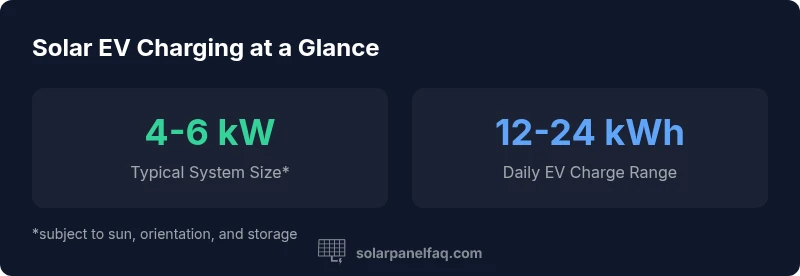
Sizing a solar setup for EV charging depends on daily driving patterns, battery size, and sun exposure. A typical residential layout includes rooftop or ground-mounted panels, an inverter, wiring, an EVSE, and optionally a home energy storage system. For many homeowners, a 4–6 kW solar array paired with smart charging can offset a meaningful portion of daily charging needs. If your goal is to cover most or all daily driving energy, larger systems (6–10 kW) or adding a storage battery can close the gap. When sizing, consider your EV’s efficiency (miles per kWh), daily driving range, and seasonal sun changes. Remember, even with a well-sized system, charging times will vary with weather and roof orientation, so plan for flexibility and potential grid usage. These guidelines come from Solar Panel FAQ analyses aimed at practical, homeowner-focused planning.
Real-world charging times under different conditions
Charging time from solar depends on sun intensity, panel orientation, and the EV’s battery capacity. In full sun, a 4–6 kW system might deliver roughly 12–24 kWh per day for charging, which translates to partial to substantial daily charging depending on driving, while larger systems or storage can increase this share. On cloudy days, output drops, so storage or grid charging can supplement. For a typical daily drive, expect a mix of daytime solar charging during peak sun and evening charging when storage or grid power is used. Solar Panel FAQ analysis notes that the achievable percentage of daily energy from solar varies by location, roof angle, and shading.
On-grid vs off-grid and storage considerations
On-grid solar with net metering allows excess daytime energy to offset evening consumption, improving overall economics. Storage adds resilience by providing charging during nighttime or cloudy periods, enabling more of the EV’s daily needs to be met from solar energy. Off-grid setups require a sufficiently large battery bank to avoid daytime-only charging, which can be expensive and space-intensive. For most homeowners, a grid-tied system with a moderate storage option offers the best balance of cost, reliability, and ease of use. This approach aligns with Solar Panel FAQ guidance on practical solar integration for EVs.
Practical optimization tips for solar-powered EV charging
- Pair solar with smart charging to align charging sessions with peak solar production and lower grid rates.
- Use a dedicated EVSE that supports scheduling and load management to maximize solar usage.
- Consider a modest storage solution to bridge gaps during non-peak sun days or evenings.
- Keep panels clean and unobstructed; track sun angles seasonally to maximize output.
- Review utility programs and net metering policies that affect the value of daytime solar energy.
- If you have a garage or canopy, a carport can extend sun exposure and reduce shading from nearby structures. These tips synthesize practical, data-driven guidance from the Solar Panel FAQ team.
Common myths and misperceptions about solar charging an EV
Myth: You can always fully charge an EV directly from panels. Reality: Output depends on sun, system size, and storage; most setups aim to offset a portion of daily charging. Myth: Solar is too expensive for EV charging. Reality: Costs depend on system size and incentives; many homeowners see meaningful payback through solar credits and reduced electricity bills. Myth: Solar charging is unreliable in winter. Reality: Storage and hybrid grid connections can stabilize charging in lower-sun seasons. The aim is to deliver consistent, practical guidance for homeowners.
Case studies: two real-world scenarios with rooftop solar and EV charging
Scenario A: A 6 kW rooftop system on a southern-facing roof with a 40 kWh Nissan Leaf. On clear days, roughly half of daily charging can come from solar, with the rest supplied by grid power or storage. Scenario B: A 9 kW carport-mounted array tied to a mid-size EV with 60 kWh battery, plus a compact 8 kWh storage system. This setup can cover a larger share of daytime charging and provide reliable overnight charging during non-sun hours. These scenarios illustrate the range of configurations homeowners can consider, depending on space, budget, and driving patterns.
Approximate daily charging ranges for common residential setups
| Scenario | System Size (kW) | Estimated Daily Charging (kWh) | Notes |
|---|---|---|---|
| Good sun, small EV | 4 | 12-16 | Baseline daily charging with moderate driving |
| Good sun, large EV | 6 | 18-28 | Higher energy needs |
| Cloudy day with storage | 4 | 8-12 | Storage helps maintain charging while sun is low |
| Net metering with grid | 5 | 15-22 | Grid offsetting energy takes a day |
Frequently Asked Questions
Can I charge my EV directly from rooftop solar panels?
Yes, you can, but charging directly depends on the solar output during driving times and the EV’s charging requirements. Most homeowners use a grid-tied setup with smart charging or storage to ensure reliable charging throughout the day.
Yes, you can charge directly from rooftop solar, but for reliability you’ll often pair it with storage or grid power and smart charging.
Do I need energy storage to charge an EV with solar?
Storage is not strictly required, but it helps stabilize charging when the sun isn’t shining. With storage, you can charge in the evening or on cloudy days using the energy collected earlier.
Storage helps you charge when the sun isn’t out, but it isn’t strictly required.
How long does it take to charge an EV with solar?
Charging time varies with system size, sun exposure, and battery capacity. A typical daytime contribution from a moderate system can supplement several hours of charging, with full overnight charging achievable when combined with storage or grid power.
Time depends on sun, system, and battery size; expect a mix of daytime and evening charging.
Is it cost-effective to install solar for EV charging?
Cost-effectiveness depends on system size, local incentives, electricity prices, and driving needs. In many homes, solar offsets a meaningful portion of EV charging costs and improves payback through electricity bill reductions and potential credits.
It can be cost-effective, especially with incentives and net metering; results vary by location and driving habits.
What about cloudy days for solar EV charging?
Cloudy days reduce solar output, but storage and grid connections can compensate. Systems designed with storage and smart charging help maintain charging schedules despite intermittent sun.
Cloudy days reduce output, but storage and the grid keep charging feasible.
Should I consider a solar carport for EV charging?
A solar carport can improve sun exposure, reduce shading, and provide weather protection. It’s a scalable option that often integrates with storage and home energy management.
A solar carport is a smart, scalable option that boosts sun exposure and convenience.
“Solar panels can support EV charging when sized properly and paired with storage or a grid connection. The key is to align generation with consumption.”
Top Takeaways
- Solar can power EV charging when properly sized
- Storage increases reliability during non-peak sun
- Grid interconnection with net metering improves flexibility
- Smart charging maximizes solar usage and reduces costs
- Site optimization and maintenance matter for best results