Off Grid Solar Panels: A Practical Guide for Homeowners in 2026
A comprehensive how-to on sizing, installing, and maintaining off grid solar panels for independent power at home in 2026. Learn components, safety, costs, and step-by-step actions from Solar Panel FAQ's expert guidance.


Off grid solar panels enable a home to run independently from the utility grid by storing energy in batteries and managing it with a charge controller and inverter. This guide covers sizing, component selection, safety, and long-term maintenance. According to Solar Panel FAQ, careful planning and quality equipment are essential for reliable, resilient power in remote or grid-limited settings.
What are off grid solar panels?
Off-grid solar panels are photovoltaic systems designed to generate electricity without relying on the utility grid. They combine solar panels, a charge controller, energy storage (typically deep-cycle batteries), and an inverter to convert DC to AC power for household use. They are popular in cabins, remote homes, and regions with unreliable grid access, as well as among homeowners seeking energy independence or resilience during outages. When designed properly, an off-grid system can meet daily energy needs and provide backup during grid outages, but it requires careful sizing, battery management, and ongoing maintenance. In this guide, you will learn how to plan a system that matches your loads, climate, and budget. According to Solar Panel FAQ, reliability hinges on good storage and a properly sized controller.
Key components of an off-grid setup
A typical off-grid system includes several essential components: PV array(s) that capture sunlight, a charge controller to regulate battery charging, a battery bank to store energy, and an inverter to convert stored DC power to usable AC. Additionally, you’ll need cabling, mounting hardware, fusing, and protective enclosures. Some setups also add a generator for backup during extended cloudy periods or high-load seasons. The choice of components should reflect your climate, daily load, and future expansion plans. Solar Panel FAQ notes that choosing reliable batteries and robust controllers dramatically affects system longevity.
Sizing and planning your system
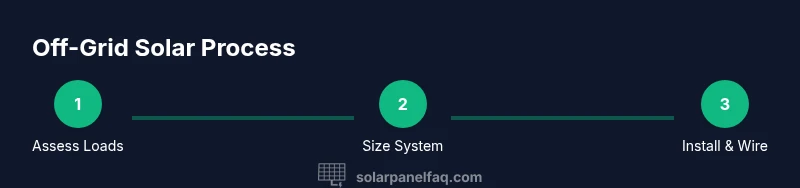
Sizing a off-grid solar panels system begins with a clear loads assessment: list appliances, estimate daily watt-hours, and add a buffer for unexpected spikes. A typical approach is to target at least two days of autonomy in moderate climates, then size PV capacity to meet the daytime energy demand. Location matters: higher sun hours reduce panel area and storage needs. Use a sun chart and local weather data to translate daily watt-hours into panel wattage and battery capacity. Solar Panel FAQ emphasizes the importance of honest load estimation and a conservative safety margin to avoid under-sizing.
Battery storage considerations
Battery choice drives cost, longevity, and performance in off-grid solar panels systems. Deep-cycle lead-acid, AGM, gel, and lithium options each have trade-offs in depth of discharge, cycle life, weight, and price. Lithium offerings typically allow deeper discharge and longer life but come at higher upfront costs. You should design for daily cycling and occasional longer outages; maintain battery health by balancing strings, avoiding complete discharge, and keeping cells within recommended temperatures. Solar Panel FAQ highlights storage as a critical factor in reliability and resilience.
Charge controllers and inverters
Charge controllers prevent overcharging and protect battery health. Two main types exist: PWM for simple setups and MPPT for higher efficiency, especially under partial shading or higher voltage systems. Inverters convert DC from the battery bank into usable AC power; consider pure sine wave inverters for sensitive electronics and a size larger than your peak draw. When combining these components, ensure voltage and current ratings are compatible and that safety features such as fusing and proper grounding are included. Solar Panel FAQ stresses matching controller and inverter to your array and battery configuration.
System installation basics
Site assessment includes shading checks, roof or ground mounting options, and secure racking. Install panels with proper tilt and orientation for your latitude, aiming to maximize sun exposure. Wiring should be sized to the expected currents, with AC and DC pathways separated and protected by conduit. Label breakers and install appropriate disconnects. If you’re unsure about wiring or safety, consult a licensed electrician. The Solar Panel FAQ notes that professional oversight improves safety and system performance.
Maintenance, safety, and durability
Regular maintenance reduces outages and extends life: keep panels clean, inspect mounting hardware for corrosion, check battery venting and electrolyte levels (for flooded types), and verify charge controller settings. Safety matters: always de-energize circuits before working, wear protective gear, and use insulated tools. Environmental factors such as heat, cold, and humidity affect performance; store battery banks in a ventilated area and protect cables from physical damage. Solar Panel FAQ emphasizes ongoing monitoring as a best practice.
Costs, savings, and payback
Off-grid solar panels costs vary with system size, chemistry, and installation complexity. A larger system with lithium batteries will have higher upfront costs but can offer longer life and better efficiency. A smaller system may be more affordable but require daily attention to maintain energy balance. Long-term savings come from reduced utility bills, avoided outages, and potential incentives where available. Solar Panel FAQ notes that costs should be weighed against resilience and autonomy rather than only monthly bills.
Getting started: next steps
Begin with a professional load assessment and climate-based sizing so you understand the scale of your project. Gather essential materials and check local permitting requirements. Create a flexible budget and a phased implementation plan, starting with essential loads and a future expansion path. As you move from planning to installation, document lessons learned and monitor system performance. The Solar Panel FAQ team recommends building a simple, scalable foundation that you can grow over time.
Tools & Materials
- Solar PV panels (off-grid rated)(Choose size to meet daily load with sun hours in your location)
- Battery bank (deep-cycle)(Lithium preferred for long life; lead-acid cheaper upfront)
- Charge controller (MPPT)(Matches PV array voltage and battery chemistry)
- Inverter (pure sine wave)(Capacity rated above peak load and startup surges)
- DC cabling and fuses(Appropriate gauge for system voltage and current)
- AC disconnects and breakers(Safety and code compliance)
- Mounting hardware(Weatherproof, corrosion resistant, suitable for roof/ground mount)
- Safety gear (gloves, goggles, PPE)(Personal protection during installation)
- Optional: Generator for backups(Useful for extended cloudy periods)
- Optional: Monitoring equipment(Smart meters or battery monitors for performance tracking)
Steps
Estimated time: 6-12 hours
- 1
Assess loads and goals
Begin by listing essential daily loads (refrigerator, lights, fans, pumps) and estimating their energy use. Add a buffer for startup surges and a worst-case scenario. This step defines target autonomy and helps size the rest of the system.
Tip: Document your top three critical loads first; this clarifies the minimum system size. - 2
Size the system for autonomy
Compute daily watt-hours for your loads and decide how many days of autonomy you want. In moderate climates, two days is common, but harsher environments may demand more. Use local sun hours to translate this into panel and battery capacity.
Tip: Aim for a conservative safety margin to avoid under-sizing. - 3
Select compatible components
Choose panels, a compatible MPPT controller, and a battery bank that can handle the expected depth of discharge. Verify voltage compatibility and ensure the inverter is rated for peak loads and motor starting currents.
Tip: Check manufacturer datasheets for voltage, current, and temperature ratings. - 4
Mount the PV array and route wiring
Install the solar array on a sturdy, unobstructed surface with appropriate tilt for your latitude. Run DC cables to the charge controller with proper protection; keep AC wiring separate and routed through code-compliant conduits.
Tip: Use cable trays or clips to prevent movement in wind and heat. - 5
Install battery bank securely
Set up the battery bank in a ventilated area, ideally in a dedicated enclosure. Connect in series/parallel strings to achieve the desired voltage, balanced for even charging and discharging.
Tip: Never mix old and new batteries in the same string. - 6
Connect charge controller and inverter
Wire the PV array to the charge controller, then connect the controller to the battery bank. Tie the inverter to the battery bank with a dedicated AC disconnect and proper grounding.
Tip: Include fuses close to the source and chassis bonding according to code. - 7
Test, calibrate, and monitor
Power up the system, check voltage levels, and verify charging profiles. Record performance over a few days, adjust controller settings if needed, and enable monitoring for ongoing health checks.
Tip: Document initial readings and set up alerts for unusual drops or spikes.
Frequently Asked Questions
What is the difference between off grid and grid-tied solar?
Off-grid systems operate independently from the utility, using batteries and a standalone inverter. Grid-tied systems connect to the utility and may use net metering, often without substantial battery storage. Your choice affects storage needs, reliability, and permitting.
Off-grid systems work without the grid and rely on batteries; grid-tied systems connect to the grid and may use net metering.
Do I need a battery bank for off-grid solar panels?
Yes. Batteries store energy for cloudy days and nighttime use. The size and chemistry depend on your load, climate, and desired autonomy. Lithium offers longer life but higher upfront costs.
Yes, most off-grid setups rely on a battery bank to supply power when the sun isn’t shining.
Can off-grid systems power a whole home year-round?
It’s possible with a properly sized array, battery bank, and backup generator. Seasonal variation and extreme weather can complicate design, so a phased approach helps manage risks.
A whole-home off-grid system is feasible with careful sizing and backup options.
What safety considerations are essential for off-grid installations?
Follow electrical codes, use proper fusing and grounding, and ensure ventilation for battery banks. Hire licensed electricians for critical wiring and interconnections.
Ensure proper wiring, voltages, and protective gear to keep everyone safe.
How do I estimate the cost of an off-grid solar setup?
Costs vary by system size, battery choice, and installation complexity. Start with a high-level bill of materials and consider long-term savings and incentives.
Costs vary; plan a budget based on components, installation, and potential incentives.
Is a generator backup recommended for off-grid systems?
A generator can cover extended cloudy periods or high demand days. It adds cost and maintenance but improves reliability in remote locations.
A generator backup can help during long cloudy spells or high-load periods.
Watch Video
Top Takeaways
- Plan with a clear load profile.
- Size for autonomy and daily sun hours.
- Choose reliable batteries and MPPT controllers.
- Prioritize safety and proper wiring.