1000-Watt RV Solar Panel Kit: A Practical Guide
Explore a 1000-watt solar panel kit for RVs: sizing, installation, components, runtimes, and maintenance. Practical guidance for off-grid camping and reliable battery charging.


A 1000-watt solar panel kit for rv provides sufficient daytime power to run essential appliances and recharge house batteries on sunny trips. Typical configurations include four 250 W panels or two 500 W modules, plus a charge controller and an RV-rated inverter. This setup balances portability, output, and ease of installation for most campers.
What a 1000 watt solar panel kit for rv delivers
The phrase "1000 watt solar panel kit for rv" often signals a practical mid-range off-grid power solution for camping and travel. According to Solar Panel FAQ, this size can support daytime loads and help recharge a house battery bank during sunny days. In most setups, you’ll find four 250 W panels or two 500 W modules, paired with a charge controller and an RV-rated inverter. The system’s real-world performance depends on sun exposure, panel orientation, shading, and how you manage loads. For many RV owners, this kit offers a balance between portability, cost, and energy reliability, making it a common starting point for those moving from portable generators to clean energy.
Sizing, loads, and planning for a practical RV energy budget
Sizing a 1000 watt kit for rv requires understanding daily energy use. Start with a simple load survey: refrigeration, lighting, fans, water pump, and electronics. Typical fridge and freezer units may consume more than other loads, especially when defrost cycles or compressors run. Use a conservative daily estimate (for example, 1,000–1,800 watt-hours per day for common RV essentials) to determine whether your proposed kit will meet needs. MPPT controllers usually offer better efficiency under varying sun angles, helping you approach peak output even when panels aren’t perfectly aligned. If your daily consumption approaches or exceeds your assumed generation, plan for a larger battery bank or modular expansion later rather than overloading a single kit.
Core components and how they fit together in a 1000-watt kit
A typical 1000 watt kit for rv includes four 250 W panels (or two 500 W modules), a charge controller (preferably MPPT for higher efficiency), an inverter sized for RV loads, cables, fuses, mounting hardware, and a basic battery bank. The charge controller optimizes energy harvest by tracking the sun’s position, while the inverter converts DC to AC for standard appliances. A well-designed kit also incorporates safety features like rapid disconnects and proper grounding. When selecting components, prioritize compatibility with your RV’s battery chemistry (lead-acid, AGM, or lithium) and ensure the inverter’s continuous wattage rating covers your heaviest loads.
Installation considerations for RV roofs and mounting options
Roof mounting demands careful planning: weight distribution, roof integrity, wind resistance, and roof penetration risk all matter. Many kits include lightweight panels optimized for travel, but you should verify that the total weight fits your RV’s roof load rating and that mounting brackets align with existing rails or roof seams. Consider aerodynamics and shade from vents or skylights. Use weatherproof sealant and properly rated connectors to prevent leaks. If you plan to travel frequently, choose a mounting system that’s quick to install and remove, with secure latching for transit.
Battery pairing, charging strategies, and inverter sizing
Pairing the kit with a battery bank tailored to your usage is essential. Lithium iron phosphate (LiFePO4) systems offer higher usable capacity, longer cycle life, and lighter weight than traditional lead-acid options, but at a higher upfront cost. An inverter should be sized to handle the peak loads you expect—for example, a 1000–1500 W inverter is common for mid-range RV kits. A well-matched system minimizes depth of discharge and preserves battery health. Additionally, plan for charging needs during travel days with matched alternator charging or portable generators as a backup for extended cloudy spells.
Real-world runtimes, expectations, and optimizing performance
In typical sunny conditions, a 1000 watt array can generate meaningful energy for RV use, but runtime depends on sun hours and battery state. Expect variable day-to-day performance: on bright mornings you might see near-peak output, while afternoons with haze or shading reduce yields. Practical tips to optimize performance include panel cleaning, angle adjustment with sun position, and minimizing energy spikes during peak generation. Remember, off-grid living is a balance of generation, storage, and consumption—start small, monitor daily usage, and adjust your kit for seasonal patterns.
Core components of a 1000 watt solar panel kit for rv
| Component | Description | Key Benefit |
|---|---|---|
| Panels | 4x 250W or 2x 500W modules | High output in a compact footprint |
| Charge Controller | MPPT preferred over PWM | Better efficiency across sun angles |
| Inverter | RV-rated pure sine wave | Safe operation of household appliances |
| Battery Bank | 12V or 24V options | Stores energy for non-sun hours |
Frequently Asked Questions
What is a 1000 watt solar panel kit for rv?
A 1000 watt kit for RVs combines several solar panels (typically four 250 W or two 500 W modules) with a charge controller, inverter, and battery storage to provide off-grid power for essential loads. It’s designed to deliver steady daytime generation and support battery charging.
A 1000 watt RV kit is a balanced solar setup with panels, a controller, and an inverter to charge batteries and run basics off-grid.
Will a 1000 W kit power my RV fridge and lights?
In most cases, yes for lights and small loads, but a typical RV fridge can draw substantial power, especially when compressor cycles run. Use a battery bank and controller sized to handle peak fridge current, and avoid running high-draw appliances simultaneously without calculating total demand.
It can handle lights and small devices, but check fridge and other high-draw loads to avoid overload.
Is an MPPT controller necessary?
MPPT controllers maximize energy harvest, especially when panel voltage is higher than battery voltage or under partial shade. They’re highly recommended for a 1000 W RV kit.
Yes—MPPT controllers optimize charging, especially in variable sun.
How much roof space do I need?
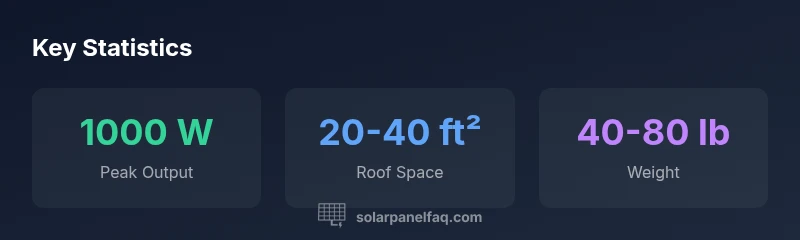
Expect about 20-40 square feet of usable roof space for a 1000 W kit, depending on panel size and mounting configuration. Lighter, higher-efficiency modules can reduce space needs.
Plan roughly 20 to 40 square feet of roof space.
Do I need a bigger battery bank?
If you use AC loads at night or during cloudy days, a larger battery bank improves reliability. Lithium systems offer longer life and deeper usable capacity than lead-acid options.
A bigger battery bank often helps with nighttime and cloudy days.
What maintenance is required?
Regularly inspect connections, clean panels, and verify seals around mounting hardware. Check fuses and battery health every few months, and test the system under a few typical loads.
Inspect, clean, and test the system periodically.
“A properly sized 1000 watt kit can meet typical RV daytime loads when paired with a suitable storage and charging strategy. Real-world performance depends on insolation, load management, and component quality.”
Top Takeaways
- Match kit size to daily RV energy needs
- Prioritize MPPT charging for efficiency
- Plan roof space and weight before mounting
- Choose battery chemistry that suits your travel style
- Expect variability; monitor usage and adjust