Solar Panel Rate: Costs, Trends, and How to Compare
Explore what the solar panel rate means, how price per watt is calculated, and how incentives, region, and financing impact total costs in 2026. Learn to compare bids accurately and maximize long-term value.


According to Solar Panel FAQ, the solar panel rate is the installed cost per watt, expressed in dollars per watt, and is the standard metric for comparing bids. Rates vary by system size, equipment quality, roof complexity, and local permitting. Incentives and financing can change the effective price, but per-watt comparisons remain the most reliable way to evaluate options.
What the solar panel rate actually measures
The term solar panel rate typically refers to the installed cost per watt for a home solar system. This per-watt metric is the most common way to compare bids because it normalizes price across different system sizes. When you receive quotes, you’ll often see a price per watt for equipment and installation bundled together. While total system price is important, the per-watt rate helps you assess value across contractors who may propose different system sizes, efficiencies, or component quality. In practice, homeowners should focus on getting apples-to-apples comparisons that isolate the per-watt price and then map that to the expected energy output.
Core components that influence per-watt pricing
Several components determine the final rate you’ll see quoted on a bid. Each element contributes a different amount to the installed cost per watt:
- Panel type and efficiency: High-efficiency panels usually command a higher per-watt price, but may reduce roof space and number of panels needed.
- Inverter choice: String inverters are common, while microinverters or optimizers can raise the upfront price but may improve performance under shade.
- Mounting hardware and racking: Roof type and angle influence labor and hardware costs.
- Roof condition and penetrations: Older roofs may require extra prep or overlays, altering the per-watt rate.
- Wiring, conduit, and electrical permits: Local permitting and wiring standards affect installation complexity and price.
- Labor and permitting: Labor costs vary by region and contractor, contributing to regional price differences.
- Warranties and service plans: Longer warranties and post-installation service add value but may increase upfront costs.
Understanding how each element contributes lets you see where a bid is stronger or weaker beyond the headline per-watt figure.
Regional market dynamics in 2026
Market dynamics in 2026 continue to shape the solar panel rate. Supply chain resilience, module and inverter availability, and labor availability influence quotes. In some regions, higher demand and limited local labor can push per-watt pricing upward, while other markets benefit from competitive bidding and installer density that drives down costs. Policy changes, including ITC status and state-level incentives, directly affect the effective price a homeowner pays after subsidies or credits. Sellers often tailor bids to regional policy, so expect meaningful regional variation even for similar system configurations.
How to read quotes and what to ask installers
When you receive quotes, request a formal per-watt price and a breakdown by major components (panels, inverter, mounting, labor, permitting). Ask for equipment models, warranty terms, and expected system output (DC/AC sizing and estimated annual kWh). To avoid bias, compare quotes that list the same or equivalent equipment where possible. If one bid shows a significantly higher per-watt rate, ensure the difference isn’t driven by higher-efficiency panels, a longer warranty, or more expensive mounting hardware. Request a side-by-side comparison table to keep apples-to-apples.
Incentives, financing, and their effects on the rate
Incentives such as the federal investment tax credit (ITC) and state programs directly impact the consumer’s effective rate. Financing options—cash, loan, or lease—also shape the apparent rate and the long-term economics. While per-watt price provides a fast, simple comparison, the total cost and payback period depend on incentives and financing terms, which can vary annually and by state. It’s essential to separate pre-incentive costs from post-incentive costs to understand true value.
Residential vs commercial rate dynamics
Residential projects often feature smaller system sizes and different permitting requirements, which can produce different per-watt pricing dynamics than commercial projects. Commercial installations may negotiate lower per-watt rates due to larger project scales, but the overall price tag is higher because of larger system sizes. Warranties, maintenance considerations, and power purchase agreements (PPAs) may also shift the economics, so compare not only per-watt price but also total lifecycle costs.
Common myths about the solar panel rate
Myth: A higher per-watt price always means better quality. Reality: It may reflect premium equipment or a smaller system size, but never assume quality without a full feature and warranty review. Myth: Quotes with a lower per-watt price are always the best deal. Reality: Lower upfront price can come with shorter warranties or higher long-term maintenance costs. Myth: Incentives guarantee the lowest possible price. Reality: Incentives reduce cost but do not guarantee the lowest rate upfront; incentives and financing can interact in complex ways.
How to maximize value: practical steps to reduce rate without sacrificing quality
- Collect multiple bids and insist on a per-watt breakdown for apples-to-apples comparison.
- Favor installers with transparent warranties for panels and inverters, plus a robust post-installation service plan.
- Assess roof suitability and plan for future maintenance when evaluating the per-watt price.
- Leverage incentives where available—know the timing, eligibility, and how to claim credits.
- Consider system design choices that optimize output per watt, such as panel orientation, tilt, and shading analysis.
Final thoughts on the solar panel rate for homeowners
The per-watt price remains the cornerstone metric for evaluating solar bids, but it’s only one part of the total cost story. The real value comes from a combination of equipment quality, installation workmanship, warranties, and the availability of incentives. As you gather quotes, keep sight of long-term energy savings, reliability, and service, not just the upfront rate. Consistent, apples-to-apples comparisons help homeowners maximize returns on solar investments.
Residential vs commercial per-watt pricing and payback rough ranges
| Plan Type | Installed cost per watt | Estimated payback (years) | Typical system size (kW) |
|---|---|---|---|
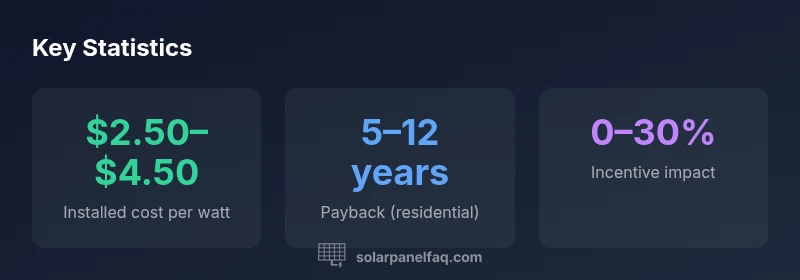
| Residential | $2.50–$4.50 | 5–12 | 4–6 |
| Commercial | $2.60–$4.20 | 6–14 | 15–100 |
Frequently Asked Questions
What exactly is the solar panel rate?
The rate is the installed cost per watt for a solar system. It combines equipment, labor, and permitting costs and is the primary metric for comparing bids.
The rate is the price per watt for installing a solar system, used to compare bids.
How does location affect the solar panel rate?
Different regions have varying labor costs, permitting rules, and incentive availability. These factors create meaningful differences in per-watt quotes across states and cities.
Where you live can change how much installers charge per watt.
Do incentives reduce the per-watt rate?
Yes. Incentives lower the effective price you pay, but quotes often show pre-incentive costs. Always compute the post-incentive cost to compare value.
Incentives can lower your final price per watt.
Should I buy or lease to affect rate?
Buying generally offers the best long-term value, while leases or power purchase agreements can alter cash flow and tax outcomes. Compare total costs and warranties.
Buying usually provides better long-term value; leases change the math.
Is payback period a reliable metric?
Payback shows how long it takes to recover the upfront investment via energy savings, but it may not capture maintenance costs or policy changes.
Payback helps, but it isn't the whole story.
How can I compare bids effectively?
Ask for a formal per-watt quote, compare equipment models, warranties, and installation scope. Use a side-by-side table and verify that similar configurations are being compared.
Get a clear per-watt quote and compare like-for-like details.
“The per-watt solar panel rate remains a foundational metric for fair bidding, but every quote should be evaluated alongside warranties, incentives, and long-term value.”
Top Takeaways
- Know the rate is per-watt price, not total system price
- incentives and financing shape the true cost you pay
- Read quotes with a per-watt breakdown to compare apples-to-apples
- Regional differences can be as impactful as equipment choices
- Ask for warranties and maintenance terms to ensure value