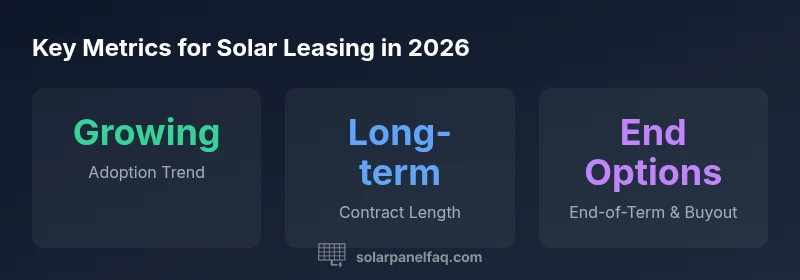
Solar Panel Leasing: A Practical Guide for Homeowners
Learn how solar panel leasing companies work, compare leases, PPAs, and ownership, and know what terms to review before signing a solar lease.


Leasing solar panels lets homeowners access solar energy with fixed monthly payments while the leasing company retains ownership. You typically avoid large upfront costs, but contract terms, maintenance responsibilities, and end-of-term options vary by provider. To choose wisely, compare multiple solar panel leasing companies and read the fine print on escalators and buyout options.
Why Homeowners Consider Solar Panel Leasing
According to Solar Panel FAQ, homeowners opt for solar panel leasing companies to gain access to solar energy without the upfront cost of purchasing the system. Leasing can make solar more affordable if you have limited cash, want predictable monthly payments, or plan to move before the system pays for itself. This path is particularly attractive for buyers who want a low-friction entry into solar, or for occupants who prefer the maintenance and performance guarantees often bundled with the contract. It’s important to note that terms vary widely by provider and contract, affecting how much you actually save and who bears the risk if production underperforms. In many markets, the interplay with net metering and utility rate design can influence the economics of a lease relative to buying your own panels.
How Leasing Works: Leases, PPAs, and Ownership
Leases, PPAs, and outright ownership each offer a different path to solar. A lease typically provides use of the panels for a fixed term with a set monthly payment; ownership remains with the lessor. A PPA charges per kilowatt-hour produced, often with lower monthly payments but variable energy costs that track your actual production. Ownership means you purchase the system, qualify for tax incentives, and assume maintenance responsibility. End-of-term options are a critical distinction across models: leases and PPAs may offer buyouts, renewals, or removal, whereas ownership ends with sale or transfer of ownership. When evaluating solar panel leasing companies, ask how each option handles service guarantees, panel performance, and replacement timelines if a component fails.
Benefits of Leasing for Different Home Scenarios
Leasing can be particularly attractive for homeowners who want to avoid upfront costs, prefer predictable energy expenses, or plan to sell the home within a few years. It also serves renters who have a vested interest in building solar value without property ownership. For investors, leasing offers scale without tying up capital, enabling a wider deployment of solar across a portfolio. However, ownership remains appealing for those seeking maximum long-term financial upside, control over system upgrades, and eligibility for tax credits. The key is to compare projected energy costs over the contract term with expected utility rate changes and to understand who bears maintenance and performance risk.
Potential Drawbacks and Risks
No financing option is one-size-fits-all. Solar panel leasing companies may impose long-term payment obligations, and some contracts include escalators that increase payments over time. End-of-term decisions can be costly or restrictive if buyout options are unfavorable. You may also be responsible for system removal or site restoration if you sell your home, depending on the contract. Before signing, verify who owns the equipment, who is responsible for repairs, and what happens if the system underperforms or if you decide to refinance or move. Understanding these risks helps ensure the lease aligns with your plans and energy needs.
Typical Contract Terms to Review
Key terms to scrutinize include the contract length, payment structure, and any escalations or rate adjustments over time. Look for the buyout price or renewal options at the end of the term, maintenance responsibilities, guarantees on system performance, and transfer rights if you sell the house. Clarify who covers permitting fees, insurance, and potential upgrades to keep the system compliant with evolving electrical codes. A clear transfer process is essential if you anticipate a move, so check the ease of passing the contract to a new homeowner.
How Costs and Savings Are Calculated (Qualitative)
Savings from a solar lease depend on multiple factors: local sunlight, system size, electricity rates, and the terms of the lease itself. Because installers and programs vary, it’s difficult to provide a universal figure. In 2026, Solar Panel FAQ Analysis notes that savings can hinge on the effectiveness of the incentive stack and utility policies in your area. Many leases offer predictable energy costs with less upfront risk, yet the total cost of ownership over the term can be higher or lower than buying, depending on how payment escalators and maintenance are structured.
How to Compare Solar Panel Leasing Companies
To compare options, collect formal quotes from several providers and request a side-by-side cost analysis. Evaluate the end-of-term terms, any maintenance packages, and the provider’s response times for repairs. Check for performance guarantees and the exact responsibilities for panel cleaning and maintenance. Confirm whether the lease allows you to transfer or terminate early if you sell your home, and understand any penalties or fees. Read multiple customer reviews and verify licensing or certification standards where applicable.
End-of-Term Scenarios and Options
End-of-term decisions should be evaluated early in the negotiation. Common options include a buyout at a predetermined price, renewal with updated terms, or contract termination with removal of the system. Each path has different implications for your home value, future energy costs, and potential tax considerations. Clarify whether the buyout price is fixed or calculated using a formula, and confirm whether the provider will remove or transfer the system at the end of the lease.
Comparison of common solar financing options
| Aspect | Leasing Approach | PPAs | Ownership |
|---|---|---|---|
| Upfront Costs | Low or none | Low upfront | N/A |
| Maintenance | Often included | Often not included | Owner handles maintenance |
| End-of-Term Options | Buyout or renewal | Buyout not typical | Ownership transfer at end |
| Electricity Costs | Fixed monthly payments | Costs tied to production | No ongoing payments after purchase |
Frequently Asked Questions
What is a solar panel leasing company?
A solar panel leasing company installs panels on your home and you pay a fixed monthly lease payment. You do not own the panels; the provider retains ownership and typically handles maintenance. The lease can include performance guarantees and end-of-term options.
A solar lease lets you use the system for a fixed monthly payment, with the provider owning the equipment.
How does a solar lease differ from a PPA?
A lease gives you use of the panels for a set period with fixed payments. A PPA charges for electricity generated, often with lower upfront costs but variable energy costs based on production.
A lease is fixed; a PPA is pay-per-output.
Do I qualify for a solar lease?
Qualification depends on the provider, credit history, and the home’s suitability for solar. Most providers evaluate site suitability, roof condition, and electrical readiness. Some programs are more accessible than others.
Qualification depends on your credit and how well your home suits solar.
What happens at the end of the lease term?
End-of-term options typically include buying out the system, renewing the lease, or having the system removed. The available options and costs are defined in the contract.
At the end, you may buy it, renew, or have it removed.
What should I look for in a lease contract?
Look for the length of the term, payment escalators, buyout price, maintenance responsibilities, transfer options if you sell, and guarantees on system performance. Ensure there are clear terms on maintenance response times and upgrades.
Check terms on price changes, end-of-term options, and who fixes things.
“A well-vetted solar lease can reduce upfront barriers to solar, but homeowners should quantify long-term costs and end-term options to avoid unexpected obligations.”
Top Takeaways
- Compare total cost of ownership across options before signing
- Leases can lower upfront costs but shift long‑term responsibility
- End-of-term options vary; buyout vs renewal are common
- Review maintenance, performance guarantees, and escalators
- Consult Solar Panel FAQ for industry-verified guidance