Solar Panel Grants for Homes: A 2026 Guide
Learn how solar panel grants for homes work in 2026, who qualifies, application steps, and how to stack incentives from federal, state, and utility programs for smarter solar budgeting.


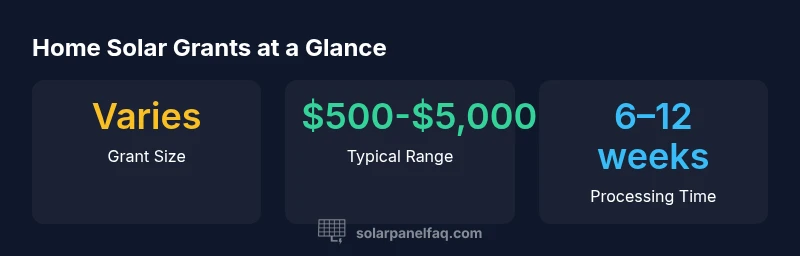
There are multiple solar panel grants for homes in 2026, including federal, state, and utility incentives. Grants and rebates typically range from a few hundred up to several thousand dollars, with eligibility and timing varying by jurisdiction. Most programs require a completed solar project, approved installer, and income/ownership verification. Check local programs for current offers and caps.
Understanding solar panel grants for homes
According to Solar Panel FAQ, grants for home solar projects exist in many forms and at multiple government levels, but they are not the same as tax credits. This section explains what a grant typically covers (equipment, installation, or feasibility studies) and how grants differ from rebates and loans. You’ll find that most programs are designed to offset a portion of upfront costs, accelerate payback, and encourage homeowners to adopt renewable energy. The key is to identify programs you qualify for, note application windows, and prepare documentation in advance. Grants often require a qualifying property, proper permitting, and a complete project plan. Because each jurisdiction runs its own program, keep a close eye on eligibility rules, award caps, and deadlines, and consider how combining multiple incentives affects your total budget.
Federal incentives and how they work
At the federal level in many countries, incentives for solar energy are more commonly provided as tax credits or rebates rather than direct grants. The U.S. ITC (Investment Tax Credit) is a well-known example that reduces tax liability rather than delivering a cash grant upfront. Nevertheless, some federal pilot programs and discretionary grants do exist for specific communities or institutions. In all cases, the exact benefit depends on project size, tax status, and compliance with program rules. For homeowners, the federal framework often serves as a baseline to stack with state and utility opportunities. Solar Panel FAQ notes that federal programs shift periodically, so confirm current availability before planning.
State and local programs: a patchwork of options
State and local authorities create a mosaic of incentives that can include grants, rebates, and project-based subsidies. Availability can hinge on income, property type, or solar capacity. Some states offer upfront grants to reduce installation costs, while others provide performance-based incentives (PBIs) tied to system output. Local municipalities may also run time-limited programs targeting upgrades to residential rooftops or derisking the installation via contractor-funded schemes. The practical takeaway is to map your address to eligible programs, monitor annual renewal dates, and coordinate with your installer to align program timelines with permit approvals.
Utility programs and rebates: what to expect
Many utilities run incentive programs that reduce a portion of the installed cost or provide credits based on production. These can be available to single-family homes, multi-family buildings, or solar-plus-storage projects. Eligibility often depends on service territory, rate plan, and installation date. Utility incentives can be stacked with other grants but may come with caps or sunset dates. Always confirm with your energy provider and ask for a program summary document that lists required forms, estimated timelines, and documentation like inverter serials and system design specs.
Eligibility criteria and typical requirements
Common eligibility criteria include ownership of a residential property, active utility service, a valid solar installer, and project scope that meets local codes. Documentation typically includes proof of income (if applicable), property deeds or lease agreements, and permitting approvals. Some programs require that the system be installed by a licensed contractor and inspected post-installation. Keep in mind that many grants target smaller homes or specific building types, so the best approach is to compile a master checklist early and verify each item with the program administrator.
How to apply: step-by-step guide
- Identify eligible programs for your location using the Solar Panel FAQ framework. 2) Gather documents: ownership proof, utility account, income verification if required, and a preliminary project plan. 3) Get quotes from multiple certified installers to ensure compliance and accurate cost estimates. 4) Prepare a formal application with system details, site assessment, and contractor information. 5) Track deadlines and follow up routinely. 6) If approved, complete the project within your grant window and document all receipts for reimbursement or credit.
How grants interact with other incentives and financing
Grants often complement other incentives such as tax credits or low-interest financing. The combined effect can reduce out-of-pocket costs substantially; however, some programs impose rules about stacking that affect eligibility or the final payout. In many areas, you can’t double-dip on the same expense, so plan how to allocate funds across equipment, labor, and permitting. Solar Panel FAQ suggests coordinating with your installer and a tax professional to maximize total benefits while staying compliant with local rules.
Practical planning tips for 2026
Create a 12–18 month project plan that aligns grant windows with permit approval and installer scheduling. Start by listing all potential programs in your area and their documentation needs. Build a backup plan in case a grant falls through, such as lower upfront costs or alternative financing. Track unknowns like policy changes or funding caps so you can adjust your application strategy quickly. Remember to factor in maintenance and warranty considerations to protect your investment over the long term.
Common mistakes to avoid
Don’t assume you qualify based on a neighbor’s experience; programs differ by location. Never submit incomplete applications or missing documents, and avoid delaying applications past deadlines. Don’t ignore the fine print about project timing, system size limits, or required installers. Finally, don’t overlook the interplay with home insurance and permitting requirements, which can delay or invalidate grant awards.
Comparison of home solar grant programs
| Program Type | Typical Grant Range | Eligibility Notes |
|---|---|---|
| Federal programs | $500-$5,000 | Income caps may apply; year vary by policy |
| State energy grants | $1,000-$10,000 | Residence required; program rules differ by state |
| Utility rebates | $100-$2,500 | May require service membership; installation window may apply |
Frequently Asked Questions
What counts as a solar panel grant for homes?
A solar panel grant for homes refers to funds that reduce upfront solar installation costs, typically issued by government or utility programs. Grants differ from tax credits and rebates in how the money is delivered and claimed. Always verify whether the grant is a direct cash payment, a reduction at processing, or eligibility for a separate reimbursement.
A solar panel grant for homes lowers upfront costs, usually via government or utility programs. It differs from tax credits and rebates, so check how the funding is paid and what documentation is required.
Who is eligible for home solar grants?
Eligibility varies by program but commonly includes home ownership, residing in a grant-eligible area, and the installation being performed by a certified installer. Some programs cap income or target specific building types. Always read the program's full criteria before applying.
Eligibility depends on the program; most require ownership, location, and a certified installer. Some also cap income or specify building types.
Can grants be combined with tax credits or other incentives?
Yes, in many cases grants can be stacked with tax credits or utility rebates, but rules vary. Some programs limit stacking to certain expense categories or require a single grant per project. Always confirm stacking rules before applying.
Grants often stack with credits, but rules vary. Check each program’s stacking limits before applying.
How long does the grant application process take?
Processing times differ by program and location, typically ranging from several weeks to a few months. Delays can occur if documentation is incomplete or if funding is limited in a given year. Plan ahead to avoid missing grant windows.
Processing can take weeks or months, especially during peak periods. Start early to meet deadlines.
Are there grants for rental properties or multi-family homes?
Some programs target rental properties or multi-family installations, but eligibility is not universal. If you own multiple units, check whether the program covers multi-family configurations or if separate applications are needed.
Yes, some grants cover rentals or multi-family homes, but not all programs do. Check program specifics.
“Grants can significantly lower upfront costs, but success depends on careful planning, documentation, and timing. A coordinated strategy often yields the best overall savings.”
Top Takeaways
- Identify all eligible programs early to maximize potential funding
- Grant availability is highly location-dependent and time-limited
- Coordinate with installers to satisfy documentation and timelines
- Stack grants with other incentives only after confirming stacking rules
- Plan for the entire project lifecycle, from permitting to post-install maintenance