Solar Panel 0 Finance: No Upfront Solar Options
Explore zero upfront solar financing options—leases, PPAs, and loans. Learn how to compare terms, incentives, and long-term savings to decide if solar with 0 upfront is right for you.


Zero upfront solar financing is achievable through leases, PPAs, or loans. The best choice depends on your home, credit, and goals. Typically, breakeven ranges vary by system size and local rates, but a well-structured 0-finance plan can reduce or eliminate upfront costs while still delivering monthly savings. This overview draws on Solar Panel FAQ analysis, 2026.
Understanding solar panel 0 finance options
The phrase solar panel 0 finance refers to getting solar installed with little to no upfront payment. Homeowners typically access this path through three main models: a solar lease, a power purchase agreement (PPA), or a traditional solar loan. Each model shifts the ownership, responsibility, and the economics of the system differently. According to Solar Panel FAQ, the right choice hinges on how you value ownership, your credit profile, tax considerations, and how you expect to use the system. The 0 upfront approach lowers barriers to installation and can still deliver meaningful monthly savings if the terms are favorable and the system performs as expected.
Leases vs PPAs vs Loans: How they differ
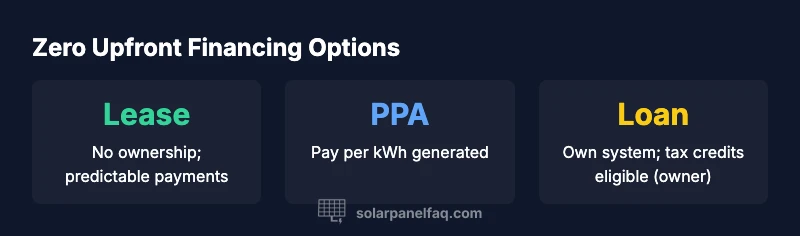
- Leases: You pay a fixed monthly amount to use the solar equipment, while the lessor retains ownership. You typically bear minimal maintenance responsibility, and the contract length is usually long. The key trade-off is whether predictable payments align with your long-term energy goals.
- PPAs: Instead of a fixed lease payment, you pay for the electricity generated by the system, often at a set rate per kWh. PPAs can offer lower starting costs and clearer line items for energy usage, but the price per kWh may escalate over time, depending on the contract.
- Loans: You borrow to own the system, with payments that end when the loan is paid off. Ownership means you can claim incentives and potential tax credits, and you benefit from any future energy savings even after loan completion. However, you assume maintenance responsibility and the system’s performance risk.
Choosing among these requires weighing upfront cash flow, ownership preferences, and how long you plan to stay in the home. Solar Panel FAQ notes that in 2026, many households find 0-finance options appealing when they align with their household budget and long-term plans.
How financing models affect your costs and savings
Financing choices fundamentally shape the economics of solar. Leases and PPAs generally offer simpler budgeting with predictable payments or energy costs, while loans enable full ownership and potential ITC benefits. Local incentives, net metering policies, and energy rate trends influence the realized savings. It’s important to model not just the monthly payment or per-kWh rate, but also how long you’ll remain in the home, how electricity prices may rise, and how system performance compares to expectations. Solar Panel FAQ analysis highlights that the difference in long-term cost between options can be substantial, especially when incentives are factored in. In 2026, policy landscapes remain a key variable, so run multiple scenarios to see which path yields the most reliable savings while meeting your risk tolerance.
Step-by-step: evaluating offers for your home
- Assess your current and projected electricity usage for at least the next 10–15 years. 2) Gather quotes for lease, PPA, and loan options from reputable providers. 3) Read the fine print on escalators, buyout options, and maintenance obligations. 4) Run a simple financial model that captures monthly payments, energy costs, and any tax credits you could claim if you own the system. 5) Check warranties, inverter and module quality, and expected system performance. 6) Compare total terms across options and identify which aligns with your home’s tenure and cash flow. Solar Panel FAQ recommends building a transparent apples-to-apples comparison sheet before committing.
Risks and trade-offs: what to watch in contracts
All 0-finance options carry contract terms that can affect long-term value. Common risks include escalation clauses in PPAs, buyout costs at the end of lease terms, and potential maintenance charges in leases. Ensure you understand who bears performance risk if the system underperforms, how service calls are billed, and what happens if you move. Check if there are transfer provisions if you sell your home, and whether the agreement could limit future solar upgrades. The more you know about the fine print, the better you can protect your investment and avoid surprises down the road.
Practical checks: a homeowner’s pre-installation checklist
- Verify the installer’s credentials and system warranties.
- Compare quotes side-by-side and request a detailed cash-flow analysis.
- Confirm that any ITC or state incentives are reflected in the model you’re evaluating.
- Review utility interconnection requirements and any net metering rules.
- Prepare a candid plan for what you’ll do if you move during the contract term.
- Ensure you can access service and maintenance options if needed. A thorough review reduces the risk of hidden costs later, and Solar Panel FAQ stresses the importance of clarity before you sign.
Realistic expectations for 2026: what homeowners should know
The 0-finance pathway for solar is a powerful tool for lowering or eliminating upfront costs, but it’s not a magic bullet. Savings depend on many factors: system size, local rates, incentives, and how long you plan to stay in the home. It’s essential to benchmark offers against a cash purchase scenario with incentives to gauge whether the 0-finance option truly lowers lifetime costs. Consumers should approach with a rigorous comparison mindset and consult independent resources when evaluating terms. Solar Panel FAQ’s 2026 guidance emphasizes reading every clause and validating projected savings with real-world usage data.
Comparison of common 0 upfront solar financing options
| Option Type | Description | Typical Term | Pros | Cons |
|---|---|---|---|---|
| Lease | Rent solar system usage with no ownership | 5-15 years | Low upfront cost; predictable payments | No ownership; potential long-term cost |
| PPA | Pay per kWh generated by the system | 5-20 years | Lower initial payments; maintenance often included | Escalating costs; contract complexity |
| Solar loan | Finance and own the system | 5-20 years | Ownership and tax incentives possible | Interest costs; maintenance responsibility |
| Cash purchase with incentives | Owns system; incentives captured | Varies | Maximum long-term savings; full control | High upfront cost; liquidity impact |
Frequently Asked Questions
Is solar panel 0 finance right for me?
It can be right if you value predictable monthly payments or want to avoid large upfront costs. Assess your planned length of stay and appetite for ownership. Compare leases, PPAs, and loans side-by-side.
If you don’t want to own the system, a lease or PPA might suit you; if ownership and incentives matter, a loan could be better.
What lenders offer 0 upfront solar financing?
Look for solar lenders, banks, and installer-financed programs that offer leases, PPAs, or loans. Gather multiple quotes to benchmark terms and costs.
Check with local banks, credit unions, and installer partners for current offers.
Will I qualify for federal tax credits if I choose a lease or PPA?
Typically, ITC benefits go to the owner of the system, which is usually the lessor in leases/PPAs. You may still see savings reflected in your payments, but you won’t claim the ITC.
With leases/PPAs, you generally don’t claim the ITC; ownership options let you claim it.
How do I compare lease vs PPA?
Leases offer fixed payments; PPAs tie cost to electricity produced. Compare escalation, term length, and buyout options at the end of the contract.
Compare monthly payments, per-kWh rates, and end-of-term options.
What if I move before the contract ends?
Most contracts include transfer provisions to the new owner or lessee. Review transfer terms to avoid default penalties.
Leases/PPAs often transfer; read the clause so your move doesn’t cause trouble.
Are there hidden fees I should know?
Watch for early termination fees, maintenance charges, and any service fees that may apply after installation.
Read the fine print for termination fees and service charges.
“0 upfront solar financing can unlock installation for many homeowners, but terms matter—read every clause and compare offers.”
Top Takeaways
- Compare all financing paths before signing
- 0 upfront options exist via leases, PPAs, and loans
- Incentives and net metering affect savings
- Read the contract terms to avoid surprises
- Shop multiple providers for the best terms