Renew Solar Panels Price in 2026: A Practical Guide
Learn how renew solar panels price changes with system size, incentives, and installation. Practical guidance, real-world ranges, and tips to estimate costs and maximize value.


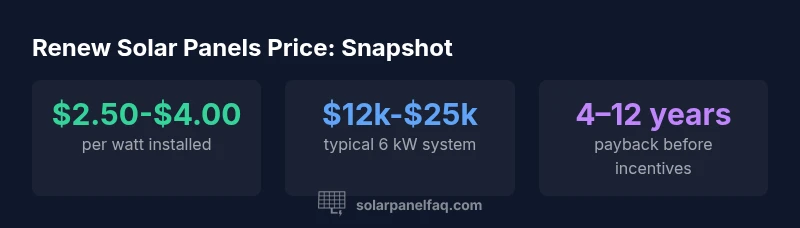
Renew solar panels price varies widely, but most homeowners see installed costs in the thousands for a typical home. In practice, prices per watt generally range from about $2.50 to $4.00, translating to roughly $12,000 to $25,000 for a common 6 kW system before incentives. Regional labor and panel choices push numbers higher or lower.
Understanding renew solar panels price
According to Solar Panel FAQ, renew solar panels price is highly variable and driven by system size, panel type, inverter choices, roof complexity, and labor costs. When homeowners say they want to renew solar panels price, they’re often comparing a full replacement of modules on an existing array versus a complete system upgrade that uses newer technology. The key is to distinguish between panel-only replacement, which may leave the same inverter and racking in place, and a full retrofit that upgrades inverters, optimizers, and sometimes roof components. The ultimate determinant is your energy needs, roof condition, and incentive landscape. For homeowners, the terminology matters: you’re balancing upfront expense, long-term output, and the reliability of warranties. In practice, you’ll see price data expressed as dollars per watt installed or as a total system price for a target kilowatt (kW) capacity. To put it into perspective, you’ll often encounter ranges rather than fixed numbers due to regional differences in labor markets and permitting costs. The goal is to understand total cost of ownership, not just the sticker price.
Factors that influence renewal costs
Renew solar panels price is not a single number; it reflects multiple moving parts. Here are the main drivers homeowners should consider:
- System size and energy goals: Larger homes and higher energy usage push the price up, but they also boost potential savings.
- Panel technologies and efficiency: Mono-crystalline panels cost more upfront but typically offer higher efficiency than polycrystalline; premium or bifacial panels can raise the price further.
- Inverter type and layout: String inverters are usually cheaper than microinverters, but microinverters can improve performance on shaded roofs.
- Roof and installation specifics: Complex roof angles, multiple penetrations, or difficult access can add labor time and cost.
- Permitting, interconnection, and disposal: Local permits, utility interconnection fees, and disposal of old panels add to the total.
- Warranties and aftercare: Longer warranties and optional service plans increase upfront costs but may reduce long-term risk.
Each factor interacts with your location and incentives, making price a spectrum rather than a fixed amount. Understanding these levers helps you compare apples to apples across bids and choose the renewal approach that best fits your home and budget.
How to estimate a renewal price
Estimating renew solar panels price starts with a clear picture of your roof, energy usage, and goals. A practical approach:
- Baseline load and desired independence: Review last 12 months of electricity bills to estimate annual kWh and the target annual energy offset.
- System sizing: Use a reputable calculator or consult a local installer to translate offset needs into a kW target. A typical home might aim for 5–8 kW, but off-grid or high-use profiles push this higher.
- Material options: Decide between standard panels and premium options, and pick an inverter strategy (central/string vs. microinverters).
- Quotes and comparisons: Obtain at least 3–4 bids, ensuring similar scope (same kW, same panel type, same roof work) for an apples-to-apples comparison.
- Incentives and taxes: Factor federal ITC and any state or local incentives into the net price. Remember that incentives reduce upfront costs but do not affect the installed price per watt.
- Long-term economics: Compute payback period and return on investment using current utility rates and projected system degradation.
A disciplined procurement process helps ensure you’re not paying for features you don’t need while still capturing value from newer technology.
Financing and incentives that affect price
Many homeowners reduce the out-of-pocket burden through financing options and incentives. The federal solar investment tax credit (ITC) commonly offers a substantial percent-off the net system price, typically around 30% through 2032, followed by gradual reductions in later years. State and local programs can add rebates or production incentives, and some utilities offer performance-based tariffs or time-of-use structuring that affects the financial case.
Beyond incentives, financing products such as solar loans or leases and power purchase agreements (PPAs) influence the cash flow. A loan may keep ownership with predictable payments, while a PPA or lease lowers upfront costs but transfers some ownership and performance risk to the provider. It’s essential to compare total costs over the contract term, including interest and escalation charges, with the net benefits of ownership. When calculating renew solar panels price, consider how incentives change the net installed price and how financing changes your monthly obligations.
Cost comparison: replacement vs. new installation
When deciding whether to renew solar panels price, homeowners often weigh replacement of existing modules against a full system upgrade. Replacement of panels on an older array can be cost-effective if the rest of the system is solid and the roof is in good shape. In contrast, a full system upgrade can unlock higher efficiency, better inverters, and longer warranties, which may justify the higher upfront cost. The choice also hinges on tax incentives, potential rebates, and the current condition of panels and electrical components. A practical approach is to model three scenarios: (a) panel-only replacement with minimal changes, (b) partial upgrade of inverters/optimizers, and (c) full system upgrade to high-efficiency panels and hybrid inverters. Running these scenarios against your energy usage, local rates, and incentives reveals the most cost-effective path over a typical 20–25 year horizon.
Common mistakes when renewing solar panels price
Even experienced homeowners can stumble during renewal planning. Common mistakes include underestimating roof repair needs, assuming old warranties transfer automatically, or not obtaining a detailed scope of work (SOA) from installers. Other slip-ups are choosing the lowest bid without confirming that all components (panels, inverters, racking) meet current performance standards, or failing to account for disposal costs of old panels. Finally, neglecting to account for future energy growth or potential tariff changes can skew the financial picture. A methodical bidding process, rigorous scope comparison, and explicit warranty terms help prevent these pitfalls.
Real-world scenarios: case studies
Case Study A: 6 kW mid-range system renewal. A homeowner with a 6 kW roof array priced at $2.70–$3.50 per watt installed, depending on panel type and mounting, might see a total installed price range of roughly $16,000 to $25,000 before incentives. With ITC and state incentives, the net price could drop substantially, shrinking the payback window to 6–10 years for a high-usage household.
Case Study B: 8 kW upgrade with higher efficiency panels. An 8 kW upgrade that includes premium panels and microinverters could push the installed price to the $22,000–$34,000 range before incentives. If energy usage is strong and incentives are favorable, this option can offer improved annual production, a shorter payback period, and more robust long-term savings. Always compare bids on a like-for-like basis and verify what each bid covers beyond panels (inverter type, wiring, roof work, and permit fees).
Maintenance and warranties that protect your renewal investment
Warranty coverage can be as important as the upfront price. Most panels come with a 25-year performance warranty, while inverters often carry 10–12 year or longer warranties depending on the model and installer. A renewal project may also rely on a labor warranty from the installing contractor, which protects against work errors for a defined period. Consider the long-term implications of module degradation, performance guarantees under the contract, and what happens if incentives change or are clawed back. By aligning warranties, contractor reliability, and panel quality, homeowners maximize the value of renew solar panels price over the system life.
Practical tips to lower renewal costs without sacrificing value
To optimize renew solar panels price, start by comparing multiple quotes with the same scope, ensuring all bidders cover removal, disposal, and roof work. Bundle upgrades where feasible (e.g., replacing inverters and optimizing wiring) to gain economies of scale. Explore standard panel options before premium choices, and consider scheduling installation during off-peak periods when labor costs may be lower. Verify that your roof is in good condition to avoid later repair costs, and plan installation to coincide with favorable weather if possible. Finally, maximize value by selecting a system that matches your actual energy needs and by taking full advantage of ITC and any available state incentives. The goal is not just lowest price, but lowest cost of ownership over the system’s lifetime.
Comparison of replacement scenarios
| Scenario | System Size (kW) | Installed Price Range | Payback Period (years) |
|---|---|---|---|
| Replacement of panels on existing system | 6 | "12,000–25,000" | "4–12" |
| Full system upgrade | 8 | "16,000–28,000" | "6–13" |
Frequently Asked Questions
What factors drive renew solar panels price the most?
System size, panel type, inverter choice, roof complexity, labor, and permitting are the primary cost drivers. Understanding these helps you compare bids accurately.
The biggest cost drivers are system size, panel choice, and your roof setup.
Is it better to renew panels or install a new complete system?
It depends on roof condition, panel age, and warranties. A full upgrade may offer better performance and longer warranties, while panel-only renewal can save money if the rest of the system is sound.
It depends on your roof and how old the rest of the system is.
What incentives reduce net cost?
Federal ITC typically reduces upfront cost; many states and utilities offer rebates or production incentives. Check eligibility and timelines with a tax adviser and local program administrators.
Look for federal and local incentives to cut the upfront price.
How long does renewal payback typically take?
Payback varies with usage and incentives, but many households see 4–12 years before breaking even after incentives.
It can take several years, depending on your energy use and incentives.
Do renewals come with warranties?
Yes. Panels usually carry 25-year warranties; inverters often 10–12 years, with installer labor warranties varying by contractor.
Warranties cover panels, inverters, and installation for several years.
What if my roof needs repairs before renewal?
Address roof needs before installation to prevent costs from rising. Delaying roof work can complicate upgrades and affect warranties.
Fix the roof first to avoid extra costs later.
“A well-planned renewal can lower lifetime costs and boost energy production, but homeowners must weigh total cost of ownership, warranties, and available incentives.”
Top Takeaways
- Know what you are renewing (panels only vs full system).
- Prices vary by size, efficiency, and roof complexity.
- Factor incentives to reduce net upfront cost.
- Always compare like-for-like bids and include all line items.
- Consider total cost of ownership, not just sticker price.