Cost to Start a Solar Panel Business: A Practical Guide
Learn the startup costs to launch a solar panel business, from licensing and equipment to marketing and financing. A practical budgeting framework for homeowners and new solar entrepreneurs.


Startup costs for a solar panel business typically range from about $50,000 to $500,000, depending on service scope, equipment quality, permitting requirements, and regional demand. This quick answer highlights the major categories that drive upfront investment and provides a rough framework to help you plan a precise budget before you launch.
Market dynamics and upfront cost drivers
Launching a solar panel business requires capital for several core reasons: equipment and tools, a basic service fleet, licensing and insurance, office or shop space, and working capital to cover the first months of operations. Geography and service scope (residential vs. commercial) heavily influence the total. According to Solar Panel FAQ, the largest upfront cost drivers tend to be equipment purchases and a small field fleet, followed by permits and insurance, with working capital buffering ordinary cash needs. Understanding these drivers early helps you tailor a realistic budget and avoid shortfalls that stall growth.
Practical budgeting starts with a clear vision of your service model—will you focus on residential roof installs, commercial retrofits, or a hybrid? Each path carries different equipment needs, labor hours, and permitting requirements. By mapping these elements, you can estimate a baseline cash reserve and set milestones for staged investments that align with revenue milestones.
Major cost categories and typical ranges
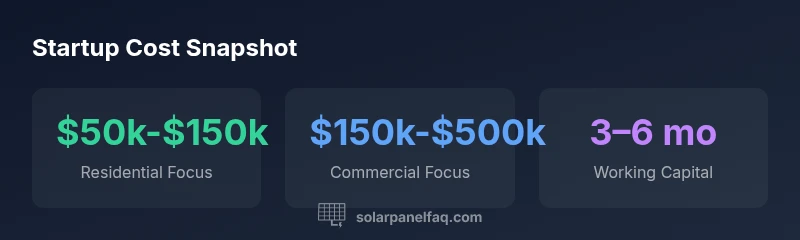
Costs break down into six broad categories. Licensing and permits typically run a few thousand dollars up to mid five figures depending on jurisdiction. Insurance protects the business and crews and varies by driver risk and coverage levels. Equipment and tools, including solar racking, inverters, testing gear, and PPE, often represent a sizable upfront expense. A modest field fleet (one to two vans) adds transport costs and fuel. Marketing and sales investment helps generate initial customer inquiries and bids. Finally, call it working capital: reserve enough to cover 3–6 months of operating expenses as you ramp up revenue. Expect wide variation by market and project mix, and plan buffers accordingly.
With a practical budget, you can prioritize spending and sequence investments to match cash flow, rather than chasing every possible upgrade at once.
How scale and service model affect startup costs
Scale matters. A solo residential installer starts with lower capex, perhaps $50,000–$150,000, especially if equipment is reused and vehicles are minimal. A small portfolio including commercial projects or a full EPC-style offering pushes up to $250,000–$500,000 or more, driven by larger crews, more sophisticated software, liabilities, and logistics. The service model also drives cost: in-house design and engineering teams require salaries and compliance costs that residential-only models may sidestep initially. Consider phased growth: begin with core services, then expand offerings as revenue solidifies and financing options mature.
Licensing, permits, and insurance: navigating compliance costs
Compliance costs are not optional: licenses, contractor registrations, and insurance protections are required to operate legally and protect your team. Permit fees vary by city and state, and some regions require electrical and building permits for each project. General liability and workers’ compensation insurance add ongoing annual costs. These expenses should be treated as fixed costs in your early budgets, not afterthoughts. The more proactive you are about obtaining permits and binding coverage early, the lower your risk of disruptive delays on active job sites.
Equipment, vehicles, and field tools: planning purchases
Your equipment plan should balance reliability, maintenance cost, and scalability. Start with core solar PV hardware, testing gear, and safety equipment; add a vehicle or two as project volume demands. Leasing can reduce upfront outlays for high-cost items and preserve cash for working capital. Invest in durable PPE, ladder racks, PPE, and safety training for crews. Factor replacement cycles into your budget and consider warranty extensions for critical components. A conservative approach protects cash flow during early project cycles.
Marketing, sales, and lead generation: budgeting for growth
New solar ventures rely on a steady drumbeat of leads. Initial budgets should include a website and inbound marketing, bid management, and sales software. Local marketing (trade shows, community outreach, partnerships with installers) can generate early referrals. Lead costs vary by market; test a few channels and scale what converts at a sustainable CAC (customer acquisition cost). Allocate funds to track ROI and adjust campaigns based on project win rates and seasonal demand.
Financing strategies: loans, leases, and grants
Financing is a practical way to bridge cash gaps. Options include conventional bank loans, lines of credit, and equipment leasing that spreads the cost of gear over time. Some regions offer grants or subsidized loans for clean energy startups; explore eligibility and application timelines. A disciplined approach pairs debt with equity or retained earnings to manage risk. Build a financing plan that aligns with projected cash flow, ensuring debt service does not exceed forecasted revenue.
Building a realistic budget: steps and templates
Begin with a simple budget template: list all cost categories, add sub-items, and assign conservative estimates to each. Obtain quotes for equipment, vehicles, and insurance; multiply by a buffer (10–25%) to cover price swings and delays. Create multiple funding scenarios (conservative, moderate, aggressive) to see how capital requirements shift. Use a monthly cash-flow projection to anticipate gaps and plan working capital needs. Review and revise quarterly as quotes update and contracts are secured.
Startup costs by business model
| Business Model | Estimated Startup Cost | Funding Sources |
|---|---|---|
| Residential solar installation (solo contractor) | $50,000–$150,000 | Self-funding / SBA loan |
| Commercial/industrial installation | $150,000–$500,000 | Bank loan / investor funding |
| Solar design and EPC firm (full services) | $200,000–$500,000 | Equity + lines of credit |
| Service and maintenance only | $40,000–$100,000 | Personal funds / credit lines |
Frequently Asked Questions
What is the typical upfront capital required to start a solar panel business?
Most startups need a broad range of capital to cover equipment, licenses, insurance, and working capital. Based on Solar Panel FAQ's 2026 analysis, a typical range is $50,000 to $500,000 depending on scale and market. Plan for contingencies and staged investments as you win your first contracts.
Most startups require between fifty thousand and five hundred thousand dollars to cover equipment, licenses, and initial working capital.
Which cost category is usually the largest in the first year?
Equipment and fleet commonly represent the largest upfront expenditure, followed by permits and insurance. Labor costs grow as you hire crews and take on more projects. A phased growth plan helps keep cash flow steady.
Equipment and fleet are typically the biggest upfront costs, followed by permits and insurance.
What financing options work best for solar startup costs?
Typical options include bank loans, lines of credit, and equipment leasing. In some regions, grants or subsidized loan programs exist for clean energy startups. Align financing with your cash flow forecast to maintain flexibility.
Bank loans, lines of credit, and equipment leasing are common; check for regional grants.
How long before a solar panel business becomes profitable?
Profitability usually emerges within 1–3 years, depending on project mix, pricing, and operating efficiency. Early years are often cash-flow positive but not yet net-positive as you invest in growth.
Most become profitable within 1–3 years, depending on revenue and costs.
Do costs differ by location?
Yes. Licensing, insurance requirements, and labor costs vary by region. Local demand and permit timelines also influence cash needs and timelines for revenue.
Location changes licensing, insurance, and wages; plan accordingly.
Can I start a solar panel business from home?
Some activities, like design work or remote consulting, can start from home. Installation typically requires on-site crews, equipment storage, and a business premises. Check local zoning and safety regulations.
You can start with design or consulting from home, but installation needs a proper setup.
“A reliable startup budget is built on transparent cost drivers: equipment, labor, permits, and financing terms. Once you map these, you can forecast cash flow more accurately.”
Top Takeaways
- Define your service scope before budgeting
- Expect major costs in equipment, fleet, and permits
- Budget 3–6 months of working capital
- Explore financing options early
- Regularly update your budget with quotes