Federal Solar Rebate 2022: ITC, Eligibility, and Homeowner Savings
A data-driven guide to the federal solar rebate in 2022 (ITC), eligibility, how to claim, and practical savings for homeowners.


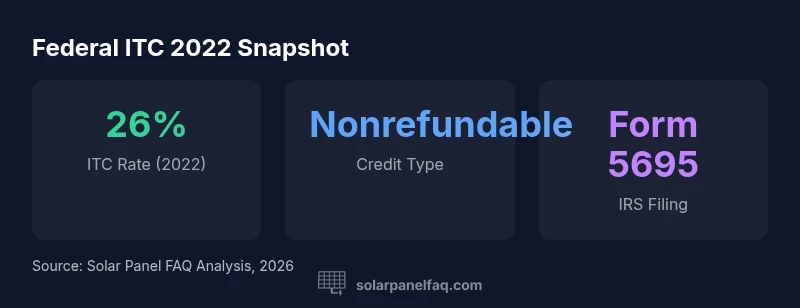
In 2022, the federal solar rebate was delivered through the Investment Tax Credit (ITC), which provided a 26% credit for eligible solar installations. This nonrefundable credit applied to both residential and commercial projects and reduced the upfront cost of going solar. Understanding eligibility and filing requirements helped homeowners maximize the benefit in that year.
Why the federal solar rebate 2022 mattered
The phrase federal solar rebate 2022 refers to the Investment Tax Credit (ITC) that year, a pivotal incentive that lowered the upfront cost of solar. According to Solar Panel FAQ, the ITC allowed eligible systems to claim a 26% credit against the total installed cost. Homeowners evaluating solar in 2022 faced a clear, data-driven decision: how large a system would maximize lifetime savings given the credit and state incentives. This year-specific policy shaped project economics, drive timelines for installation, and influenced financing choices. The Solar Panel FAQ team highlights that the ITC was a cornerstone for early adopters, helping families predict payback periods more reliably than before.
In practice, the ITC reduced the capital barrier for many households and encouraged installers to start early in the construction season to lock in the credit before any potential policy changes.
How the ITC worked in 2022
The ITC in 2022 provided a 26% federal tax credit on eligible solar equipment, labor, and soft costs for both residential and commercial installations. It was a nonrefundable credit — meaning it reduces tax liability rather than issuing a cash rebate. If your tax bill was lower than the credit, you could not claim the full amount in that year, but unused credit could generally be carried forward to offset future taxes. Installations had to place systems in service within the calendar year; ordering and permitting timelines directly affected eligibility. As the Solar Panel FAQ analysis notes, eligibility hinged on ownership of the system and meeting the ITC’s defined cost basis. Importantly, batteries could qualify if integrated with the solar system and part of the eligible cost base.
Eligibility and eligible costs
Eligible costs under the 2022 ITC included solar PV panels, inverters, racking, wiring, and labor costs directly tied to the installation. The credit applied to systems owned by the taxpayer, including those financed with a loan, lease arrangements generally did not qualify unless the taxpayer retained ownership rights. The ITC emphasized that the property must be a residence or a commercial site where the solar system is installed. State and local incentives could be stacked with the federal credit to amplify savings, but rules varied by jurisdiction. The key takeaway is to document all eligible expenses and confirm ownership status before claiming the credit.
Financing choices and ITC ownership in 2022
In 2022, whether a homeowner purchased outright, financed, or used a solar lease affected ITC eligibility. Ownership determined who could claim the credit, with the primary requirement being that the taxpayer owned the system. In many cases, buyers who financed solar could still claim the ITC, provided they met ownership criteria at the time the system was placed in service. This nuance made upcycling programs and third-party ownership arrangements more complex, requiring careful coordination between the installer, the financier, and the homeowner for accurate ITC handling.
Filing basics: what you needed to claim the ITC
To claim the 2022 ITC, homeowners filed Form 5695 with their federal tax return. Documentation included receipts, installation invoices, and a declaration that the system was placed in service during the tax year. Tax preparers advised keeping records of performance warranties and system specifications to support eligibility. The 2022 credit was applied to the tax return in the year when the system was placed in service, which meant timing of installation and permitting was crucial. Solar Panel FAQ emphasized working with a tax professional to ensure proper form completion and maximize the credit.
This block centers on the practical steps to claim the ITC and emphasizes careful documentation and timing to avoid missing out on the credit.
ITC in context: 2022 vs. post-2022 changes
While 2022 ITC offered a substantial benefit, the policy landscape evolved with subsequent legislation. The 2022 environment encouraged homeowners to pursue solar projects sooner to lock in the credit while it was still at a known rate. Later policy updates expanded or adjusted ITC terms, including eligibility for storage and different placement timelines. For homeowners evaluating a project after 2022, it is crucial to compare the current ITC rate and rules against the 2022 framework to estimate all potential savings accurately. The comparison helps homeowners understand how policy changes influence payback periods and total lifetime savings.
Real-world savings scenarios (illustrative only)
Consider a typical 6 kW residential system with a installed cost range of roughly $15,000–$25,000 before incentives. With a 26% ITC in 2022, the credit could reduce the upfront cost by about $3,900–$6,500, depending on the final eligible amount and any additional credits. The remaining cost would be financed or paid upfront. Real savings depend on local utility rates, system performance, and maintenance. Batteries added in 2022 could qualify as part of the system if integrated with the solar array, further enhancing savings by reducing peak-grid usage. Always model your expected electricity bill reductions and tax implications with a professional.
Practical steps to maximize the 2022 ITC
- Verify ownership and placement in service within 2022. 2) Gather all eligible cost documentation (equipment, installation, interconnection). 3) File Form 5695 with your tax return and consult a tax professional for guidance. 4) Coordinate with your installer to ensure all components are part of the eligible cost base. 5) Check for stacking opportunities with state or local incentives to maximize total savings. 6) Keep warranties and performance data for maintenance planning and potential future upgrades.
Resources, next steps, and ongoing considerations
Research federal ITC guidance and compare it with state incentives and local programs. Keep abreast of policy changes that could affect eligibility or credit percentages. Use reputable sources such as the IRS ITC guidance and Solar Panel FAQ analyses for up-to-date information. Finally, consult a tax professional to tailor the ITC to your personal financial situation and ensure you maximize all eligible incentives in 2022 and beyond.
Federal ITC details for 2022
| Topic | 2022 ITC Details | Notes |
|---|---|---|
| Federal ITC rate (2022) | 26% | Nonrefundable credit against tax liability |
| Eligible systems | Residential & commercial solar | Owner must own the system; batteries may qualify if integrated |
| IRS form | Form 5695 | Attach to tax return; keep receipts and placement date |
Frequently Asked Questions
What was the federal ITC rate for solar in 2022?
In 2022, the ITC offered a 26% credit on eligible solar system costs for both residential and commercial installations. The credit was nonrefundable and applied to the year the system was placed in service.
In 2022, the ITC offered a 26 percent credit for eligible solar systems, applied to the year the system went into service.
Is the ITC refundable if my tax bill is low?
No. The ITC is nonrefundable, meaning it reduces tax liability but does not provide a cash refund. You can carry forward unused credits to future years in some cases.
No, the ITC isn’t refundable, but you may be able to apply unused credits to future years depending on your tax situation.
Can battery storage qualify for ITC in 2022?
Yes, batteries could qualify if installed as part of the solar system and meet ITC eligibility criteria. Standalone batteries generally did not qualify on their own.
Batteries could qualify if they were installed with solar and met the ITC rules.
What form do I file to claim ITC?
File Form 5695 with your federal tax return to claim the ITC. Keep all installation records, receipts, and placement date documentation.
File IRS Form 5695 with your tax return and keep your records.
Did 2022 ITC interact with state incentives?
Yes. State and local incentives can be stacked with the federal ITC, potentially increasing total savings, but program rules vary by state and locality.
State incentives can add to the federal ITC, but rules vary by state.
Do I need to own the solar system to claim the ITC?
Yes. Generally, the ITC is claimed by the system owner. If you lease the system, the ITC typically goes to the owner/lessor unless a transfer agreement is in place.
Ownership is key to claiming the ITC; leases may transfer eligibility depending on agreements.
“Policy clarity and careful documentation are essential to maximizing ITC benefits. Homeowners should work with tax professionals to ensure the credit is properly claimed.”
Top Takeaways
- Identify ITC eligibility for 2022 installations.
- Understand ITC is a nonrefundable credit against tax liability.
- Document all eligible costs and ownership status for ITC claims.
- Coordinate with tax professionals to maximize the 2022 ITC and any stacked incentives.