Solar Panel Tax Credit 2024: A Homeowner's Guide
Understand the solar panel tax credit 2024: eligibility, the federal ITC at 30%, and how to stack state incentives. Practical steps, examples, and FAQs for homeowners.


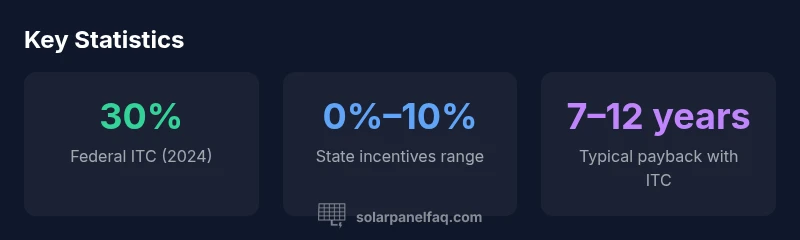
Here’s the core fact you need for 2024: homeowners can claim a federal solar tax credit (ITC) equal to 30% of qualified system costs, and many states offer additional incentives. The ITC applies to equipment and installation, reducing upfront costs. To benefit, install a qualifying system within the year and file the ITC on your federal return, alongside any state credits.
What qualifies for the solar panel tax credit in 2024?
According to Solar Panel FAQ, the federal ITC provides a 30% credit for qualified solar costs placed in service in 2024. Eligible costs include solar panels, inverters, mounting hardware, wiring, and professional installation. The credit applies to both residential and commercial systems, and can be claimed for primary and secondary homes that are used for energy generation. Rental properties may be eligible when used for business purposes. To qualify, systems must be installed by a qualified installer and placed in service within the year. The IRS defines qualified costs broadly, but exclude purely non-energy improvements or ongoing maintenance. Keep detailed receipts, installation contracts, and manufacturer certifications to support your claim.
How the ITC works in 2024 (mechanics, eligibility, and the claim process)
The ITC is a nonrefundable federal tax credit, meaning it can reduce your tax liability but not generate a refund beyond what you owe. For 2024, the credit remains at 30% of qualified costs for residential and commercial solar projects. You claim the credit on IRS Form 5695, then transfer the result to your Form 1040. If the credit exceeds your tax liability for the year, you can carry forward the unused portion to future years. The amount you can claim may be affected by other credits or the timing of the installation, so keep precise records of cost, permits, and dates.
State and local incentives: stacking opportunities and caveats
Beyond the federal ITC, many states and utilities offer additional incentives that can dramatically lower the net cost of solar. In some cases, you can stack state credits, property tax exemptions, rebates, or performance-based incentives with the ITC, increasing overall savings. Eligibility, availability, and expiration dates vary by location, so start with your state’s database (DSIRE is a common reference) and speak with your installer about local programs. Remember that some incentives are limited to residents, while others target commercial installations.
Eligible costs: what counts toward the ITC and what doesn’t
Eligible costs generally include the solar PV modules, inverters, racking and mounting hardware, wiring, metering equipment, and the labor to install the system. Permitting fees and interconnection costs are typically included. Some costs that often cause confusion are roofing or interior improvements performed as part of installing the system; if the work is primarily for energy generation, it may qualify, but consult a tax professional. Keep invoices and breakdowns organized to avoid delays during tax filing.
Claiming the credit: a practical checklist
To claim the ITC, keep organized records: purchase receipts, installation contracts, Manufacturer's Certification Statements, and proof that the system was placed in service in 2024. File Form 5695 with your federal tax return and attach it to Form 1040. If you have multiple solar projects or a business deduction, track the credit you claim each year. Consider consulting a tax advisor to maximize benefits and confirm eligibility for any battery storage added, which may qualify when paired with solar.
Common pitfalls and misconceptions
One common misconception is that the ITC covers all costs or that the full credit translates into a refund. The credit is nonrefundable and can only offset tax liability; unused portions may be carried forward. Leased systems generally do not provide the ITC to the lessee; instead, the owner may claim the credit. Battery storage eligibility has specific rules and must be paired with a qualifying solar installation. Always verify eligibility with a professional.
Example scenario: estimating your 2024 ITC impact
Consider a typical residential solar install with a total cost of $20,000, including panels, racking, and labor. With a 30% ITC, the credit would be $6,000, reducing eligible costs to $14,000. This example illustrates potential savings before state incentives. If your state offers a 5% credit, combined savings could reach $1,000–$1,500 more, depending on caps and limits. Real-world results vary by system size, location, and tax situation.
Overview of ITC and related incentives
| Incentive Type | Description | Typical Value | Eligibility | Notes |
|---|---|---|---|---|
| Federal ITC (2024) | Tax credit on qualified solar costs | 30% | Residential & commercial systems, placed in service in 2024 | Applies to equipment and installation; nonrefundable |
| State incentives | Varies by state and utility programs | 0%–10% | Residents and/or businesses depending on program | Check DSIRE or local resources |
| Battery storage ITC | Credit for storage when installed with solar | 30% | Paired with a qualifying solar system | Subject to program rules; may affect battery capacity |
Frequently Asked Questions
What is the solar panel tax credit 2024?
The federal ITC provides a 30% credit on qualified solar costs in 2024 for both residential and commercial systems. It covers equipment and installation costs; The credit reduces your tax liability, and any unused portion can be carried forward.
In 2024, the ITC offers a 30% credit on qualified solar costs; you can reduce your tax bill with it, and any unused portion can be carried forward.
Can I claim ITC if I lease my solar system?
Typically, the ITC goes to the system owner, not the lessee. If you lease, you may not receive the credit directly, but the owner can claim the ITC and pass savings through via lease terms. Check your contract and consult a tax professional.
If you lease, the credit usually goes to the owner, not you as the lessee, though savings may be reflected in the lease terms.
What costs are eligible under the ITC?
Eligible costs include panels, inverters, mounting hardware, wiring, metering, and installation labor. Some permitting fees and interconnection costs may also qualify. Roofing or non-energy improvements are usually excluded unless tied directly to energy generation costs.
Eligible costs cover the solar equipment and installation labor, with some permitting costs; non-energy improvements typically don’t count.
Can ITC be combined with other incentives?
Yes, many homeowners stack the federal ITC with state, local, or utility incentives. Availability and rules vary by location, so verify eligibility through DSIRE and your installer before purchasing.
Yes, you can often stack it with state and local incentives, but rules vary by location.
How do I claim the ITC on my taxes?
File IRS Form 5695 with your federal tax return and transfer the credit to Form 1040. Keep receipts, installation contracts, and a cost breakdown in case the IRS requests documentation.
File Form 5695 with your tax return and attach it to Form 1040; keep all receipts and cost details.
Is the ITC refundable or carry-forward only?
The ITC is nonrefundable, offsetting tax liability. If the credit exceeds what you owe, unused portions can be carried forward to future years.
The credit reduces your tax bill and, if unused, can be carried forward to future years.
Do batteries count toward ITC eligibility in 2024?
Battery storage can qualify when installed with a qualifying solar system. Check current guidance and ensure the storage unit is properly integrated with the solar PV system.
Yes, storage can qualify if installed with solar; confirm it’s part of a qualifying system.
“The federal solar tax credit 2024 remains a cornerstone of solar financing, and homeowners should plan for it as part of the total project budget. The Solar Panel FAQ Team's verdict is to combine ITC with local incentives for maximum ROI.”
Top Takeaways
- Claim the ITC to reduce upfront costs
- The federal ITC remains 30% for 2024
- Stack with state incentives for maximum savings
- Keep Form 5695 documentation
- Battery storage eligibility requires paired solar installation