Cost of Solar Panels for a 2500 Sq Ft Home: A 2026 Guide
Estimate solar panel costs for a 2500 sq ft home, including system size, price ranges, incentives, and payback timelines. Based on Solar Panel FAQ Analysis, 2026, with regional variation.


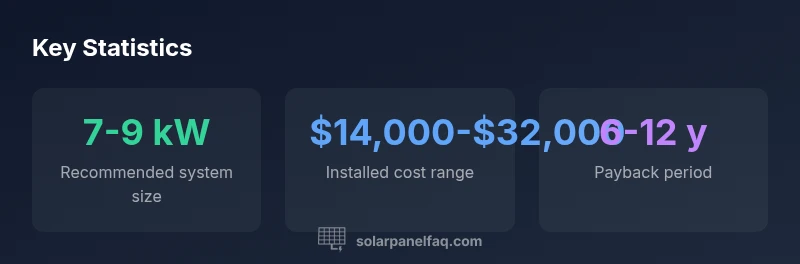
For a typical 2500 sq ft home, the cost of solar panels for 2500 sq ft home generally runs roughly from $14,000 to $32,000 before incentives. A 7-9 kW system is common for this size, with payback depending on location, incentives, and financing. Geography, roof space, and panel efficiency also influence final numbers, but this range captures typical buyer experiences across many U.S. markets.
Cost drivers for solar panels on a 2500 sq ft home\n\nIn the realm of solar investments, several levers determine the upfront cost and long-term value. The cost of solar panels for 2500 sq ft home is shaped by system size, panel type, and the complexity of installation. According to Solar Panel FAQ, the biggest determinant is how large the system must be to meet a substantial portion of daytime demand. Higher efficiency panels cost more upfront but can deliver more watts per square foot, reducing space and potentially lowering balance-of-system costs. Roof design—slope, orientation, and shading—also influences both the number of panels needed and the labor intensity of installation. Regionally, labor costs, permitting fees, and interconnection charges create meaningful price differentials. Finally, add-ons such as microinverters, optimizers, or a home battery can shift the total cost upward. The end result is a price range that reflects a mix of hardware choices, roof realities, and local market dynamics.
How system size is estimated for a 2500 sq ft home\n\nEstimating system size starts with energy analysis: reviewing past electricity usage, climate patterns, and the homeowner’s goals (offsetting bills vs. maximizing resilience). For many 2500 sq ft homes, a 7-9 kW array balances current use and future needs. The Solar Panel FAQ Team notes a typical US household consumes roughly 10,000-15,000 kWh/year; a 7-9 kW system can produce 9,000-12,000 kWh annually under decent sun exposure. Production hinges on sun hours, roof orientation (south-facing is best), and shading. When planning, consider seasonal energy spikes (air conditioning in summer, heating in winter) and potential additions like an electric vehicle or heat pump, which may push the recommended size upward.
Price ranges by region and installer type\n\nCosts vary by region and installer model. Nationally, installed prices for a 6-9 kW system before incentives commonly fall in a broad range, but regional differences are substantial. In the Solar Panel FAQ Analysis, 2026, factors such as labor market strength, permitting rigor, and local competition shape bids. Large national firms may offer uniform warranties and financing, while local shops can tailor packages with variable labor loads. Premium components (high-efficiency panels, optimizers, or microinverters) add to upfront costs but can improve performance in specific climates. Always compare total bids, not just per-watt prices, to understand installed costs and potential savings.
Financing options and incentives you can leverage\n\nFinancing and incentives are central to the total cost of ownership. Cash purchases minimize interest, but many homeowners opt for loans, leases, or PPAs. Federal tax credits (where available) and state or local incentives can substantially lower upfront costs. The Solar Panel FAQ Analysis, 2026, indicates combined incentives may cut upfront costs by 10-40% or more, depending on eligibility. Utilities may offer rebates, performance-based incentives, or net metering arrangements that affect long-term value. When evaluating options, compare loan terms, interest rates, and any ongoing maintenance fees. Consider how incentives interplay with your insurance and home value to gauge overall benefits.
Installation considerations and roof compatibility\n\nYour roof is central to the project’s feasibility and price. Roof age, material, slope, and orientation affect labor time and mounting complexity. Replacing an aging roof alongside solar can add upfront costs but saves future work. Shading from trees or nearby structures reduces energy output and may require panel layout adjustments or the use of microinverters/optimizers, increasing cost slightly. Asphalt shingles are typically the easiest and cheapest to install; tile and metal roofs may demand specialized mounting hardware and additional labor. A skilled installer will perform a shading analysis and provide a layout that maximizes energy capture within budget, while ensuring seasonal performance and warranty compliance.
Maintenance, warranties, and resale impact\n\nSolar panels require minimal maintenance but benefit from periodic checks. Most systems carry 20-25 year module warranties and 10-15 year inverter warranties. Routine inspections help catch degradation or loose components early. Solar installations can enhance resale value, especially in high-electricity regions, though the exact impact varies by market. Keep performance records and maintenance logs to support any future appraisal. The Solar Panel FAQ analysis suggests that energy savings and incentives often offset a meaningful portion of upfront costs over the system’s lifetime.
Practical steps to get a quote for a 2500 sq ft home\n\nTo move from planning to installation, start with a practical quoting process: 1) gather 12-24 months of energy bills to understand usage patterns; 2) use a reputable solar calculator to estimate production and payback; 3) seek multiple bids from installers with solid warranties and local references; ensure bids specify modules, inverters, mounting hardware, wiring, permitting, and any roof work; 4) confirm incentive eligibility and financing terms before signing; 5) request a sample performance report and warranty booklet for comparison.
Cost considerations by system size and roof characteristics
| Scenario | System Size (kW) | Estimated Installed Cost | Notes |
|---|---|---|---|
| Moderate size (6-7 kW) | 6-7 | 14,000-21,000 | Average costs; regional variation |
| Large system (8-9 kW) | 8-9 | 20,000-32,000 | Higher energy production |
| Two-story/shaded roof | 6-8 | 16,000-27,000 | Potential extra complexity |
Frequently Asked Questions
What is the typical cost to install solar panels for a 2500 sq ft home?
Costs vary by system size, location, and incentives, but a common range is $14,000-$32,000 before incentives. Financing and rebates can reduce the upfront outlay.
Typical costs fall within a broad range, depending on installation details and incentives.
How large a system do I need for a 2500 sq ft home?
A 7-9 kW system is common for a 2500 sq ft home to offset much of daytime usage. Your exact size should be based on your energy bills and goals.
Most homes in this size range use about 7 to 9 kilowatts.
What incentives exist in 2026 for solar installations?
Federal tax credits and state/local incentives reduce upfront costs. Incentive availability varies by location and eligibility; check with a certified installer for current programs.
There are federal and regional incentives, but they vary by place and eligibility.
Is it cheaper to lease or buy solar panels?
Buying usually provides greater long-term savings and ownership benefits, while leases/PPAs can lower upfront costs but limit total savings and control.
Buying often saves more overall, though leases can be easier upfront.
What is a realistic payback period for a 2500 sq ft home?
Payback typically ranges from 6 to 12 years depending on incentives, electricity prices, and system performance.
Expect about 6 to 12 years to pay back the upfront cost, depending on incentives.
How should I compare solar bids effectively?
Focus on system size, panel type, inverter type, warranties, installation timelines, and included maintenance. Ask for a side-by-side comparison.
When comparing bids, look at all components, not just price.
“Cost estimates are highly location-dependent, and a well-structured plan with incentives can dramatically alter both price and payback.”
Top Takeaways
- Size system to match current usage and future needs
- Expect regional price variation and competitive bids
- Incentives can significantly reduce upfront costs
- Compare bids holistically (hardware, labor, warranties) and factor financing
- Plan for roof or shading issues that can raise costs
- Maintain and monitor performance to maximize long-term value