TopCon vs Monocrystalline: Solar Panel Comparison
In this analytical guide, we compare TopCon solar panels with monocrystalline options, detailing efficiency potential, cost, durability, and installation considerations for homeowners evaluating topcon solar panel vs monocrystalline.


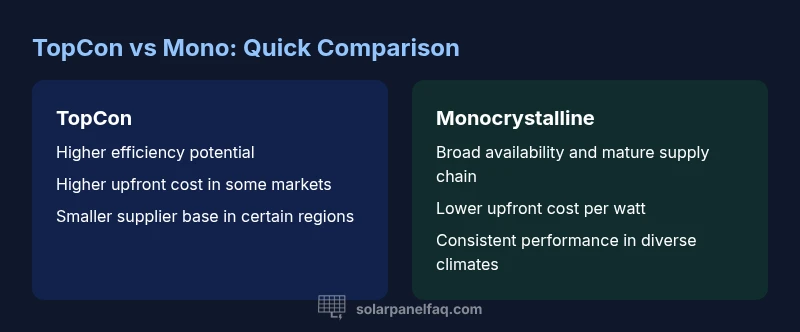
When evaluating topcon solar panel vs monocrystalline options, homeowners should weigh efficiency potential, cost, and install constraints. TopCon designs emphasize passivated contacts that can boost electrical performance in compact spaces, while monocrystalline panels provide a mature, widely available baseline. This quick comparison highlights where TopCon may offer advantages and where mono panels remain the cost-effective default.
Overview: Understanding the comparison landscape
The phrase topcon solar panel vs monocrystalline captures a fundamental choice in residential solar design: one path leans on advanced cell architecture to maximize efficiency, while the other relies on the long-established, cost-competitive monocrystalline silicon platform. According to Solar Panel FAQ, TopCon refers to passivated contact approaches that minimize contact losses and enable high current flow with refined layering. Monocrystalline panels, by contrast, use single-crystal silicon and a straightforward passivation scheme that has proven reliable over decades. For homeowners, the decision hinges on space constraints, roof orientation, and long-term energy goals. This section sets the stage by clarifying what each technology is trying to achieve and how that translates to real-world performance. We will repeatedly emphasize that the true winner depends on site-specific factors, installation quality, and the balance between upfront cost and long-term savings. The takeaway is simple: there is no one-size-fits-all answer to the topcon solar panel vs monocrystalline debate, only the right fit for your home.
Cell Architecture and What It Means in Practice
TopCon cells aim to reduce resistive losses at metal contacts by introducing passivated contact layers that improve charge collection. This architecture can enable higher efficiency potential, especially when device designers optimize every layer for minimal parasitic losses. Mono cells rely on a high-purity silicon lattice and robust metallization approaches that have matured through large-scale manufacturing. In practice, the TopCon path can yield better current generation per unit area, which matters most on smaller roofs or steeper pitches where space is limited. However, the advantages depend on the full module design, encapsulation quality, and how a given installer integrates the cells with junction boxes and bypass diodes. In short, cell-level efficiency is one aspect; module-level performance and system design determine the final energy output.
Real-World Performance: What homeowners should expect
Real-world performance for any solar panel hinges on more than the cell type. Temperature effects, shading, soiling, panel orientation, and inverter compatibility all shape energy harvest. TopCon modules may display higher efficiency potential under certain conditions, but the gains can narrow when a system encounters high operating temperatures or partial shading. Mono panels typically deliver consistent results across a wide range of climates, aided by broad supply chains and proven performance in thousands of homes. The key decision factor is not just label but how well a system is engineered: panel grade and brand quality, mounting hardware, electrical connections, and warranty coverage all contribute to how much energy a home ultimately receives.
Cost, Availability, and Lifecycle Costs
Pricing for solar panels is influenced by manufacturing complexity, scale, and regional demand. TopCon modules, because of specialized processes used in passivated contact cells, can carry a higher upfront price in some markets, especially where supply chains for this niche technology are smaller. Mono panels benefit from a deep, mature market with wide supplier options, competitive per-watt pricing, and robust after-sales support. For homeowners, the lifecycle cost argument often tilts toward mono panels when roof space is ample and energy demands are moderate; however, if a property has limited roof area or requires the highest possible efficiency per square foot, TopCon can justify the premium. Remember to factor in installation costs, permitting, and potential savings from improved shading tolerance.
Aesthetics, Durability, and Warranty Considerations
Aesthetics matter on visible roofs, and both TopCon and mono modules can present dark, uniform appearances. Some TopCon designs may display subtle color differences due to cell architecture and encapsulation choices, while mono modules usually offer a uniform appearance across manufacturers. Durability ratings are driven by materials, coatings, and the quality of lamination; in general, both technologies offer decades-long service life when properly installed. Warranty terms vary by brand and market, but it is common to see 25-year guarantees on performance and workmanship. Homeowners should scrutinize performance guarantees and read the fine print on degradation rates and coverage for microcracks or color changes under real-world conditions.
Installation Context: Roof type, climate, and spacing
Your roof characteristics shape how TopCon vs mono panels perform in practice. On small or densely shaded roofs, the slightly higher efficiency potential of TopCon cells can translate into meaningful energy gains, potentially reducing required panel area. In larger installations with plentiful space, mono panels deliver excellent returns at a lower upfront cost per watt. Climate considerations such as ambient temperature, humidity, and wind uplift can influence both technologies differently; corrosion resistance, frame strength, and mounting hardware should be evaluated alongside electrical performance. A reputable installer will balance panel choice with inverter selection, fan cooling options, and grid interconnection to maximize year-round generation.
Environmental Impact and End-of-Life Considerations
Choosing between TopCon and mono panels also touches on environmental factors and recyclability. Both technologies rely on silicon and glass, with similar end-of-life pathways once modules reach the end of their useful life. The production footprint of TopCon cells can be higher due to additional processing steps, though manufacturers are pursuing efficiency gains and reduced waste through thinner wafers and improved encapsulants. Opting for high-quality, certified modules from responsible manufacturers helps ensure lower environmental impact over the life of the system. Homeowners should consider a supplier's sustainability reports, recycling programs, and product stewardship commitments as part of the decision process.
Decision Framework: How to choose for your home
To decide between topcon solar panel vs monocrystalline, start with your roof area and energy goals. If you have limited space and can justify a premium for higher efficiency per square foot, TopCon may be worth evaluating. If your roof offers ample area and you want a cost-effective, readily available solution, mono panels are usually the safer default. Compare available warranties, track record of the manufacturer, and the installer’s experience with each technology. Finally, consider future needs such as battery storage or smart inverters, which can influence whether a higher efficiency module will unlock meaningful, long-term savings. The bottom line is that your unique site factors will determine the best choice.
Market Trends and Future Outlook
The solar industry continues to experiment with new cell architectures, including advanced passivated contact approaches and alternative passivation schemes. Market shifts toward higher efficiency modules often come with improvements in manufacturing yield, supply chain maturity, and installation standards. For homeowners, this means that today’s TopCon options may become more cost-competitive over time as the technology scales and becomes more widely deployed. Staying informed about product certifications, third-party testing, and evolving standards helps ensure the chosen solution remains compatible with future upgrades and grid requirements.
Practical Decision Rules for Homeowners
- Prioritize roof space efficiency: if square footage is constrained, prioritize higher efficiency potential.
- Compare total installed cost: look beyond sticker prices to long-term energy savings and maintenance costs.
- Check warranty coverage: verify performance guarantees and what constitutes panel degradation.
- Review supplier credibility: choose brands with transparent materials sourcing and recycling commitments.
- Align with future plans: if you anticipate storage or smart home integration, ensure compatibility with inverters and mounting hardware.
- Consult local installers: their experience with TopCon and mono in your climate informs realistic performance expectations.
Regional Variations and Grid-Connected Installations
Geographic differences in solar incentives, climate, and utility interconnection rules can influence how TopCon vs mono panels perform and pay off. In some regions, incentives favor high-efficiency modules to maximize solar yield on tight budgets or limited space. In others, abundant roof area and strong policy support for cost-effective solutions favor mono systems. A local installer who understands your climate and utility rules can help tailor a system that balances upfront cost with long-term value, regardless of the underlying cell technology.
Comparison
| Feature | TopCon Solar Panel | Monocrystalline Solar Panel |
|---|---|---|
| Efficiency potential | Potentially higher with optimized TopCon designs | Baseline high efficiency common to mono panels |
| Cost per watt | Higher upfront cost in some markets | Generally lower cost per watt and broad supplier base |
| Manufacturability/availability | Smaller but growing market; niche suppliers | Mature, widely available across regions |
| Shade tolerance and real-world performance | Can outperform in tight spaces with good design | Consistent performance under average conditions |
| Aesthetics and packaging | Often uniform dark appearance with design variations | Consistent visual appearance across brands |
| Warranty and service ecosystem | Varies by manufacturer; select trusted brands | Extensive warranty options and established networks |
Strengths
- Higher efficiency potential in optimized TopCon designs
- Better real-world performance in constrained roof spaces
- Growing ecosystem with dedicated R&D and niche suppliers
- Opportunity to maximize space value on small roofs
Drawbacks
- Higher upfront costs due to specialized manufacturing
- Limited availability in some regions
- Warranty terms vary significantly by brand
- May require more careful systems integration
TopCon can offer advantages in efficiency-per-area, but mono panels remain the safer default for most homes
If roof space is at a premium, TopCon may justify the premium with better per-square-foot output. For typical roofs and budget constraints, monocrystalline panels deliver strong value and broad support. The final choice should align with site specifics, warranty terms, and the installer’s expertise.
Frequently Asked Questions
What is TopCon solar technology and how does it differ from monocrystalline panels?
TopCon refers to passivated contact cell designs that improve charge collection, potentially increasing efficiency. Monocrystalline panels use single-crystal silicon with mature manufacturing processes for reliable, cost-effective performance. The choice depends on roof space, budget, and installer expertise.
TopCon uses advanced contacts to improve efficiency, while mono is the traditional, reliable choice. The best pick depends on space and budget.
Are TopCon panels more efficient in real-world conditions than mono panels?
TopCon designs can achieve higher efficiency under ideal conditions, but real-world results depend on temperature, shading, and system design. Mono panels deliver consistently strong performance in most residential situations.
TopCon can be more efficient in theory, but real-world gains depend on installation and environment.
What are the cost implications of choosing TopCon over Mono?
TopCon modules can carry higher upfront costs due to specialized manufacturing, though price gaps vary by supplier and volume. Mono panels usually offer a lower upfront price and broad availability.
TopCon may cost more upfront, but it depends on supplier deals and volume.
Which is better for a residential roof in a sunny climate?
Mono panels are typically the cost-effective default for sunny climates with adequate roof space. TopCon may be preferred when roof area is limited and higher efficiency per area justifies the premium.
Mono is usually best for sunny homes unless space is tight.
How do warranties compare between TopCon and Mono panels?
Warranties vary by brand, but both technologies commonly offer long-term coverage for performance and workmanship. Review specific terms, degradation allowances, and who covers installation issues.
Warranty details vary; compare terms before buying.
Top Takeaways
- Assess roof space before choosing a technology
- Mono panels offer broad availability and cost-efficiency
- TopCon may boost efficiency in tight installations
- Always compare warranties and supplier reliability
- Factor installation costs and future upgrades into the decision