How Is Solar Panel Efficiency Measured: A Practical Guide
Learn how solar panel efficiency is measured, including STC conditions, Pmax, area, and real-world factors. A homeowner-friendly guide to understanding efficiency ratings and how to compare panels.


Solar panel efficiency is the ratio of electrical power output to the solar power input, defined under standard test conditions as the maximum power (Pmax) divided by the incident irradiance (G) times the panel area (A). In practice, manufacturers report efficiency as a rating, while real-world performance varies with temperature, shade, and soiling.
What solar panel efficiency means
The term solar panel efficiency describes how effectively a panel converts sunlight into electricity. If you ask how is solar panel efficiency measured, the answer hinges on comparing the electrical power the panel can produce to the solar power it receives. In practice, engineers define efficiency as the ratio of maximum electrical power the panel can produce (Pmax) to the incident solar power (G × A), where G is irradiance and A is the active area. To keep comparisons fair, manufacturers use standard test conditions (STC): a defined irradiance, a standard spectrum, and a controlled temperature. Under STC, efficiency is reported as a rating that you can compare across products. According to Solar Panel FAQ, efficiency ratings reflect lab conditions, but real-world performance will vary with temperature, shade, and soiling on the panel. Understanding this helps homeowners interpret datasheets without assuming identical results across different rooftops.
How efficiency is calculated
Efficiency is calculated as η = Pmax / (G × A) as explained earlier. Pmax is the peak power point on the panel’s current–voltage (IV) curve, measured in watts. G is the solar irradiance in watts per square meter that reaches the panel, and A is the illuminated area of the photovoltaic cells. In a controlled lab, these values are obtained under STC: 1000 W/m^2 irradiance, a spectrum described as AM1.5, and a cell temperature near 25°C. The resulting η is a unitless percentage that indicates how much of the sun’s energy is converted to electricity. Some datasheets also report cell efficiency and module efficiency; cell efficiency refers to the PV material itself, while module efficiency accounts for losses in the assembled panel. Remember that real-world results will differ due to temperature, shading, and installation conditions.
Real-world vs. rated efficiency
Module ratings assume ideal conditions; field results often differ. The rated efficiency is a manufacturer spec under STC, but real-world efficiency is affected by temperature, irradiance, tilt, and shading. Performance Ratio (PR) is a practical metric that compares actual energy output to theoretical output under STC. Solar Panel FAQ analysis shows that shading, soiling, and electrical losses can widen the gap between rating and reality. Still, efficiency remains a critical comparator when evaluating panel technology, because higher efficiency means more watts per unit area and less roof space required. For homeowners planning a retrofit or new installation, understanding this difference helps in selecting a system that meets energy goals while staying within space and budget constraints.
Testing standards and lab conditions
Testing standards define how to measure efficiency in a repeatable way. STC uses 1000 W/m^2, AM1.5 spectral distribution, and a cell temperature of about 25°C to report module efficiency. NOCT, by contrast, captures more realistic daytime operation, with higher temperatures and different irradiance; it yields a lower efficiency value that better mirrors on-roof performance in hot climates. While both sets of data help consumers compare options, neither perfectly matches your specific roof. Analysts and installers rely on datasheets and performance data under a range of conditions to estimate system output accurately.
The role of standard test conditions (STC) and NOCT
STC provides the baseline for comparing panels; NOCT offers a closer look at how a panel performs in normal operating temperatures. When evaluating two panels with similar STC efficiencies, differences in NOCT and temperature coefficients can explain why one panel performs better in heat. Homeowners should review the temperature coefficient, which indicates how much efficiency declines with rising temperature. The higher the coefficient, the more the efficiency drops in warm climates. This context helps convert a single efficiency rating into practical expectations across seasons.
How temperature, shading, and soiling affect efficiency
Temperature reduces voltage and thus Pmax; shading reduces current and total power; soiling blocks light from reaching the cells. High ambient temperatures cause the cells to become less efficient even as sunlight remains strong. The derating factor derived from a panel’s temperature coefficient quantifies these losses. Dirt and dust on panels can accumulate quickly in dusty or polluted environments, further lowering G. Regular cleaning, trimming surrounding branches, and ensuring minimal shading throughout the day can meaningfully improve real-world performance.
How to measure Pmax and area in practice
To measure Pmax, you typically need the IV curve; with a data logger or IV tester, you sweep voltage while recording current to identify the maximum product V × I. If you are testing at home, you can approximate by measuring the open-circuit voltage Voc and short-circuit current Isc, and then estimating Pmax as a fraction of Voc × Isc, though this is less accurate. The active area A is usually listed in the datasheet or can be calculated from the panel dimensions (length × width). Recording G with a pyranometer or reliable irradiance app allows normalization of Pmax to G × A; this yields a practical efficiency estimate that can be compared across panels at similar conditions.
Quick home estimation steps
To estimate efficiency at home, gather the panel area from its datasheet, measure current output under steady sun (Pout), and record irradiance (G). Then compute η ≈ Pout / (G × A). For better accuracy, adjust by the panel’s temperature coefficient to reflect hot-day performance. This approach gives a ballpark efficiency and helps you compare panels or size a system, though it won't match lab results exactly.
Interpreting datasheets and comparing panels
Datasheets differentiate between module efficiency and cell efficiency. Module efficiency accounts for packaging, contacts, and glass, while cell efficiency represents the active photovoltaic material. Temperature coefficient and spectral response matter; check the rated Pmax relative to panel area to gauge watts per square meter. When comparing panels, use the same condition baseline (preferably STC) and consider the system’s orientation and shading; in real life, higher efficiency often means less roof space and better performance during cloudy days.
Practical tips for maximizing efficiency at home
Choose a roof with maximum sun exposure, ideally south-facing in the northern hemisphere, and minimize shading from trees or vents. Regularly clean panels to remove dirt and pollen, especially in dusty or polluted climates. Ensure proper orientation and tilt angle for your latitude. Over time, consider microinverters or optimisers to reduce mismatch losses in shade-prone arrays. Then monitor performance with a data logger to detect anomalies early.
Common mistakes and how to avoid them
Don't rely solely on efficiency ratings when comparing panels; ensure you compare under the same test conditions and consider temperature coefficients. Don't ignore shading or soiling. Avoid assuming real-world performance equals the datasheet; use performance ratio and energy yield estimates. Finally, don't neglect maintenance or aging effects; efficiency can degrade as modules age.
Summary: how to use efficiency figures in your solar plan
Efficiency figures help with panel comparisons, sizing, and energy planning, but should be used alongside other metrics like power rating, temperature coefficient, degradation rate, cost, and warranty. The Solar Panel FAQ team recommends using efficiency data with real-world performance estimates, site conditions, and installer guidance to choose the best system for your home.
Tools & Materials
- Digital multimeter(Measure voltage and current; use proper safety gear.)
- Clamp meter or IV tester(For higher accuracy on live systems.)
- Measuring tape(Determine panel dimensions (L × W) in meters.)
- Calculator(Compute efficiency and derate factors.)
- Solar irradiance meter / pyranometer(Optional but improves G readings.)
- Panel datasheet(To obtain Pmax and area.)
- Safety gear (gloves, harness as needed)(Roof work requires safety.)
- Ladder or access equipment(Only if on-roof access is necessary.)
Steps
Estimated time: 30-60 minutes per panel
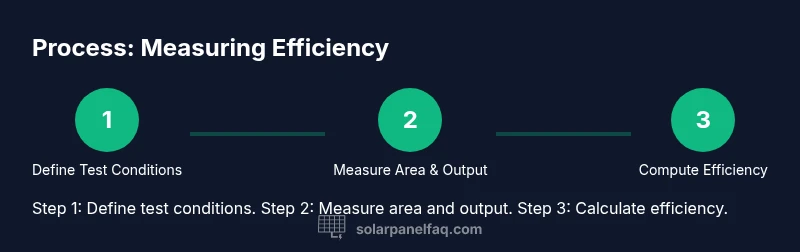
- 1
Identify test conditions
Define baseline using STC or NOCT references and ensure consistent measurement conditions.
Tip: Document ambient conditions before starting. - 2
Measure panel area
Use a measuring tape to record the panel’s length and width, then compute A in m^2.
Tip: Use the same area measurement for all panels you compare. - 3
Measure electrical output
With sunlight steady, measure panel voltage and current to approximate Pmax.
Tip: If possible, obtain the IV curve from a data logger. - 4
Record irradiance
Measure irradiance G with a pyranometer or estimate from a reliable app.
Tip: Capture readings at multiple times for reliability. - 5
Compute efficiency
Calculate η = Pmax / (G × A) and annotate units (W, m^2, W/m^2).
Tip: Keep units consistent. - 6
Adjust for real-world conditions
Apply known temperature coefficient or environmental factors to approximate real-world efficiency.
Tip: Temperature has a notable impact on voltage.
Frequently Asked Questions
What is solar panel efficiency?
Solar panel efficiency is the ratio of electrical power output to the incident solar power under standard test conditions. It indicates how effectively the panel converts sunlight into electricity and is a useful comparison metric across products.
Efficiency is the share of sunlight converted to electricity under lab conditions, used to compare panels.
Why is there a difference between rated efficiency and real-world efficiency?
The rating is determined under standardized lab conditions, which rarely match a real roof. Real-world factors like temperature, shading, dirt, and wiring losses reduce actual performance.
Real-world results are often lower due to temperature, shade, and dirt.
What are STC and NOCT?
STC (Standard Test Conditions) define a baseline for efficiency testing; NOCT (Nominal Operating Cell Temperature) reflects typical operating temperatures and irradiance. Both help consumers compare panels but real-world performance varies.
STC is lab baseline; NOCT simulates typical operating conditions.
Can I measure efficiency at home?
You can estimate efficiency using measurements of panel area, output power, and irradiance, but accuracy is limited compared with lab testing. For precise results, rely on professional testing or manufacturer data.
You can estimate, but lab tests are more precise.
How does shading affect efficiency?
Shading reduces current and overall power; even partial shading can dramatically cut energy output due to module-level and string-level losses.
Shade cuts electricity output, even if part of the panel looks sunny.
Watch Video
Top Takeaways
- Understand the basic efficiency definition and how it is calculated.
- Recognize the difference between rated efficiency and real-world performance.
- Use standard tests (STC/NOCT) as baselines, not exact field results.
- Apply measurements and a simple formula to estimate your panel efficiency at home.