Solar Panel Quality Comparison: A Data-Driven Guide
A data-driven, objective comparison of solar panel quality focusing on efficiency, durability, warranties, certifications, and total value for homeowners


Solar panel quality hinges on three core drivers: efficiency, durability, and value over time. According to Solar Panel FAQ, the top modules deliver high electrical output, slow degradation, and solid warranties, backed by consistent QA and reliable materials. For homeowners, a side-by-side look at datasheets, certifications, and field performance helps distinguish strong performers from underachievers. Key signals include high efficiency without excessive temperature losses, tight tolerances on glass and frames, and credible degradation guarantees.
Introduction to Solar Panel Quality and Why It Matters
Solar panel quality is not a single metric but a bundle of performance, reliability, and long-term value. For homeowners evaluating a prospective solar installation, understanding what constitutes high-quality modules helps prevent costly surprises years later. This section lays out the core drivers of quality and why they matter in practical terms. The Solar Panel FAQ team emphasizes that quality should reflect real-world performance, not just lab ratings. In regions with high heat, intense sun, or variable weather, selecting reliable modules can translate into meaningful energy yield and fewer maintenance headaches over a 25-year horizon. By focusing on durability, efficiency, and warranty coverage, you can build a robust system that performs consistently across seasons and weather patterns.
Top Features to Evaluate in Quality Solar Panels
When comparing panels, certain features consistently predict quality and long-term value. Start with efficiency and thermal performance, then verify durability measures like low degradation, robust frame construction, and glass that resists microcracks. Warranties matter as a proxy for trusted manufacturing and post-sale support. Look for independent certification marks and credible third-party testing. A practical checklist includes: datasheet performance, temperature coefficient, shading tolerance, anti-reflective coatings, backsheet integrity, and laboratory QA routines. Finally, consider the manufacturer’s track record for reliability and customer service. A solid combination of these signals helps separate dependable modules from underperformers.
Materials, Cells, and Build Quality: What to Look For
Module quality starts with the cell type and how it’s integrated into the panel. Monocrystalline cells generally offer higher efficiency than polycrystalline, with variations in cell size and half-cut configurations that improve shading performance. The glass and frame framework should resist corrosion and bending over decades. Look for tempered glass with anti-reflective coating, an aluminum or steel frame with proper sealing, and a backsheet that maintains color stability under UV exposure. Build quality also includes soldering quality, junction box seals, and cable management that minimizes micro-movements under wind loads. A well-built panel maintains performance while resisting microcracking and delamination. Over time, this translates into sustained output and reduced maintenance.
Certifications, Standards, and QA Processes
Quality panels meet or exceed industry standards and undergo rigorous QA processes before market release. Key certifications include IEC 61215 (crystalline silicon modules) and IEC 61730 (safety and performance). In many markets, UL verification and regional testing further bolster credibility. Independent third-party testing reports help buyers compare claims against verifiable data. QA processes span material sourcing, cell quality checks, laminated layer integrity, and final electrical testing. Consumers should request certificates, test reports, and supplier QA statements when evaluating bids. A transparent certification trail reduces the risk of hidden defects and performance discrepancies.
Real-World Performance: Degradation, Reliability, and Climate Effects
Declared efficiency is only part of the story. Panels lose output over time due to degradation, typically expressed as a percent decrease per year. Temperature coefficients indicate how a panel performs as ambient temperatures rise, which matters in hot climates. Shading, soiling, and panel orientation can also affect actual energy yield. High-quality panels exhibit slower degradation, favorable temperature coefficients, and stable performance under partial shading. Understanding these factors helps buyers estimate long-term output and whether a panel will meet projected energy goals in their climate.
Price, Value, and Total Cost of Ownership
Quality does not exist in a vacuum; it intersects with cost. Premium modules often deliver higher efficiency and longer warranties, which can translate into greater energy production and better annualized returns, especially in high-irradiance locales or roof constraints. Conversely, mid-range panels frequently offer excellent value with strong warranties and competitive performance. Price ranges per watt vary by market and installer, and it is essential to consider balance-of-system costs, such as racking, wiring, and monitoring. The key is to compare lifetime energy yield and maintenance costs rather than upfront price alone.
How to Conduct a Practical Side-by-Side Comparison
Develop a standardized comparison protocol: collect datasheets, warranty terms, certification documents, and performance tests for each panel. Create a shared scoring rubric focusing on: efficiency, degradation, temperature coefficient, warranty length, and build quality. Verify supplier reliability and after-sales service, including replacement policies and dispatch times. If possible, review independent test reports or performance simulations. By applying the same rubric to every candidate, you avoid bias and identify the best quality-to-value option for your home.
Climate, Geography, and Site-Specific Quality Signals
Quality signals can vary with geography. In high-heat regions, panels with lower temperature coefficients and robust heat tolerance perform better. In cold climates, mechanical durability against freeze-thaw cycles matters. Roof orientation, shading from nearby trees, and installation angle influence real-world energy generation, which later affects perceived quality. A quality panel remains productive across seasons rather than peaking briefly in favorable conditions. Homeowners should align product selection with local climate data and typical irradiance patterns to maximize the return on investment.
Practical Install Considerations and Risk Mitigation
A high-quality panel also depends on the installation system’s integrity. Choose experienced installers who follow best practices for electrical safety, wiring routing, and grounding. Ensure complementary components—like inverters, optimizers, and mounting hardware—match the panel’s quality level to avoid bottlenecks in performance. Finally, document everything: the panel model, serial numbers, warranty terms, and installation records. A careful, documented approach reduces risk and facilitates faster claims if issues arise.
How to Decide: Quality vs Budget Scenarios
For new homeowners on tight budgets, mid-range panels with solid warranties can deliver reliable performance without overspending. For luxury installs or cases with space constraints, premium modules may unlock higher energy yield, improved shading tolerance, and longer service life. Solar installations serving critical power needs or in extreme climates often justify investing in higher-quality modules. The outcome should be a balance between expected energy production, maintenance cost, and the installer’s capability to deliver the chosen quality level over the system’s lifespan.
Comparison
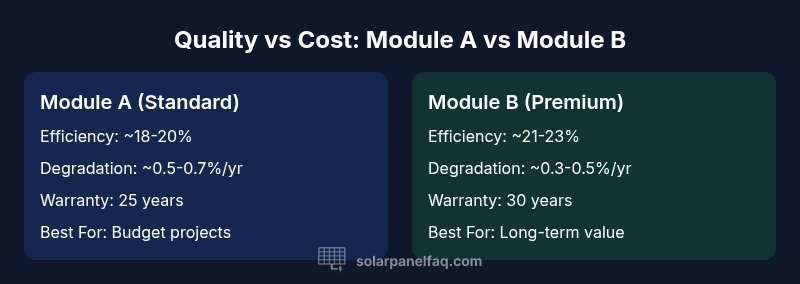
| Feature | Option A (Standard) | Option B (Premium) |
|---|---|---|
| Efficiency | ~18-20% | ~21-23% |
| Degradation Rate (per year) | ~0.5-0.7% | ~0.3-0.5% |
| Temperature Coefficient | -0.35%/°C to -0.40%/°C | -0.25%/°C to -0.30%/°C |
| Warranty | 25-year product warranty | 25-30 year product warranty |
| Certifications | IEC 61215/61730, UL | IEC 61215/61730, UL, additional regional tests |
| Build Quality | Standard frame, basic anti-corrosion protection | Rugged frame, enhanced edge sealing, improved glare reduction |
| Best For | Budget-conscious projects | High-output, long-term value in sunny climates |
Strengths
- Clear value proposition for budget-conscious buyers
- Good availability and broad installer support
- Strong warranties on mid-range to premium panels
- Better long-term energy yield in hot climates
Drawbacks
- Premium modules carry higher upfront costs
- Quality varies by brand and supply channel; vetting needed
- Dealing with multiple certifications can be confusing
- Some regions have limited access to top-tier brands
Premium modules win on long-term quality and performance; standard modules offer solid value for budget-focused projects
Choose premium panels if you want maximum efficiency, slower degradation, and stronger warranties. Opt for standard modules when upfront cost matters more than marginal gains in energy output over the system life.
Frequently Asked Questions
What defines solar panel quality?
Quality is defined by durable materials, reliable manufacturing, proven performance, and credible warranty terms. It combines efficiency, temperature tolerance, and long-term degradation with third-party certifications and transparent QA data.
Quality means durable materials, consistent performance, and solid warranties backed by independent testing.
Do higher efficiency panels always outperform cheaper ones?
Not always. Higher efficiency often comes with higher cost and sometimes reduced performance in non-ideal conditions. Real-world yield depends on temperature, shading, and system design, so compare efficiency alongside degradation and warranty.
Higher efficiency is good, but consider climate and cost. Real-world yield matters most.
What certifications should I look for?
Look for IEC 61215 and IEC 61730 for performance and safety, UL certifications where applicable, and third-party test reports. Certifications help confirm product reliability and cross-market acceptance.
Check for IEC certifications and third-party tests to verify reliability.
How long do solar panels typically last?
Most panels are designed for 25 years of warranty-supported performance, with degradation over time. Actual lifespan can extend beyond warranty if properly maintained and installed.
They’re built to last decades, with performance guaranteed for about a quarter-century.
Does climate affect quality signals?
Yes. Temperature coefficients and moisture resistance influence how a panel performs in hot, humid, or freezing conditions. Choose modules rated for your climate and ensure proper installation details to maximize durability.
Climate matters—pick panels rated for your conditions and ensure proper installation.
What data should I collect to compare panels?
Collect datasheet values (efficiency, degradation, temperature coefficient), warranty terms, certification documents, and independent test reports. Create a standardized scoring rubric to compare apples to apples.
Gather datasheets, tests, and warranties, then compare with a consistent rubric.
Top Takeaways
- Evaluate efficiency, degradation, and warranty together
- Check independent certifications and QA documentation
- Balance upfront cost against expected lifetime energy yield
- Match panel quality to climate and site conditions
- Request complete datasheets and service terms from suppliers