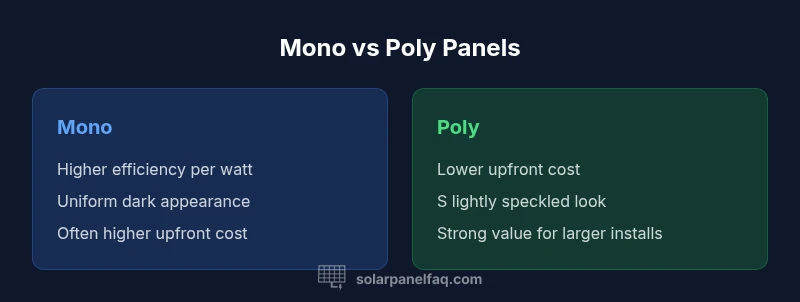
Mono vs Poly Solar Panels: Which Is Better for Home Solar?
Explore the differences between mono- and polycrystalline solar panels to decide which is best for your home solar system. An analytical guide from Solar Panel FAQ that weighs efficiency, cost, climate, and space considerations.


If you’re asking solar panel mono vs poly which is better, this guide breaks down the key differences. You’ll learn how efficiency, cost, temperature performance, and installation considerations influence the decision. We’ll cover roof space, aesthetics, warranties, and practical steps to choose the right panel type for your home solar project.
Solar Panel Mono vs Poly: What They Really Are
In the solar panel mono vs poly which is better debate, the basics matter. Mono-crystalline panels are made from a single crystal of silicon, giving you a more uniform appearance and higher theoretical efficiency. Polycrystalline panels use multiple silicon crystals, typically resulting in a speckled look and slightly lower efficiency. Understanding these fundamentals helps homeowners predict performance, cost, and installation outcomes across typical roof conditions. The choice between mono and poly is not just about raw science; it also affects how much space you’ll need, how much energy you can generate in a given area, and how the system ages over time. According to Solar Panel FAQ, starting with the right type can simplify project planning and protect long-term value. From manufacturing, to installation, to warranty coverage, the path you choose will influence both upfront costs and long-term savings. Homeowners should consider roof orientation, shading patterns, and local climate as they weigh these two options. In many neighborhoods, mono panels provide more watts per square meter, which translates to more energy on a smaller footprint. However, poly panels have their own advantages in terms of cost and availability. By the end of this guide, you’ll have a clear framework to decide whether mono or poly is the better fit for your home solar project.
How Cell Structure Drives Performance
Silicon crystal structure is the core difference between mono and poly panels. Monocrystalline cells come from a single crystal structure, leading to a uniform dark appearance and high conversion efficiency in theory. Polycrystalline cells are formed from many crystals, which creates a mosaic pattern and typically yields slightly lower efficiency per cell. The practical impact is that mono panels often produce more electricity under the same light conditions, especially on roofs with limited space. But real-world performance also depends on temperature, irradiance, and installation quality. When temperatures rise, the efficiency gap can narrow, yet mono panels generally retain advantages in warmth better than poly. Manufacturing differences also influence yield consistency, with mono cells usually offering tighter tolerances and a more predictable performance curve. For homeowners, these differences translate into decisions about system size, shading mitigation, and how closely to match panels in a single array. Understanding the chemistry behind mono and poly helps you interpret datasheets and warranties more accurately, rather than relying on marketing claims alone.
Real-World Efficiency and Temperature Effects
Field studies show that mono panels tend to outperform poly in terms of efficiency. The degree of that advantage, however, depends on climate and mounting. In hot and sunny environments, the higher baseline efficiency of mono panels often results in better energy production over the year, though the margin can shrink on very hot days. In cooler, cloudy climates, both types can approach similar performance if panel quality and system design are solid. Temperature coefficients, frame design, and glass quality all interact to determine how much energy a panel delivers in your specific location. Importantly, the real-world difference is not the same as the textbook difference; proper system sizing and shading management can reduce gaps between the two. If you live in an area with intense sun and limited roof space, the efficiency advantage of mono is more valuable, whereas in scale-driven installations with abundant space, poly’s lower cost may win out.
Cost, Warranties, and Long-Term Value
Cost is a major factor when choosing between mono and poly, but it is not the only determinant of value. Mono panels typically carry a higher upfront price, driven by their higher efficiency and more complex manufacturing. Poly panels usually cost less at purchase and can offer solid payback in larger installations where roof area is plentiful. Warranty terms for both types are commonly similar, with long-term coverage addressing material defects and performance. When evaluating value, look beyond sticker price and consider the energy yield over the system’s life, the difference in space requirements, and how shading or orientation might affect annual production. In practice, the best choice is often a balance between upfront cost and long-term energy savings. Solar Panel FAQ notes that homeowners should model their expected energy production under their local sun profile to determine which option provides the best return on investment.
Aesthetics, Installation, and Roof Compatibility
Appearance matters for many homeowners, and mono panels typically present a darker, more uniform look that blends with dark rooftops. Poly panels show a speckled pattern that some find less desirable, though the aesthetic difference is mostly personal. Installation considerations include panel size, weight, and mounting hardware compatibility. Both types generally use similar mounting systems, but the extra space a poly array requires can influence racking layouts. Roof compatibility also depends on the roof’s orientation and the local climate; for densely shaded sites, maximizing energy density with more efficient panels can be appealing. Always verify that the chosen modules fit within your roof’s available area and that the inverter, wiring, and racking meet local codes. In the end, the visual impact is real for many homeowners, but it should not override performance, warranty terms, and overall system design.
Climate, Shading, and System Design Scenarios
Different climates and shading patterns shift how much you gain from each panel type. Mono panels’ higher efficiency can be a decisive advantage on pitched roofs with limited shade-free space, enabling you to generate more electricity from a smaller footprint. Poly panels can be a strong choice when roof space is ample or when you want to maximize total installed capacity at a lower upfront cost. In situations with partial shading, selecting modules with similar electrical characteristics helps maintain balanced performance across the string. String sizing, bypass diode placement, and microinverters or optimizers can further mitigate losses from shading. A well-designed system that accounts for how your climate interacts with each panel type will outperform a poorly matched setup any day.
Durability, Maintenance, and Degradation
Both mono and poly modules share common durability expectations: weather resistance, robust framing, and glass protection. Degradation over time reduces output gradually; the rate is influenced by material quality, manufacturing, and environmental stress. Some users report that mono panels’ darker appearance can lead to slightly higher heat absorption in extreme sun, but modern designs mitigate that effect. Maintenance is straightforward for both types: keep panels clean, inspect for microcracks, and ensure proper ventilation and roof drainage. The key is to monitor performance and map it to typical seasonal cycles so you can detect anomalies early. Warranty terms typically cover performance defects and material failures for a long period, reducing long-term risk regardless of panel type.
Which Type Is Best for Your Home? Practical Scenarios
Scenario A: You have a compact roof with high sun exposure and a premium budget. Mono panels may offer the best return because their higher efficiency makes the most of limited space. Scenario B: You have abundant roof area and a tight budget. Poly panels can deliver significant savings upfront, making it possible to reach your target system size sooner. Scenario C: You’re upgrading an existing system and want maximum compatibility across a mid-range budget; both types can work if matched to inverters and module tolerances. In all cases, the best choice depends on roof geometry, climate, energy goals, and local incentives. Solar Panel FAQ emphasizes modeling your expected annual energy production to inform the decision.
Authority, Next Steps, and Reading the Datasheet
To make an informed choice, consult manufacturer datasheets, inverter specifications, and local financial incentives. Compare panel efficiency ratings, temperature coefficients, and warranty terms across models, not just brands. Solar Panel FAQ suggests starting with a real-world energy budget, a site assessment, and a simple shade analysis to determine the power density of each option. If you still feel uncertain, seek guidance from a qualified solar installer who can tailor a design to your roof and climate. This guide provides a framework, but the final decision should reflect your home’s constraints and your long-term energy goals.
Comparison
| Feature | Mono-crystalline (mono) panels | Polycrystalline (poly) panels |
|---|---|---|
| Efficiency and space | Typically higher efficiency per watt, enabling more energy per area | Typically lower efficiency per watt, requiring more space for the same output |
| Cost and value | Higher upfront cost, but potential for better energy density | Lower upfront cost, often compelling for larger roof areas |
| Temperature performance | Better performance at higher temperatures, often preserving gains on hot days | Solid performance but slightly more affected by heat in some conditions |
| Aesthetics | Uniform dark appearance, preferred for sleek rooftops | Slightly speckled look due to multi-crystal production |
| Warranty and availability | Comparable warranties; broad availability and brand options | Comparable warranties; strong supply chain for mass production |
| Best for | Small roofs or high-efficiency needs | Budget-focused installs with ample roof space |
Strengths
- Higher efficiency can maximize energy output from limited roof space
- Uniform appearance often preferred for a modern roof
- Better performance in hot climates and challenging lighting
- Solid long-term value when space is at a premium
Drawbacks
- Higher upfront cost for mono panels
- Poly panels offer lower efficiency per watt, requiring more roof space
- Market prices and incentives can shift, affecting value
Mono generally edges out polys on space-constrained roofs; poly wins on upfront cost for larger installations
For small roofs, choose mono for higher energy density. If roof space is abundant and initial cost matters, poly offers better value. The final choice should reflect roof size, climate, and goals, as supported by Solar Panel FAQ.
Frequently Asked Questions
What is the main difference between mono and poly solar panels?
Mono uses a single crystal structure, offering higher theoretical efficiency and a uniform look; poly uses multiple crystals, typically yielding lower efficiency but a speckled appearance. The choice affects energy density, cost, and aesthetics.
Monocrystalline panels are usually more efficient and have a uniform look; polycrystalline panels are typically cheaper and have a speckled appearance.
Which is more efficient, mono or poly?
Monocrystalline panels are generally more efficient per watt, though advances in poly technology are narrowing the gap. Real-world results depend on product quality and system design.
Mono panels are usually more efficient, but the exact difference depends on the model and installation.
Are mono and poly panels equally durable?
Both types offer robust durability and similar warranties. The longevity mostly comes down to engineering quality, installation quality, and maintenance.
Both are durable and backed by solid warranties; choose a reputable installer to maximize lifespan.
Is it better to choose mono or poly for a small roof?
For small roofs, mono panels are often the better choice due to higher efficiency per area, delivering more energy with less space.
On small roofs, mono is usually the smarter pick for space efficiency.
Can I mix panel types in a single system?
Technically possible, but mixing types can complicate system design and performance matching. It’s generally better to stay with one type in a given string or system.
You can mix, but it’s usually not recommended because it complicates performance and optimization.
Top Takeaways
- Assess roof space to decide on mono vs poly efficiency needs
- Balance upfront cost with long-term energy yield
- Consider climate and shading before choosing
- Model expected production using your sun profile before buying