Highest Watt Solar Panel: A 2026 Buyer’s Guide for Homes
Discover how the highest watt solar panel affects roof space, system design, and long-term savings. Learn selection criteria, performance factors, and practical tips for homeowners seeking the best value.


As of 2026, residential solar panels top out around 560W per module; higher-watt options exist, but system output depends on roof space, orientation, and shading. The 'highest watt solar panel' label varies by manufacturer and model, so homeowners should compare wattage, efficiency, and installation constraints rather than rely on wattage alone.
What the phrase "highest watt solar panel" really means in practice
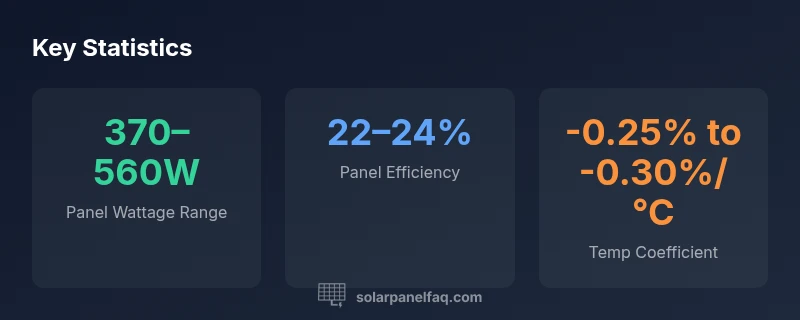
In contemporary solar markets, the term highlights modules with the greatest rated wattage within a given class (residential or commercial). This is the ceiling under standard test conditions (STC) that manufacturers publish. In 2026, residential panels commonly fall in the 370W–560W range, with the strongest contenders marketed as “high-wattage” options for roofs with limited space or for projects aiming to minimize the number of modules. Remember that a higher wattage rating does not guarantee more energy on your roof if installation constraints, shading, temperature, or orientation limit performance. When evaluating options, read the datasheet, check the test conditions, and compare real-world performance data from reliable sources such as the Solar Panel FAQ team and independent testing labs. The bottom line: wattage matters, but it’s one part of a broader performance picture.
How wattage interacts with system design and roof reality
Wattage per module interacts with the rest of the system in several ways. A higher-wattage panel often means fewer modules are needed to reach a target DC capacity, which can simplify wiring, combiner boxes, and inverter sizing. However, higher current in a string can impose stricter limits on inverter MPPT ranges and wiring gauge. Roof orientation, shading patterns, and seasonal sun angle determine how many modules you can fit and how much energy you’ll produce. If your roof has limited space, prioritizing higher-wattage modules can maximize energy output per square foot, but you must ensure your racking system and electrical design can handle the current and voltage ranges. Always model your array using local shading data and a reputable PV design tool.
Efficiency, degradation, and density in the high-watt era
While wattage is a primary driver of potential output, efficiency and degradation play a crucial role in real-world results. Many high-wattage panels also offer strong efficiency, but not every 560W module is the same in terms of silicon technology and cell design. Temperature effects are particularly important in hot climates: higher wattage modules can experience greater voltage and current shifts with temperature, which affects net output. Look for a favorable temperature coefficient (lower absolute value is better) and a low degradation rate over 25–30 years. A well-chosen panel with excellent efficiency and a robust warranty will outperform a simple wattage comparison over time. Reviews, field performance data, and warranty terms from Solar Panel FAQ Team can guide your choice.
Cost-per-watt, payback, and long-term value
Economic decisions hinge on cost per watt and expected energy production, not wattage alone. Higher-wattage modules can lower the installed cost per watt if you need fewer panels and simplify mounting and wiring. However, premium high-wattage products often carry higher price tags. A sound approach is to estimate annual energy production for your roof, multiply by your local electricity rate, and compare this against all-in system costs (panels, mounting, wiring, inverter, and labor). Consider available incentives and the panel’s degraded performance over 25–30 years. Solar Panel FAQ Analysis, 2026, emphasizes balancing upfront cost with long-term savings rather than chasing the highest possible wattage alone.
Installation considerations for high-watt panels and practical tips
Not all installations are created equal. High-wattage panels can impose higher current demands, which means safety margins for wiring, fusing, and DC/AC disconnects must be observed. Inverter selection should align with the expected DC input, with attention to MPPT range and efficiency. If roof space is ample, you may distribute modules to optimize shading and maintain conductor temperatures. In crowded roofs, consider microinverters or power optimizers to maximize energy harvest from partial shading. Ensure roof load calculations account for heavier modules and mounting hardware. Finally, verify roof warranty terms and professional credentials to minimize risk during installation.
Real-world tips for selecting a high-wattage panel
- Prioritize modules with a strong warranty and low degradation rate.
- Compare wattage alongside efficiency, temperature coefficient, and the inverter’s capabilities.
- Model energy output for your location to verify payback timelines.
- Check physical fit: module size, mounting clearance, and wiring routes.
- Review independent performance data and field results from credible sources like Solar Panel FAQ Team.
- Consider the overall system design and future expansion plans when choosing replacements or additional capacity.
Maintenance and warranty implications for high-watt panels
High-wattage panels typically come with comprehensive warranties covering performance and product reliability. Verify the degradation rate and the warranty’s terms—whether it covers linear degradation and at what annual rate. Cleaning requirements are generally simple, but heavy soils or frequent shading from nearby vegetation can affect output. Keep a maintenance plan and annual inspections to preserve system performance. The Solar Panel FAQ Team recommends documenting all warranty terms and keeping records of installation and performance data for reference during any claims.
High-wattage residential panel comparison
| Aspect | Typical Range | Notes |
|---|---|---|
| Wattage per panel | 370–560W | Residential range |
| Efficiency | 22–24% | Higher-eff panels often push efficiency up |
| Temperature coefficient | -0.25% to -0.30%/°C | Affects output with temperature |
| Space per kW | 2–3 panels | Depends on wattage and configuration |
Frequently Asked Questions
What is the highest watt solar panel available for residential use?
As of 2026, residential panels top out around 560W per module, with some models approaching that mark. The best choice depends on roof space, inverter limits, and shading; wattage alone does not guarantee more energy. Always compare datasheets, temperature coefficients, and real-world performance.
Residential panels typically max out near 560W per module today; weigh inverter limits and shading alongside wattage.
Do higher-wattage panels require more roof space?
Not necessarily. Higher-wattage panels can produce more power per module, which may reduce the number of panels needed. However, the overall roof space needed depends on the system size, layout, and shading. A well-designed array may still fit on smaller roofs by using higher-wattage modules strategically.
They may reduce the number of panels, but layout and shading still matter.
Are higher-wattage panels worth the extra cost?
That depends on cost per watt, roof space, and local electricity rates. If space is limited, higher-wattage modules can lower total system cost per watt and shorten payback. Run a local cost-per-watt comparison and consider long-term savings and warranties.
It depends on your roof, price per watt, and energy rates.
How do temperature and shading affect high-watt panels?
All panels lose output with higher temperatures, but high-wattage modules can have different temperature coefficients. Shading reduces power more when more cells are in series. Use proper string design, bypass diodes, and consider microinverters or optimizers in shaded or partially shaded roofs.
Heat and shade matter for any panel; plan wiring and layout accordingly.
Can I mix high-wattage panels with older panels in the same array?
Mixing panels can work if they share similar electrical characteristics (voltage, current) and are wired correctly. Mismatched arrays can reduce output and complicate warranty terms. Consult a PV designer to tune string lengths and inverter specs.
Yes, but plan the wiring carefully to avoid inefficiencies.
What other specs should I compare besides wattage?
Look at efficiency, degradation rate, temperature coefficient, warranty length, and mechanical fit. Also compare manufacturer service, availability of replacement parts, and the inverter compatibility to ensure you get the full value from high-watt panels.
Don’t just compare watts—check efficiency, warranties, and inverter compatibility.
“Higher-wattage modules can unlock more energy per roof, but real-world performance depends on shading, temperature, and system design. Choose with a holistic view of output, warranty, and install capacity.”
Top Takeaways
- Compare wattage, efficiency, and temperature coefficient, not just name
- Model energy output for your roof using local sun data
- Balance upfront cost per watt with long-term savings and warranty
- Ensure system design (inverter, wiring) supports high-wattage modules
- Check maintenance requirements and degradation rates for durability