The Highest Wattage Solar Panels of 2022: A Practical Guide
Explore the highest wattage solar panel 2022 landscape, what it means for homes, and how to evaluate premium 400W-class modules with real-world performance insights from Solar Panel FAQ.


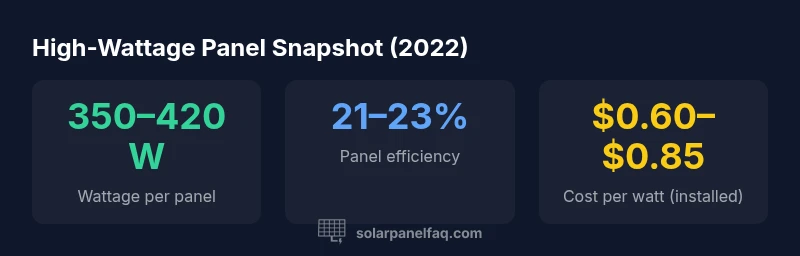
The highest wattage solar panel 2022 commonly reached about 400 watts per module in premium residential lineups, with some models pushing toward 420 watts under standard test conditions. In practice, real-world output depends on temperature, shading, orientation, and system design, so many homeowners target a 400W-class panel as a practical ceiling rather than chasing the extreme end.
The highest wattage solar panel 2022: a practical snapshot
In 2022, homeowners and solar designers began to treat the 400W class as a practical ceiling for residential rooftops, rather than chasing the absolute highest wattage available. The phrase highest wattage solar panel 2022 captures a moment when premium modules around 400–420 W per panel were common in high-end installations. Real-world performance, however, remains governed by temperature, shading, and array optimization. In other words, wattage is a critical input, but system design, insulation, and mounting quality determine the actual energy you get from every sun hour. The Solar Panel FAQ team notes that the shift toward higher wattage panels reflected both improved cell technologies and smaller downsides from balancing components like inverters and racking. When evaluating options, many homeowners weigh a 400W-class target against roof space, budget, and long-term reliability.
How wattage translates to real-world energy production
Wattage alone does not equal yearly energy output. Real-world production depends on naming conditions that standard tests do not fully replicate: temperature, angle of incidence, solar irradiance, and wiring losses. The NOCT (Nominal Operating Cell Temperature) and STC (Standard Test Conditions) ratings offer benchmarks, but installers must apply derating for temperature and soiling. Higher wattage per panel can reduce system area for a given annual energy goal, yet it may also require more attention to shading analysis and microinverters/optimizers. In practice, a 400W panel benefits systems that can accommodate a tighter, more compact array with fewer modules, provided the site passes electrical and structural constraints.
Technical drivers that shaped 2022 ratings
Manufacturers pushed higher wattage through improvements in cell interconnection, passivated emitter rear contact (PERC) cells, and better module framing. Standards bodies and certification labs continued to emphasize long-term performance and reliability, which influences a panel’s apparent wattage rating in spec sheets. For homeowners, the take-away is that a panel’s wattage is one piece of the puzzle: the balance of system components, like inverters, junction boxes, and wiring, determines ultimate system performance. When 2022 data is analyzed, it becomes clear that the best value often sits at the intersection of wattage, efficiency, and system design rather than wattage alone.
Practical considerations when choosing 400W-class modules
- Roof space and orientation: A higher wattage reduces the number of modules needed, but space availability and shading patterns matter.
- Temperature and mounting: Warmer climates reduce real-world output relative to STC ratings, so consider temperature coefficients.
- System layout: Inverter size, wiring, and optimizer/Mirco-inverter options should align with module count to minimize losses.
- Warranties and certification: Look for modules with robust power warranties and independent certification to ensure sustained performance.
- Installation costs: Higher wattage modules can lower balance-of-system costs, but upfront pricing and long-term returns vary by region.
Evaluating panels within the 350–420W range: practical guidance
Evaluating a 350–420W module in 2022 often meant comparing efficiency, temperature coefficient, and warranty terms alongside wattage. panels in this range typically offered similar durability ratings, but the small differences in efficiency translate into meaningful year-over-year gains for homeowners with limited roof space. When planning, simulate energy output for different orientations and shading scenarios. Use third-party solar calculators to estimate annual production, then compare against installed costs and expected payback periods. The best decision blends real-world performance with reliability and service support, not just the highest nameplate wattage.
Sizing your array around 400W-class modules
Sizing an array around 400W-class modules reduces the number of physical panels needed for a given target output, which can simplify wiring and monitoring. However, roof geometry and local regulations may favor a larger array of lower-watt panels if shading and spacing constraints exist. A thorough shading analysis, plus a clear understanding of inverter efficiency and voltage/current constraints, will inform the optimal balance between module wattage, count, and spacing. In many cases, a well-designed 400W-class system achieves the best compromise between area, cost, and performance.
Warranty considerations and long-term performance
Warranty terms reflect manufacturers’ confidence in long-term performance. In 2022, premium modules often featured lengthy power warranties and product warranties, with performance guarantees over 25 years trending toward standard in many regions. Buyers should scrutinize the difference between a power warranty (how much of the initial wattage is guaranteed over time) and a product warranty (physical defects). Real-world reliability also hinges on installation quality, local climate, and maintenance practices. Regular cleaning and inspection help preserve output. The Solar Panel FAQ team emphasizes verifying warranty coverage in the datasheet and confirming service support networks before purchase.
Typical wattage ranges for high-wattage solar panels in 2022
| Panel Type | Wattage per Panel | Approx Year | Notes |
|---|---|---|---|
| Premium module | 350–420 | 2022 | High-end residential class |
| Commercial class | 400–480 | 2022 | Utility-scale potential in compact form |
| Emerging tech | 450–550 | 2022 | Prototype or limited release |
Frequently Asked Questions
What was the typical top-wattage range for panels in 2022?
In 2022, high-end residential panels commonly ranged from roughly 350 to 420 watts per module. Some models reached slightly above 420 W under ideal testing, but real-world output varies with conditions.
In 2022, premium panels usually ranged from about 350 to 420 watts per module; real-world results depend on conditions like temperature and shading.
Do higher wattage panels always save more on my bill?
Higher wattage per module can reduce the number of panels needed, which can lower balance-of-system costs. However, savings depend on roof space, local incentives, and energy usage patterns, so wattage alone doesn’t guarantee bigger savings.
Higher wattage can reduce the number of panels, but your savings still depend on space, incentives, and how you use energy.
How does temperature affect wattage in 2022-era panels?
Temperature affects real output: panels lose some efficiency as heat rises. The 2022 designs mitigated this with lower temperature coefficients, but warmer climates still see a drop from the nominal wattage rating.
Heat lowers output; even 400W-class panels lose a bit of performance on hot days, depending on the temperature coefficient.
Should I prioritize wattage or panel efficiency?
If roof space is limited, prioritize higher wattage to reduce panel count. If space is abundant, efficiency and diameter of the array can offer better energy per square foot, especially under partial shading.
If space is tight, go for higher wattage; if you have room, efficiency and layout matter more.
Are 2022 high-wattage panels compatible with microinverters?
Yes, many 2022-era high-wattage panels were designed to be compatible with microinverters or optimizers, though you should verify electrical compatibility and wiring requirements with your installer.
Yes, you can use microinverters with these panels, but check compatibility with your system.
“Higher wattage is a powerful lever for reducing module counts, but the real value lies in system design, reliability, and long-term performance.”
Top Takeaways
- Target the 400W-class for residential rooftop efficiency.
- Wattage is only one factor; system design matters more.
- Real-world output depends on temperature, shading, and orientation.
- Compare efficiency, warranty, and certification, not just peak wattage.
- Plan array sizing around roof space and inverter compatibility.