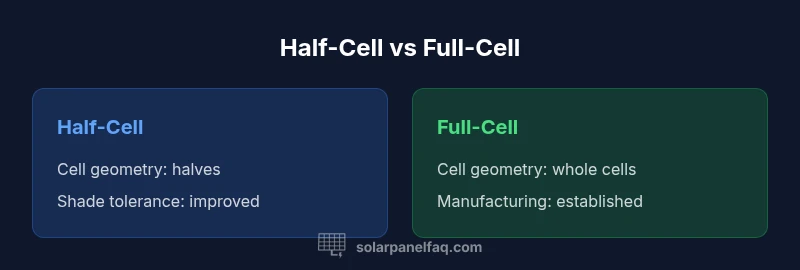
Half-Cell Solar Panel vs Full Cell: An Objective Comparison
A detailed, objective comparison of half-cell solar panels versus full-cell designs, focusing on efficiency, shading resilience, manufacturing complexity, lifecycle impact, and real-world performance for homeowners and solar buyers.


Half-cell panels generally reduce shading losses and resistive heating by splitting cells in two and wiring them in smaller strings, boosting real-world performance. Full-cell designs emphasize established manufacturing and cost competitiveness. Overall, half-cell panels are often the better choice for roofs with partial shade or where long-term efficiency matters, while full-cell options remain strong for budget-focused installs.
What half-cell solar panel vs full cell means
In photovoltaic technology, there are two prominent approaches to wiring silicon cells inside a module: half-cell designs and full-cell designs. The phrase half-cell solar panel vs full cell captures this contrast. Half-cell solar panel vs full cell refers to cutting standard solar cells in half and connecting them in series to form the module. This change in geometry reduces forward current in each string, which can lower resistive losses and improve shading resilience. According to Solar Panel FAQ, half-cell configurations also distribute heat and microcracks more evenly across the panel, potentially improving durability. For homeowners evaluating a rooftop system, understanding this distinction helps translate lab measurements into real-world performance.
However, the distinction is not a guarantee of higher efficiency in every climate; performance depends on the overall module design, quality of materials, and system configuration. In many cases, the choice is driven by supply chain factors, warranty terms, and installer familiarity. The right selection aligns with roof orientation, shading patterns, and long-term energy goals. Solar Panel FAQ emphasizes that while half-cell designs can improve shading resilience, differences may shrink in uniform sun conditions. The key is to assess how the module behaves across a typical seasonal cycle for your home.
Historical context and design rationale
Two major ideas shaped the development of half-cell and full-cell panels. First, engineers sought to reduce current in each circuit path to minimize resistive losses and hotspot risk. Second, manufacturers explored ways to improve shading tolerance without sacrificing reliability. Historically, full-cell modules dominated the market due to manufacturing simplicity and established supply chains. Over time, half-cell modules emerged as a premium option offering real-world gains in partial shade and higher voltage operation per string, which can help with inverter efficiency and balance-of-system performance. These shifts reflect evolving manufacturing capabilities, quality controls, and customer demand for better field performance. While full-cell panels remain common, many suppliers now offer both designs with warranty support tailored to the technology.
How half-cell geometry affects electrical performance
Half-cell designs slice standard cells in half along their midline and connect the halves in parallel strings to form the module. This reduces the current per string, which lowers I²R losses and reduces the likelihood of hotspot formation under shading. The result can be improved shaded-area output and a more uniform temperature profile across the panel. From an electrical standpoint, half-cell modules can sustain higher voltages for a given string length, which can influence inverter choice and dc-to-ac conversion efficiency. The trade-off is that the manufacturing process is more intricate, requiring careful handling of cell halves and precision soldering to avoid microcracks. In practice, real-world performance depends on module quality, cell quality, and the balance-of-system.
Real-world performance: shading, temperature, and durability
Shade is the primary enemy of solar output. Half-cell panels typically show a smaller performance drop when part of the panel is shaded because the current path is split across multiple strings. This translates into better energy yield on partially shaded roofs or complex roof designs. Temperature coefficients also matter: lower current paths in half-cell modules can help reduce thermal stresses and leakage in high-temperature conditions. Durability depends on the robustness of solder joints, encapsulation, and frame integrity. Both designs, when built to quality standards and with proper installation, offer long service lives and reliable warranties. The practical verdict often hinges on local climate and roof geometry more than the design label alone.
Manufacturing complexity and reliability
Half-cell panels demand a more sophisticated manufacturing process, including precise cutting, handling of delicate halves, and more complex interconnections. This can translate into tighter quality controls and, occasionally, higher production costs. Full-cell panels benefit from decades of established production lines and wide supplier ecosystems, which can translate into lower purchase prices and easier sourcing of replacement parts. Reliability for both technologies depends on module construction, glass, encapsulant, frame materials, and the integrity of junction boxes. Modern manufacturing practices, robust testing, and standardized warranties mitigate most reliability concerns for either design, provided you buy from reputable brands and ensure proper installation.
Cost considerations and value proposition
Cost dynamics for half-cell versus full-cell modules hinge on supply chain maturity, manufacturing complexity, and demand. Half-cell modules often command a premium in the market because of their shading advantages and perceived performance benefits, but the premium can be offset by higher long-term energy yield in certain roofs. Full-cell panels generally offer lower upfront costs and broad availability, making them attractive for installations with straightforward shading profiles and budget constraints. When evaluating value, homeowners should look beyond sticker price and consider performance under typical conditions, warranty terms, and expected system payback. A well-structured comparison should convert lab efficiency into real-world energy production estimates for the specific roof.
Durability and warranty considerations
Durability is a function of materials, assembly quality, and protective coatings. Both half-cell and full-cell modules can feature similar warranty terms and expected lifespans when sourced from reputable manufacturers. Some providers offer extended warranties or performance guarantees tailored to the specific design, which can influence long-term confidence. In practice, the durability gap between the two designs is minor when high-quality components and correct installation are used. Homeowners should review warranty coverage for power output, materials flaws, and workmanship, and verify how performance guarantees are measured over 25 years or more.
Which scenario is best for half-cell vs full-cell
If your roof has significant shading from trees, chimneys, or adjacent structures, half-cell panels are often the better choice due to their improved shading tolerance and higher field performance. For roofs with uniform sun exposure, or if upfront cost is a dominant consideration, full-cell modules can deliver reliable energy at a lower initial price. Large commercial installations sometimes favor full-cell designs for existing supply chains, while residential projects in mixed climates may benefit from half-cell options. The best decision comes from a site-specific assessment that includes roof orientation, shading map, local climate, and energy goals.
Installation and compatibility considerations
Installation practices for both designs should follow best-in-class mounting, sealing, and wiring standards. Inverters and optimizers can affect the relative benefit of half-cell designs, as some systems may exploit higher string voltages or different current paths more effectively. It’s important to confirm compatibility with mounting hardware, racking, and electrical safety standards. A qualified installer can model expected production for your roof using shading simulations and temperature profiles to quantify the real-world advantage of one design over the other.
Environmental impact and lifecycle considerations
From a lifecycle perspective, both designs contribute to reduced fossil fuel use when integrated into a well-designed system. Material choices, recyclability, and manufacturing emissions influence the environmental footprint. Half-cell modules, with their higher manufacturing complexity, may have slightly different embodied energy profiles, but this can be offset by higher energy yield in challenging conditions. Solar Panel FAQ notes that buyers should consider end-of-life recycling options and manufacturer commitments to responsible production as part of the environmental assessment.
Practical steps to choose between them
Begin with a roof shading assessment and a quick energy simulation if possible. Gather quotes from multiple installers that clearly document their expected production under your site conditions for both designs. Compare warranties, maintenance requirements, and the availability of replacement parts over time. Consider local support and service networks, which can reduce long-term risk. Finally, factor in your household energy goals, climate, and roof design to determine which design aligns best with your payback expectations.
Real-world decision framework for homeowners
To decide between half-cell and full-cell designs, build a simple framework: (1) shading risk score for your roof, (2) up-front budget vs. long-term value, (3) warranty coverage, and (4) supplier reliability. Run a side-by-side energy estimate for typical sunny and partially shaded days. If shading risk is high and long-term performance is a priority, lean toward half-cell; if cost containment and rapid deployment drive the project, consider full-cell. Always corroborate with a reputable installer and verify the current market options for your region.
Comparison
| Feature | Half-cell solar panel | Full-cell solar panel |
|---|---|---|
| Cell arrangement | Half-cut cells interconnected in multiple strings | Whole standard cells in a single grid |
| Electrical performance | Lower current per string; reduced resistive losses | Higher current paths; straightforward circuitry |
| Shade tolerance | Better performance under partial shading | More sensitive to shading losses |
| Manufacturing complexity | More intricate manufacturing and handling | Established, simpler production lines |
| Durability/warranty | Comparable durability; some designs optimize for stress | Strong, with mature warranty terms |
| Cost per watt | Often premium due to manufacturing complexity | Typically lower upfront cost |
Strengths
- Improved shading tolerance in real-world conditions
- Potentially higher energy yield on partially shaded roofs
- Better voltage characteristics for certain inverter configurations
- Greater design flexibility for premium installations
Drawbacks
- Higher manufacturing costs can raise upfront price
- Limited availability in some markets
- Slower supply chains for certain suppliers
- Slightly more complex installation considerations
Half-cell panels are generally the better choice for shaded or challenging roofs; full-cell panels are strong when upfront cost and simplicity matter.
Choose half-cell if shading and long-term yield matter most. Choose full-cell if you prioritize lower initial cost and broad availability; both can work well with quality installation.
Frequently Asked Questions
What is a half-cell solar panel?
A half-cell solar panel divides standard silicon cells into two halves and connects them in multiple strings. This reduces current in each path, which can lower resistive losses and improve shading performance. The design aims to boost real-world energy yield, especially on partially shaded roofs.
A half-cell solar panel splits the cells to lower current in each path, helping with shade and efficiency. It’s a common option when shading is a concern.
Do half-cell panels perform better in shade?
Yes, half-cell panels typically show less output loss when portions of the panel are shaded. The split-cell design reduces the impact of shading on the overall string, helping maintain energy production. Real-world gains depend on module quality and installation specifics.
They usually perform better under shade because the design minimizes losses when part of the panel is shaded.
Are half-cell panels more expensive?
Half-cell modules often carry a premium due to their manufacturing complexity and performance advantages. However, some markets may still offer competitive pricing depending on supply and demand. Buyers should weigh potential long-term energy gains against upfront cost.
They can be pricier upfront because of their manufacturing, but long-term energy gains may offset the extra cost.
Do half-cell panels require special installation?
Installation is generally similar to full-cell panels but requires careful handling of the cut cell halves and connections. A qualified installer with experience in half-cell designs helps ensure reliability and warranty coverage. No radically different mounting or safety requirements are typically needed.
No special installation beyond proper handling of the halves; use a qualified installer.
How should I choose between half-cell and full-cell?
Start with your roof’s shading profile, budget, and local solar incentives. Compare producer warranties, system payback estimates, and installation support for both designs. If shading is common and you want higher real-world yield, lean toward half-cell; otherwise, full-cell may be sufficient.
Assess shading, cost, and warranties; pick half-cell for shade and long-term yield, otherwise consider full-cell.
What warranties apply to half-cell vs full-cell panels?
Warranty terms vary by manufacturer but typically cover product defects and performance over 20-25 years. Both designs can offer strong warranties if purchased from reputable brands. Always verify what is included in performance guarantees and how they’re measured over time.
Most warranties cover defects and performance for 20-25 years; verify details with the seller.
Top Takeaways
- Evaluate roof shading before choosing design
- Compare real-world performance estimates, not just lab tests
- Check warranties and installer support for both designs
- Factor long-term energy yield into the value proposition