Half-Cut Solar Panel vs Full Cell: Which Performs Best on Your Roof?
A detailed, objective comparison of half-cut solar panels and full-cell modules, covering design, efficiency, shading performance, price factors, and long-term reliability to help homeowners choose wisely.


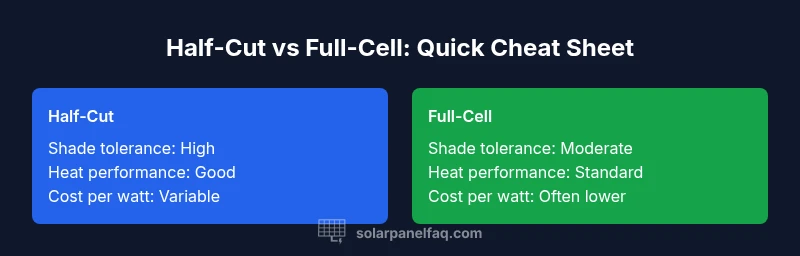
For most homeowners evaluating half cut solar panel vs full cell, half cut cells offer higher shade tolerance and lower mismatch losses, with slightly better performance in hot climates. However, full-cell modules remain cheaper per watt and can have fewer manufacturing defects. Overall, choose based on shading profile and budget.
How half-cut solar panel vs full cell differ in design
Both half-cut and full-cell solar modules are built from crystalline silicon cells, but the way those cells are manufactured and connected changes how the panel behaves under real-world conditions. In a half-cut design, each cell is cut in half, effectively creating two smaller cells per unit. This arrangement reduces the current in every path, which lowers resistive (I²R) losses and mitigates hotspot formation when shading or cell cracks occur. The full-cell variant uses intact standard-size cells, which are simpler to assemble and can be cheaper to manufacture at scale. The key takeaway is that half-cut cells trade a minor increase in manufacturing complexity for meaningful gains in shading tolerance, higher energy yield in certain climates, and more forgiving performance in partial shade scenarios.
What the term values mean in practice: defining the keyword half cut solar panel vs full cell
When people compare half cut solar panel vs full cell, they’re evaluating how cell segmentation affects current flow, wiring, and the way bypass diodes protect the module. In practice, the half-cut approach reduces the impact of shaded or degraded cells on neighboring cells, which helps preserve output in complex roof orientations or cluttered shading. For homeowners, this translates to steadier daily production across the sun’s arc, particularly when trees or neighboring structures create intermittent shade.
The historical context and why the difference matters
Historically, full-cell modules dominated the market due to straightforward fabrication and lower unit costs. As the industry matured, manufacturers began adopting half-cut designs to improve yield under partial shade and to enhance performance in hot climates. Solar Panel FAQ analysis shows that many under-roof scenarios benefit from the resilience of half-cut cells, while the cheapest options often remain full-cell modules. The result is a practical trade-off: better shading performance for half-cut, with potential cost savings favoring full-cell depending on supplier and installation scale.
Electrical performance: efficiency, shading, and hot spots
Cell architecture directly impacts how efficiently a module converts sunlight into electricity under varying conditions. Half-cut cells typically exhibit a higher bypass-protection margin and lower series resistance, which can translate into a higher fill factor under shade. In contrast, full-cell modules may show slightly more pronounced voltage losses when shaded but can deliver robust output under uniform sun. The practical effect is that half-cut designs often maintain more of their rated performance in partial shade or irregular illumination, while full-cell designs excel in clean, sunny roof sections.
Real-world energy yield and reliability under shade
The real-world performance gap between half-cut and full-cell modules becomes noticeable in partial shade. With half-cut cells, shaded sections impact fewer cells, reducing the risk of large-scale current bottlenecks. This yields a more linear response to shade and less dramatic dips in power during morning or late-afternoon sun. Reliability-wise, half-cut modules benefit from built-in protection against microcracks and hot-spot stress by distributing current more evenly, though high-quality full-cell modules still offer solid durability when properly engineered.
Cost, manufacturing, and supply considerations
Price is a critical factor in any solar project. Full-cell modules often have a lower upfront cost per watt in markets with strong scale manufacturing, but the gap can narrow or reverse as half-cut production scales up. The decision can hinge on supply chain choices, warranty terms, and the particular model’s cell efficiency and build quality. For many homeowners, the most important cost factor is the long-term value: energy yield over time, degraded performance, and maintenance expenses.
Mechanical fit: size, weight, frame, and installation
The physical footprint of half-cut and full-cell modules is typically similar, as both use standard mounting patterns and frame thicknesses. However, half-cut modules may permit more flexible busbar routing and wiring configurations, potentially enabling marginally higher module density on constrained roof spaces. Installers should verify racking compatibility, edge clearance, and mounting hardware guidelines for each model to ensure proper airflow and self-weight distribution.
Durability, degradation, and warranties
Degradation rates of solar modules depend more on construction quality than the decision to use half-cut versus full-cell architecture. High-quality half-cut modules can offer improved performance stability under shade, while robust full-cell modules can deliver consistent results under uniform sunlight. Warranty terms commonly span 10–25 years for materials and workmanship, with performance warranties ensuring a specified minimum output over time. Always compare the warranty details across models rather than relying on cell architecture alone.
Environmental impact and lifecycle considerations
Both half-cut and full-cell modules rely on similar supply chains for silicon, glass, and encapsulants. The environmental footprint is driven more by manufacturing energy intensity, material quality, and recycling practices than by whether the cells are half-cut or full-size. When evaluating sustainability, consider module efficiency, expected lifetime, and end-of-life recycling programs offered by the manufacturer.
Choosing by shading profile: best for different roof scenarios
Shading is the dominant practical variable many homeowners face. If your roof experiences frequent partial shading from trees, chimneys, or adjacent structures, half-cut modules tend to preserve output more effectively under those conditions. For roofs with long, unobstructed sun exposure and a budget-conscious plan, full-cell modules can offer compelling value, especially when sourced from reputable manufacturers with strong warranties.
System integration: inverters, strings, and configuration
The configuration of panels, inverters, and any microinverters or power optimizers affects how half-cut and full-cell modules perform as a system. Partial shading or hot spots can cause larger voltage mismatches in string-configured inverters; optimizing with microinverters or power optimizers can help both architectures, but half-cut modules often benefit more noticeably because their resilience reduces mismatch losses across the string.
How to compare models: a practical checklist
Create a side-by-side evaluation for each panel you’re considering: (1) shading tolerance and real-world yield, (2) thermal performance, (3) manufacturing quality and warranty terms, (4) upfront cost per watt, and (5) compatibility with your roof type and inverter. Use independent test data and model-specific performance curves rather than general marketing claims. This checklist helps ensure you choose a panel that aligns with your roof’s conditions and your long-term goals.
Common misconceptions debunked
A common myth is that half-cut cells always deliver higher efficiency. In reality, efficiency specs are product-specific and depend on many factors beyond the cell cut. Another misconception is that half-cut modules are only for high-end roofs; in fact, they can offer meaningful advantages on modest budgets when shade and temperature are significant concerns. Finally, some assume full-cell panels are universally cheaper—pricing varies widely by supplier and volume.
Comparison
| Feature | Half-cut solar panel | Full-cell solar panel |
|---|---|---|
| Cell architecture | half-cut cells (cells cut in half) to reduce current and losses | standard, intact full-size cells |
| Shade tolerance | improved due to distributed current paths | more susceptible to shading effects in practice |
| Electrical performance under heat | often better temperature coefficient and fill factor under shade | robust under uniform sun but can drop with hot spots |
| Manufacturing complexity | slightly more complex assembly due to halved cells | simpler manufacturing flow |
| Cost per watt | comparable or slightly higher depending on model | often lower upfront in high-volume markets |
| Reliability and warranty | comparable warranties with added resilience to hot spots | depends on quality; generally solid if well-made |
| Best use case | roofs with partial shading; hot climates; space-optimized layouts | open-sun roofs with uniform irradiance; budget-focused installs |
Strengths
- Improved shading tolerance reduces energy loss in partial shade
- Lower hotspot risk supports more stable daily yields
- Better performance in hot climates with partial shading
- Potential for higher system yield when shade is a factor
Drawbacks
- Often higher upfront cost per watt if model options are limited
- Slightly more complex manufacturing can limit supplier choices
- Cost advantage depends on scale and availability of models
Half-cut solar panels generally offer better shade resilience and real-world yield; full-cell panels remain a strong value option when shade is limited and budget is tight.
If your roof experiences partial shading or high temperatures, lean toward half-cut designs for steadier output. For sunnier, unobstructed roofs and budget pressure, full-cell modules can be the more cost-effective choice, especially with strong warranties.
Frequently Asked Questions
What is a half-cut solar panel and how does it differ from a full-cell panel?
A half-cut solar panel uses cells that are divided into two halves, reducing current in each path and improving shading tolerance. Full-cell panels use intact standard cells. The half-cut design helps minimize performance losses when some cells are shaded or cracked, potentially boosting real-world energy output.
A half-cut panel uses split cells to cut current paths, which helps it keep producing when parts are shaded. A full-cell panel uses full-size cells and is typically simpler to manufacture.
Are half-cut panels more efficient than full-cell panels?
Efficiency ratings are model-specific. Half-cut panels often deliver better shading tolerance and steadier output, which can translate to higher practical yield in partial shade. Under uniform sun, both types may perform similarly depending on the cell quality and system design.
Half-cut panels often perform better under shade, but the actual efficiency depends on the model and conditions.
Do half-cut panels cost more to buy or install?
Upfront cost per watt can be similar or slightly higher for half-cut panels, depending on manufacturers and volumes. Long-term value depends on energy yield, shading conditions, and warranty terms.
Upfront costs can be similar or a bit higher for half-cut panels, but long-term value varies with shade and warranties.
Which is better for a shaded roof: half-cut or full-cell?
Half-cut modules typically yield more consistent output on shaded roofs due to reduced current paths and better hotspot management. If shading is rare, either type can work well depending on price and warranty.
Half-cut panels tend to perform better when shading is a factor.
Will half-cut panels degrade faster than full-cell panels?
Degradation depends more on build quality, encapsulation, and environmental exposure than cell architecture. Both types can have long lifespans if sourced from reputable manufacturers and installed correctly.
Degradation is mainly about build quality, not just the cell type.
How should I decide between half-cut and full-cell for my home?
Start with your shading profile, roof layout, and budget. Compare model-specific performance data, take note of warranty terms, and consider system design options like microinverters or optimizers to maximize real-world output.
Look at shade, budget, and warranties, then compare model data and use optimizers if your roof has uneven shading.
Top Takeaways
- Assess your roof shading profile before choosing
- Weigh long-term yield against upfront cost per watt
- Prefer microinverters or optimizers for shaded layouts
- Compare model-specific data rather than general claims
- Check warranty terms and recycling options