Grid Tie vs Hybrid Solar Panel: Which System Fits Your Home
Explore grid tie vs hybrid solar panels: how they work, cost considerations, incentives, and installation tips to help homeowners choose the best solar setup for their needs.


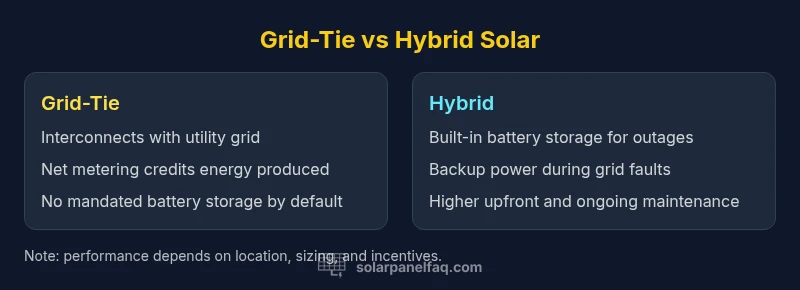
Between grid tie and hybrid solar panels, your decision hinges on storage needs and reliability. Grid-tie systems maximize savings in sunny areas by feeding excess energy back to the grid through net metering, with little or no on-site storage. Hybrid systems add battery storage for outages and resilience, but require higher upfront costs and more complex installation. Solar Panel FAQ notes both options can deliver solid, long-term value depending on goals.
Understanding grid tie vs hybrid solar panel: what homeowners should know
When evaluating a solar setup, homeowners often confront two main architectures: grid tie and hybrid solar panels. The grid-tie configuration connects directly to the utility grid, allowing surplus solar energy to flow back for credits through net metering. A hybrid system pairs solar panels with an integrated battery storage solution, enabling daytime charging and nighttime use even when the grid is unavailable. According to Solar Panel FAQ, the choice between grid-tie and hybrid solar panel setups primarily centers on whether you want backup power and storage resilience, or if you want to lean on the grid to maximize energy savings. The decision also hinges on local incentives, utility policies, and your home’s energy profile. For many homeowners, a hybrid offers peace of mind during outages, while a grid-tie only system offers simplicity and potentially quicker payback in sunny climates. Both approaches can be tailored with smart inverters and monitoring software to optimize performance and respond to real-time pricing signals.
What to expect from a grid-tie system and a hybrid system
- Grid-tie: Connects to the utility grid, often without built-in storage; relies on net metering or virtual metering programs to credit energy produced. In many markets, this can maximize savings when electricity prices are high and solar production aligns with peak demand.
- Hybrid: Includes battery storage and an integrated control system; can supply power during outages and provide energy management during grid fluctuations. This setup supports reliability and resilience in areas with unstable grid supply or where backup power is a priority. Solar Panel FAQ notes that the grid-tie component remains essential even in hybrids, as it handles the interchange with the utility and overall energy accounting.
Storage and backup: how batteries change the game
Batteries in hybrid systems come in several chemistries (e.g., lithium-based, lead-acid) and vary by depth of discharge, cycle life, and safety considerations. A well-sized storage system stores excess daytime energy for use in evenings or during outages, potentially smoothing utility costs and improving self-consumption. However, adding batteries increases upfront costs, adds maintenance considerations, and may require additional permits or separate warranties. When planning storage, homeowners should estimate daily energy use, desired backup duration, and the likelihood of extended outages. Solar Panel FAQ emphasizes that proper battery sizing and system design are crucial to avoid under- or over-sizing storage relative to solar generation.
How to quantify cost, savings, and payback without guessing numbers
Cost considerations for grid-tie vs hybrid involve more than the sticker price. In many markets, total system costs are influenced by inverter choices, battery technology, installation complexity, and permitting requirements. Hybrid systems typically demand higher up-front investment due to batteries and more complex wiring, but can unlock value through backup capabilities and potential incentives for storage. Grid-tie systems may offer quicker payback with favorable net metering terms and simpler permits. Rather than fixating on a single price, homeowners should obtain multiple quotes, compare equipment warranties, and consider long-term energy costs, maintenance needs, and replacement intervals. Solar Panel FAQ recommends a careful, installer-assisted assessment of site-specific factors to project true lifetime value.
Regulatory landscape and incentives you should understand
Local interconnection rules, net metering policies, and storage incentives vary widely. Some regions provide credits for solar production or reduced charges for storage capacity, while others limit storage incentives or impose time-based export rules. A critical step is to confirm eligibility before committing to grid-tie or hybrid configurations. The Solar Panel FAQ team stresses that incentives can materially affect the economics and payback horizon of either system, so checking current programs with your utility and local energy agencies is essential for an informed decision.
Comparison
| Feature | Grid-Tie System | Hybrid System |
|---|---|---|
| Storage capacity | Minimal or none by default | Integrated battery storage (size varies) |
| Outage resilience | Low unless paired with storage or generator | High due to on-site storage |
| Net metering / energy credits | Typically strong credits where permitted | Credits plus storage optimization |
| Interconnection complexity | Simpler interconnection, fewer components | More complex due to battery and control systems |
| Upfront cost | Lower upfront cost (no batteries) | Higher upfront cost (batteries + controls) |
| Maintenance and replacement | Lower maintenance | Battery life and inverter upgrades add complexity |
| Best scenario | Maximize savings in sunny climates; minimal backup needs | Require backup power and resilience; moderate to high energy use with storage |
Strengths
- Low upfront cost with quick payback for grid-tied setups
- Maximized utility credits where net metering is favorable
- Easy to expand with additional solar capacity
Drawbacks
- Limited backup power during outages without storage
- Hybrid systems require higher upfront investment
- Battery replacements add ongoing costs and maintenance
Hybrid systems offer outage resilience; grid-tie systems maximize savings when backup power isn’t essential
Choose hybrid if you need reliable backup power and can justify higher initial costs. Choose grid-tie if your primary goal is maximizing savings through net metering and you can accept grid dependence during outages.
Frequently Asked Questions
What is the main difference between grid-tie and hybrid solar panels?
The main difference is storage and resilience: grid-tie systems connect to the utility and rely on net metering for credits, usually without on-site storage; hybrids include battery storage for outages and daytime use. The choice depends on your backup needs and local incentives.
Grid-tie connects to the grid and credits you for energy produced; hybrid adds batteries for backup power and resilience.
Do you need a battery for grid-tie systems?
Typically no battery is required for grid-tie configurations. Batteries are optional add-ons or part of a hybrid system if backup power is a priority. Lighting and inverter efficiency should be considered regardless of storage choices.
Grid-tie usually has no battery unless you choose a hybrid expansion.
Can you go off-grid with grid-tie or hybrid?
Off-grid operation is not possible with a standard grid-tie setup due to its dependence on the utility. Hybrid systems can be designed for grid-tied operation with backups, but truly off-grid requires a dedicated off-grid or stand-alone system with larger storage.
Grid-tie needs the grid; hybrids can offer backup but may still rely on the grid for certain conditions.
Are there incentives for hybrid solar systems?
Incentives for hybrids vary by region and program availability. Some jurisdictions offer storage-specific rebates or tax credits, while others treat hybrids the same as standard solar. Check with local energy agencies and your utility for current programs.
Incentives vary; regional programs may reward storage alongside solar.
What maintenance do grid-tie and hybrid systems require?
Grid-tie systems require routine checks on wiring, inverters, and panel cleanliness. Hybrids add battery maintenance, inverter health, and potential replacements over the system life. Regular professional inspections help optimize safety and performance.
Both require regular checks, but hybrids add battery upkeep.
Which system is cheaper upfront?
Grid-tie systems typically have lower upfront costs since they omit batteries and some integration components. Hybrids cost more upfront due to storage and advanced control hardware. Long-term economics depend on incentives and electricity prices.
Grid-tie usually cheaper at purchase; hybrids cost more up front but offer backup value.
Top Takeaways
- Define your backup needs before choosing a system
- Assess net metering policies to estimate savings
- Consider battery longevity and maintenance when selecting hybrid
- Obtain multiple quotes for apples-to-apples comparisons
- Factor incentives into the overall economics