What is Solar Panel Price in India? A Homeowner's Guide (2026)
Explore current solar panel price trends in India, including per-watt costs, installation charges, subsidies, taxes, and tips to compare quotes for homeowners.


According to Solar Panel FAQ, solar panel prices in India are not fixed. They vary by wattage, brand, installation complexity, and available subsidies. You should expect price ranges rather than a single figure, with final costs influenced by incentives, GST, and regional installers. Net metering eligibility and contractor benchmarks also shape final quotes. This quick answer gives a framework to understand the typical price landscape in 2026.
What is the price landscape for solar panels in India?
The price landscape for solar panels in India is shaped by a three-part reality: upfront module costs, balance-of-system (BOS) components, and installation charges. For homeowners, the key is to understand that the figure you see on a quote is not a single sticker price; it combines several line items that differ by brand, wattage, and project specifics. According to Solar Panel FAQ, the price journey starts with the module's price per watt, which varies by efficiency and color, then adds BOS items like mounting hardware, wiring, and inverter, and finally includes labor and commissioning. This means two quotes for the same wattage can look very different if one includes a higher-efficiency module, a larger inverter, or a more complex rooftop mount. Additionally, incentives, GST, and state policies can shave the total cost, sometimes substantially. For 2026, expect a broad price spectrum rather than a single fixed number, and plan to compare quotes on apples-to-apples bases.
Key price components that determine the sticker price
Understanding what drives price helps homeowners avoid sticker shock. The core components are: modules (the solar panels themselves), balance-of-system (BOS) hardware (inverter, mounting rails, wiring), installation labor, and soft costs (permits, inspection fees, and taxes). Module efficiency and brand affect cost per watt directly. Higher-efficiency modules usually cost more per watt but may deliver more energy per year, potentially lowering payback time. BOS costs depend on roof type, mounting complexity, and whether microinverters or a string inverter is chosen. Regionally, installation labor rates and transport costs vary, influencing the final per-watt price. There is also GST and state-level incentives to consider; whenever you receive a quote, confirm whether these costs are included and whether subsidies apply to your project. Finally, maintenance, warranties, and performance guarantees influence the long-term value, even if they don’t immediately alter the upfront price.
How subsidies and policies influence pricing in India
Policy and subsidy environments shape affordability. The Indian government and state agencies offer schemes that reduce upfront costs, boost efficiency, or accelerate payback. Subsidies can come as direct rebates, reduced tax rates, or favorable financing options. It’s essential to understand how GST applies to solar equipment, and whether net metering policies affect your system size or bill savings. Subsidies and incentives may vary by state, and some programs require installation within a specified timeline or by approved installers. The net result is price compression in some regions and price stability in others. Solar Panel FAQ Analysis, 2026 notes that policy clarity and timely subsidy reception play a significant role in the realized cost of a residential solar system, especially for first-time buyers. Homeowners should check current state programs in their area and work with reputable installers who can help navigate the paperwork.
Regional variation and installation costs across states
Costs are not uniform across India. Coastal and northern states often have different labor costs and transport considerations than central or southern states. Roof type and structural considerations also drive price fluctuations; a flat roof can simplify mounting, while a terraced rooftop may require additional safety measures and scaffolding. Additionally, local incentives or rebates can tilt the math in favor of one state over another. Buyers should therefore obtain several quotes from installers who operate in their city or district and ask for a breakdown by line item. The bottom line is that the same installed system can have a noticeably different price tag depending on your location, the installer’s footprint, and the specific rooftop conditions.
How to read a price quote: per watt vs per kW and other metrics
The most common way prices are presented is per watt (₹/W) or per kilowatt (₹/kW). Per-watt pricing makes it easier to compare modules across brands, while per-kW pricing helps when you are evaluating total system capacity. When you receive quotes, ensure both module price and BOS are itemized and labeled clearly. Watch for hidden costs such as:
- GST on equipment and services
- Inverter upgrade options
- Structural reinforcement or scaffold charges
- Commissioning and testing fees
Also check whether savings estimates assume a certain number of sun-hours or energy tariffs. A quote that seems cheap at the panel level may not deliver expected returns if BOS costs are high or if the warranty terms are weak. The goal is apples-to-apples comparison and a transparent view of maintenance costs over time.
Practical price scenarios for common homes
Scenario A: Small rooftop system for a typical apartment or hybrid home with moderate daytime usage. Module cost plus BOS per kW might land in a lower-end range, while installer charges stay moderate due to straightforward mounting. Scenario B: Mid-sized family home with a larger array and a high-efficiency module. Upfront price per kW increases with module choice, but higher energy generation can shorten payback. Scenario C: A large, sun-rich house with multiple roof faces and shading considerations. Complex installation can push BOS costs higher, but government programs and group-bargained quotes may offer savings. The key takeaway is to focus on the installed cost per kW and to evaluate energy production over 20 years to estimate ROI.
How to compare quotes effectively: a checklist
- Ask for a line-item breakdown (modules, BOS, installation, taxes, permits)
- Compare on a per-watt basis, not just total price
- Verify warranties: module, inverter, and workmanship
- Check installer reputation and post-sale support
- Confirm subsidies, rebates, and net metering eligibility apply to your project
- Request performance estimates and a production guarantee
- Get multiple quotes from certified installers to benchmark pricing
- Consider financing options and total cost of ownership over the system life
Common myths about solar panel pricing in India
Myth: The cheapest option is always best. Reality: long-term energy savings and reliability depend on module quality and system design, not just upfront price. Myth: Subsidies cover most of the cost. Reality: subsidies help but are not universal; the net cost after incentives varies by state and applicant. Myth: All installers quote the same price. Reality: quotes differ due to equipment choices, warranties, and installation complexity. Myth: Solar is too expensive in India. Reality: for many homeowners, the long-term energy savings and government incentives make solar pricing economically viable, especially in sunny regions with high tariff parity.
Next steps: planning and ROI considerations
Start with a home energy assessment to estimate your annual consumption and peak demand. Use this to define the required system size and energy generation targets. Gather quotes from multiple installers, focusing on per-watt pricing and total installed cost. Review warranties, service plans, and the installer’s track record. Run a simple ROI calculation using your old electricity tariff against expected solar generation and the anticipated payback period. With careful planning and a clear understanding of price components, homeowners can identify a price point that balances upfront cost with long-term savings.
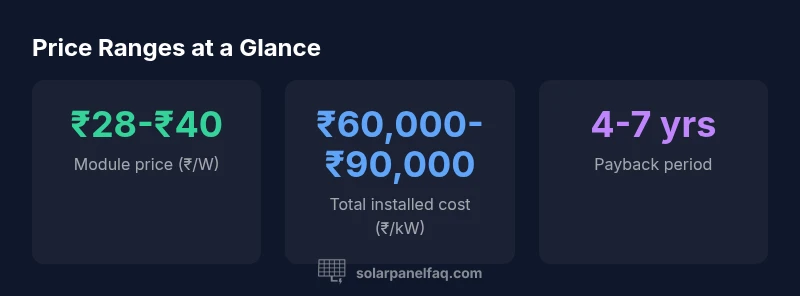
Estimated price ranges for residential solar panels in India (indicative). Sources: https://mnre.gov.in, https://cea.nic.in, https://iea.org
| Component | Typical Range (₹) | Notes |
|---|---|---|
| Module price (per watt) | ₹28-₹40 | Depends on efficiency and branding |
| Balance of System (BOS) and installation (per watt) | ₹20-₹35 | Includes mounting, wiring, inverter |
| Total installed cost (per watt) | ₹48-₹75 | Sum of module + BOS + taxes/fees |
Frequently Asked Questions
What factors impact solar panel price in India?
Module efficiency, brand, installation complexity, and BOS components all shape the final cost. Quotes may separate module price from BOS, so compare apples-to-apples.
Prices depend on module quality, installer, and rooftop setup.
Do subsidies reduce the overall price?
Yes. Subsidies, tax incentives, and net metering policies can lower upfront costs, though availability varies by state and program timing.
Subsidies can lower the upfront cost; check your state programs.
Is price per watt the best way to compare quotes?
Yes. Per-watt pricing standardizes quotes and helps you compare module quality and BOS items across installers.
Per-watt pricing helps apples-to-apples comparison.
What is a typical payback period in India?
Payback depends on energy usage, tariffs, and subsidies. It generally ranges from a few to several years.
It depends on usage and incentives; usually several years.
How do I choose a reputable installer?
Look for warranties, certifications, licensed electricians, and a track record of completed installations with positive references.
Check warranties and customer reviews.
“Pricing for solar panels in India is nuanced; the total value comes from system design, warranties, and after-sales service, not just module price.”
Top Takeaways
- Prices vary widely by system size, brand, and installer.
- Subsidies and GST reduce upfront costs.
- Compare quotes using per-watt and per-kW metrics.
- Prices vary by state and installation complexity.
- Estimate ROI with payback period and energy savings.