Tata Solar Panel Price in 2026: A Practical Guide for Homeowners
Explore Tata solar panel price ranges, the factors that drive costs, how to estimate total system costs, subsidies, and tips to secure the best value for your home.


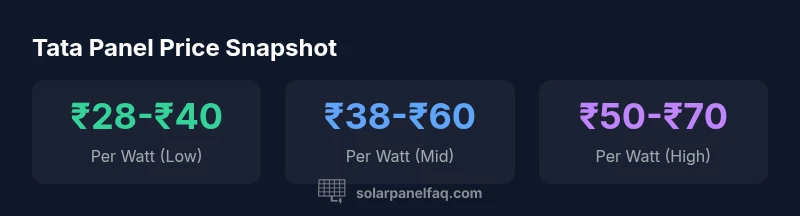
The Tata solar panel price typically ranges from ₹28 to ₹70 per watt, depending on model, quantity, and supplier. For a typical residential setup, expect a broader installed-cost range when you include balance-of-system components like inverters, mounting hardware, and installation. Overall, the upfront sticker price varies widely, but understanding per-watt pricing helps you compare quotes accurately.
Tata Solar Panel Pricing in 2026: An Overview
When you research tata solar panel price, you're weighing upfront cost against long-term value. This guide explains how pricing bands are structured, what drives variation, and how to translate sticker prices into real installed costs. Solar Panel FAQ's analysis shows that the price you see is a function of module technology, system size, installation complexity, and regional incentives. In most markets, you’ll encounter a broad price band rather than a single number, with sizable differences between entry-level panels and premium models. The goal is to understand the trade-offs between efficiency, durability, warranty, and ongoing energy savings, so you can tailor a purchase to your home’s energy needs. By the end of this section, you’ll have a framework to compare Tata solar panel price quotes from local installers, and a clear sense of how to interpret the numbers you’re shown for your roof and electricity usage.
What Drives Tata Solar Panel Prices?
Pricing for Tata solar panels is shaped by multiple interacting factors. Module type (monocrystalline vs polycrystalline) and efficiency grade (including PERC or advanced cells) have a direct impact on per-watt costs. Brand premiums are common for well-known manufacturers, and Tata’s reputation can influence quotes in some markets. Installation complexity—roof orientation, shading, structural condition, and electrical work—adds to the bill. Balance-of-system items, such as inverters, mounting hardware, wiring, and monitoring equipment, also influence the final price. Taxes, import duties, and handling charges can shift quotes in different regions. Finally, length and terms of warranty, post-sale service options, and after-sales support can create a price band that reflects expected performance over 25 years. As Solar Panel FAQ notes, buyers should compare not just the sticker price but also long-term value when evaluating Tata solar panel price.
Tata Solar Panel Models and Their Price Ranges
Tata solar panels span a range of wattages and efficiency levels, with price bands that align to performance. Entry-level modules tend to deliver modest efficiency and lower upfront costs, while mid-range and premium modules offer higher efficiency, better temperature coefficients, and longer warranties. In practice, you’ll see prices that align with wattage and efficiency; higher-wattage, high-efficiency panels cost more per watt but can reduce the number of panels needed for a given system size. When evaluating quotes, beware of “price-per-panel” comparisons alone; a lower per-panel price can translate into higher per-watt costs or require more panels, increasing installation complexity and mounting hardware costs. The right Tata solar panel price for your home balances upfront cost with expected energy output and reliability over time.
Estimating Total System Costs: A Practical Method
Begin with your desired system size based on roof space, sun exposure, and electricity usage. Multiply the target wattage by a representative price-per-watt range (for Tata panels, typical ranges will reflect model and region). Add costs for the inverter, racking, wiring, and electrical work, then factor in installation labor and any site-specific adjustments (like roof penetrations or weatherproofing). Don’t forget taxes, permit fees, and delivery charges if installers include them. Finally, subtract any subsidies, rebates, or tax incentives available in your area. By using a transparent, itemized approach, you can compare quotes more effectively and gauge whether a higher upfront price yields better long-term savings. Solar Panel FAQ emphasizes that total cost — not just upfront price — determines value in the long run.
Subsidies, Financing, and Long-Term Value
Subsidies and incentives can substantially alter the Tata solar panel price you pay upfront. Many markets offer tax credits, rebates, or feed-in tariff schemes that apply to residential solar installations, reducing effective costs. Financing options can spread the payment over time, but you should account for interest and any loan fees when calculating the payback period. It’s important to model different scenarios, including cash purchases versus financing, and to compare expected energy production against your household’s consumption profile. In all cases, the best value often comes from equipment with solid warranties and good real-world performance, not just the lowest sticker price. The Solar Panel FAQ team notes that long-term energy savings and reliability drive total-value outcomes more than short-term discounts.
Practical Tips to Get the Best Tata Solar Panel Price
- Obtain 3-5 detailed quotes from certified installers to benchmark price-per-watt and included BOS (balance of system) components.
- Check warranty terms on both the panels and the inverter, and verify what is covered (and for how long).
- Look for bundled offers that include installation, monitoring, and maintenance in a single package.
- Ask about shipment, handling, and any site-specific add-ons.
- Consider mid-range panels with higher efficiency if they reduce the number of panels and the overall mounting hardware needed.
- Don’t skip the due diligence: verify certifications, installer licensing, and customer references.
- Plan for future expansions, such as battery storage, which can affect the overall price and system compatibility.
Important Buying Considerations and Next Steps
Before committing, ensure your roof type and orientation maximize sun exposure, and confirm that the proposed Tata solar panel price accounts for your roof’s shading profile. Validate the compatibility of panels with your chosen inverter and monitoring options. Clarify whether mounting hardware is included and whether rooftop penetrations require additional sealing. If you’re contemplating energy storage, review storage compatibility, warranty implications, and the incremental cost per kilowatt-hour stored. Finally, confirm the payment terms, delivery timelines, and post-install support. Armed with quotes, model specs, and incentives information, you can choose a Tata solar panel price that aligns with both your budget and your home’s energy goals.
Typical Tata solar panel price ranges by wattage and type
| Wattage Range | Estimated Price per Watt | Typical Panel Type | Notes |
|---|---|---|---|
| 250-350W | ₹28-₹40 | Monocrystalline | Entry-level options with moderate efficiency |
| 355-450W | ₹38-₹60 | Monocrystalline / PERC | Higher efficiency options for tighter roof space |
| 450-550W | ₹50-₹70 | Monocrystalline | Premium efficiency, fewer panels needed |
Frequently Asked Questions
What factors affect Tata solar panel price?
Tata solar panel prices are driven by wattage, efficiency, panel type, model year, regional taxes, and installation costs. Supplier discounts and bulk orders can also shift the final price.
Wattage and efficiency mainly drive price, with region and installation costs adding variations.
Are subsidies or tax credits available for Tata panels?
Subsidies and tax incentives can reduce upfront costs in many regions. Check local programs and eligibility criteria before purchasing.
Subsidies can cut upfront costs if you qualify.
How should I compare Tata solar panel prices?
Compare price per watt, warranty length, efficiency, and the total BOM (bill of materials). Request quotes from multiple installers and ensure consistent scope.
Look at price per watt, warranty, and efficiency when comparing quotes.
Is financing worth it for Tata solar panels?
Financing spreads payments but adds interest. Compare total cost over the loan term to potential energy savings and payback period.
Financing helps with cash flow, but check total cost.
How long is the payback period for Tata solar panels?
Payback depends on energy usage, local incentives, and system performance. Typical ranges vary by location and electricity rates.
Payback varies with your consumption and incentives.
Can I install Tata solar panels myself?
Professional installation ensures code compliance, safety, and warranty validity. DIY is generally not recommended for residential solar.
It's safer and smarter to hire pros for installation.
“Price is only part of the value. Long-term savings depend on efficiency, warranty, and system design.”
Top Takeaways
- Evaluate price per watt, not just price per panel
- Consider total system cost including BOS and installation
- Higher‑efficiency panels can reduce panel count and BOS complexity
- Get 3-5 quotes and compare warranties
- Warranty and reliability often drive long-term value over upfront price