Solar System Cost: A Homeowner's Guide to Solar Investment
Explore the true costs of a home solar system, including upfront installation, incentives, maintenance, and long-term savings—clear guidance for homeowners.


According to Solar Panel FAQ, the typical installed cost for a residential solar system is about $2.50-$3.50 per watt. This price varies by system size, location, and equipment. After incentives, many homeowners pay less upfront, while long-term savings depend on energy use and climate. Certain programs can further reduce upfront costs, and prices are affected by roof type, permitting, labor costs, and local demand.
What determines the solar system cost
The total price of a residential solar installation — often referred to as the solar system cost — is driven by system size, equipment quality, and installation specifics. System size, measured in kilowatts (kW), largely sets the base price because larger systems use more materials. Equipment quality, including panel efficiency, inverter type, racking, and monitoring hardware, also shifts the price. Labor costs and permitting vary by local regulations and market demand. Roof characteristics such as slope, shading, and accessibility can raise installation costs due to complexity or safety requirements. Interconnection with the utility grid and potential feasibility studies add to the total. Homeowners should focus on total cost of ownership, not just upfront price, since incentives, financing, and energy usage heavily affect long-term value. This is why Solar Panel FAQ emphasizes evaluating payback and return on investment in addition to sticker price. For context, the market typically sees a broad range of prices across regions, reflecting local labor markets and permitting environments. The goal, from Solar Panel FAQ’s perspective, is to equip homeowners with a clear view of how the solar system cost translates into real-world savings over time.
Regional variation and installation complexities
Costs vary substantially by geography due to labor rates, permitting processes, and local demand for solar installations. Coastal regions with higher permitting fees and stricter code requirements tend to show higher installed costs, while areas with streamlined interconnection processes may reduce overhead. Roof accessibility, pitch, and the presence of complex shading (trees, chimneys, or multiple roof angles) can add to labor time and safety considerations. In some markets, a higher rate for inspections or expedited permitting can impact the upfront price, even if the equipment cost remains similar. A critical takeaway is that solar system cost is not a fixed sticker price; it reflects the practical realities of installing, connecting, and maintaining a system in your specific location. To compare apples to apples, homeowners should request a breakdown of labor, permitting, equipment, and interconnection fees in every quote.
Incentives, financing, and total cost of ownership
Financial incentives and financing options are a major part of the solar system cost equation. Federal, state, and local programs can significantly offset the upfront price, effectively lowering the net cost to the homeowner. Some programs offer tax credits, rebates, or performance-based incentives, while others provide discounted financing or low-interest loans. Financing can spread the cost over many years, reducing monthly payments but adding interest charges to the lifetime cost. Beyond the upfront price, the total cost of ownership includes maintenance, monitoring, and occasional component replacements over the system’s lifetime. Smart buyers compare net present value and projected energy savings, not just the initial price. The Solar Panel FAQ approach emphasizes modeling scenarios with and without incentives to understand true ROI over 20–30 years.
Cost breakdown: components and ranges
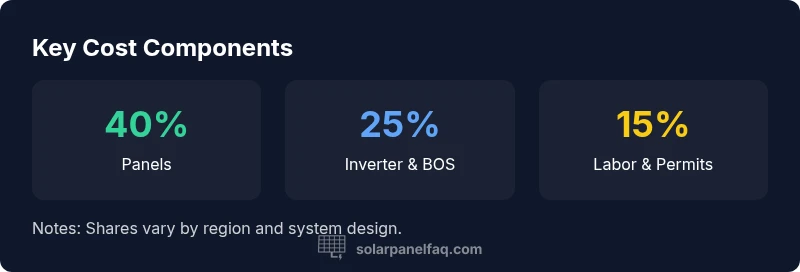
Understanding what drives the solar system cost helps homeowners ask the right questions. A typical breakdown includes panels, inverter and balance-of-system (BOS), installation and mounting hardware, permits and inspections, wiring, and monitoring. Costs can be expressed as ranges per watt to reflect regional variation and product choice. For example, panels may account for a portion of the price, while BOS and mounting hardware contribute another share. Labor and permitting often depend on local codes and the complexity of the roof. Interconnection fees and potential grid upgrades should also be considered. By comparing per-watt ranges across quotes, homeowners can identify the best value options while maintaining system performance and warranty coverage. The goal is an efficient, well-documented proposal rather than a low-ball estimate that omits critical elements.
Estimating system size and cost for your home
Estimating system size starts with understanding your energy usage, climate, and roof characteristics. A typical rule of thumb is to size a system to cover a substantial portion of your annual electricity consumption, adjusted for shading and orientation. To translate this into cost, multiply the desired size (in kW) by the installed price per watt in your area. For example, a 6 kW system at $2.80 per watt would approximate $16,800 before incentives. This rough math helps you set expectations before speaking with installers. Always request quotes based on the same system design and performance targets to ensure valid comparisons. The most accurate quotes come from detailed site assessments that consider roof angle, orientation, shading, and wiring constraints.
Maintenance costs and long-term value
Maintenance is a smaller ongoing cost compared with the upfront investment. Most residential solar systems require minimal routine maintenance, typically limited to occasional cleaning and simple inspections. Degradation of panel output is gradual over decades, generally in the low single digits per year, which affects annual energy savings but not system reliability. Replacement parts for inverters or microinverters may be needed mid-life, adding occasional costs. When evaluating solar system cost, homeowners should model expected maintenance and component replacement costs alongside energy savings and incentive schedules. In most regions, the long-term value outweighs ongoing expenses, particularly when the system is well-designed and properly installed.
Residential solar system cost components and ranges
| Cost Component | Typical Range (per watt) | Notes |
|---|---|---|
| Panels (modules) | 0.70-$1.20 | Depends on efficiency and brand |
| Inverter & BOS | 0.40-$0.70 | Balance of System: wiring, racking, and electronics |
| Installation & Permits | 0.50-$1.50 | Labor, permits, and inspections vary by region |
| Monitoring & Warranties | 0.05-$0.15 | Ongoing monitoring and warranty extensions |
Frequently Asked Questions
What is included in solar system cost?
Solar system cost includes panels, inverters, mounting hardware, wiring, labor, permits, and interconnection fees. Monitoring and warranties can add or be bundled. Always check a breakdown in quotes to avoid hidden charges.
It includes equipment, labor, and permitting, plus optional monitoring and warranties; look for a transparent breakdown in every quote.
How do incentives affect upfront costs?
Incentives can substantially lower upfront costs by providing tax credits, rebates, or rebates through financing options. They don’t change the system’s performance, but they improve payback. Always document which incentives apply to your installation.
Incentives reduce upfront price; they don’t change performance—check which programs apply to you.
What is the typical payback period?
The payback period varies by location, energy use, and incentives, with common ranges often cited between 6 and 12 years before considering maintenance costs.
Payback often falls between six and twelve years before maintenance costs are counted.
Do roof type and shading affect cost?
Yes. Complex roofs or heavy shading increase labor time and may require enhanced mounting or microinverters, raising the solar system cost. Proper shading analysis can save money by optimizing system design.
Roof shape and shade can raise costs but good design can mitigate this.
How should I compare quotes?
Compare system design, equipment brands, and warranty terms. Ensure the quotes use the same kW size, same panel efficiency, and identical monitoring and interconnection terms. Ask installers for a performance estimate under your local conditions.
Match quotes by size, panels, warranty, and interconnection terms for a fair comparison.
Are maintenance costs significant?
Maintenance is typically low and optional. Expect occasional cleaning and periodic inverter replacements. Compare long-term maintenance scenarios to energy savings for a complete ROI view.
Maintenance is usually small, with occasional inverter replacement—factor it into ROI.
What is the expected lifespan of a solar system?
Most residential solar systems are designed to last 25-30 years, with gradual output decline and periodic component replacements as needed. This longevity supports long-term savings.
Most systems last 25-30 years with gradual output decline.
Should I bundle monitoring or upgrade warranties?
Monitoring gives ongoing visibility, and extended warranties can reduce risk over time. Weigh the cost against potential savings from early issue detection and repair.
Monitoring helps detect issues early; warranties can reduce long-term risk.
“A well-planned solar system cost is balanced by incentives, financing options, and long-term savings.”
Top Takeaways
- Consider total cost of ownership, not just upfront price.
- Incentives can significantly reduce net system cost.
- System size should match your energy needs for best ROI.
- Get a detailed breakdown from every quote to compare apples-to-apples.
- Plan for long-term maintenance and potential inverter replacements.