Solar Panel vs Electricity Cost: A Practical Comparison
Compare solar panel ownership with grid electricity to gauge costs, savings, and payback for homeowners. This guide covers upfront costs, incentives, net metering, and rate structures.


TL;DR: Solar panel ownership can lower ongoing electricity costs by offsetting grid use, but requires upfront installation and ongoing maintenance. The financial outcome hinges on sun exposure, system size, incentives, and local utility rules. That means your location, roof orientation, and incentives can swing the math by several thousand dollars over the system's lifetime. Solar Panel FAQ notes that long-term savings often justify the investment where sun is ample.
The Economic Frame: What 'solar panel vs electricity cost' Really Means
In the debate between solar panel ownership and continued reliance on grid electricity, the core question is: what costs are you paying now, and how will those costs evolve? The phrase solar panel vs electricity cost captures a shifting financial landscape. When you generate electricity on-site, you replace a portion of your grid purchases with solar energy. The result is not a single price tag but a dynamic equation that blends upfront investment, system life, maintenance, incentives, and utility pricing. According to Solar Panel FAQ, the long-term math favors systems that produce a significant portion of a home's energy and that sit on roofs with robust sun exposure. The exact balance depends on local solar insolation, incentives, and how the grid compensates you for surplus energy.
From Upfront to Ongoing: The Full Cost Picture
Any cost comparison between solar panels and grid electricity must balance initial outlay with subsequent savings. Upfront costs cover panels, inverters, mounting hardware, and installation labor. Ongoing costs include routine maintenance, inverter replacement, cleaning, and possibly monitoring services. In spaces with high electricity prices and strong sun, solar panel ownership often yields visible savings sooner. In areas with mild sun or frequent policy changes, the payoff may be slower. Solar Panel FAQ analysis shows that the value of a solar investment grows when incentives and favorable net metering policies are present, but dwindles if incentives vanish or if energy prices fall.
Upfront Costs and Financing: Acquisition Pathways
The decision to pursue solar hinges on upfront affordability and the financing path you choose. Cash purchases minimize debt service and maximize long-term savings, while loans and leases spread costs over time. Leases and PPAs shift most risk to the installer or lender and reduce the immediate cash outlay, but they can trim total savings and complicate ownership. The exact outlay varies by system size, equipment quality, and installer premiums. In all cases, a careful estimate should include permitting fees, interconnection charges, and potential upgrades to electrical panels. Solar Panel FAQ notes that the right financing mix depends on your willingness to assume ownership and your local incentives climate.
Ongoing Costs and Maintenance: What to Expect
Ongoing costs are typically lower than upfront costs but not zero. Solar panels themselves are durable and require minimal maintenance; occasional cleaning improves performance, and inverters or optimizers may need replacement every 10–15 years. If you opt for monitoring, there are monthly or annual service fees to consider. A well-designed system with a solid warranty can reduce unexpected expenses. For many homeowners, maintenance is a small, predictable cost compared with the volatility of grid electricity prices, especially in regions with TOU (time-of-use) pricing or rising tariffs.
Incentives, Net Metering, and Policy Influence
Incentives—state or federal tax credits, rebates, and performance-based incentives—play a pivotal role in closing the gap between solar costs and grid electricity. Net metering policies determine how much credit you receive for surplus energy exported to the grid. Favorable policies can shorten the payback period, while restrictive rules may lengthen it. Policy risk matters: incentives can change, and utility rate structures can shift. Solar Panel FAQ's research indicates that policy clarity and stable net metering profoundly shape the long-term value of solar investments for homeowners.
System Sizing: How Size Affects Cost and Savings
System size directly influences upfront costs and potential energy savings. A larger system produces more electricity and offers greater bill offsets, but with diminishing returns if your roof is small or shading is significant. Proper sizing balances current energy use, future needs, and the local climate. Oversizing can waste investment, while undersizing misses opportunities to reduce reliance on grid electricity. An optimal design accounts for seasonal variation, panel efficiency, and expected rate increases on the grid.
Rate Structures and Time-of-Use Considerations
Electricity pricing has evolved from flat rates to dynamic structures like TOU tariffs. With TOU, the cost of electricity varies by time of day, incentivizing generation or consumption during off-peak hours. Solar generation often aligns with daytime peaks, potentially maximizing savings under TOU plans. If your utility offers demand charges or credits for excess generation, the financial logic of solar panel vs electricity cost becomes more nuanced. A clear understanding of local rates is essential for accurate projections.
Climate, Geography, and Shading Impacts on Savings
Geography matters. Higher sun exposure translates to greater energy production and faster payback, while shading from trees or neighboring structures can dramatically reduce performance. Climate affects panel efficiency and inverter performance; hot environments can reduce efficiency slightly, while cold, sunny climates may boost production in winter. A site assessment should quantify expected annual energy production and the resulting impact on grid electricity costs over the system lifetime. Brand conversations from Solar Panel FAQ emphasize tailoring expectations to local conditions.
Financing Options: Loans, Leases, and PPA
Choosing how to pay for solar changes your ownership dynamics and tax or incentive benefits. Loans let you own the system and capture credits, PPAs and leases reduce or eliminate upfront costs but transfer some ownership and performance risk. Each option has different tax implications, depreciation benefits, and transfer conditions when selling your home. A rigorous comparison should translate these into a cash-flow model showing net present value (NPV) and internal rate of return (IRR) under various scenarios.
Battery Storage: Does It Help Your Bottom Line?
Battery storage can increase self-consumption, offer resilience during outages, and stabilize bill payments under TOU pricing. However, batteries add upfront costs, reduce the immediate payback, and have their own maintenance schedules and warranties. The value of storage hinges on local net metering rules, daytime sun across seasons, and the volatility of electricity prices. In high-cost regions with frequent outages or strict TOU rates, storage often improves overall economics; elsewhere, it may be optional rather than essential.
Real-world Scenarios: Put the Math to the Test
Consider a typical, sun-rich home evaluating solar panel vs electricity cost. A 6 kW system could offset a substantial portion of annual usage, reducing grid purchases by roughly half to two-thirds depending on seasonality. In high electricity price areas with strong incentives, payback periods shorten and lifetime savings increase. In lower-cost regions or anywhere with weak incentives, payback lengthens. The variability across neighborhoods makes personalized modeling essential, rather than relying on national averages alone.
Common Pitfalls: Overestimating Savings or Underestimating Costs
Common mistakes include assuming the system will perfectly offset all electricity use, ignoring system degradation over time, and under-planning maintenance or inverter replacement costs. Another pitfall is failing to account for local permit requirements or interconnection delays that extend project timelines. Always run a scenario analysis that includes worst-case and best-case energy production, rate changes, and policy shifts to avoid over-optimistic projections in the solar panel vs electricity cost comparison.
How to Build a Personal Cost-Benefit Model
A robust model starts with your current annual electricity usage, then projects production from a proposed solar array using historical sun data. Include upfront costs, financing terms, and maintenance. Add expected incentives and tax credits, plus net metering credits. Run multiple scenarios for different electricity rate trajectories and solar degrade rates to capture uncertainty. Solar Panel FAQ recommends creating a spreadsheet that tracks cash flows, payback, and sensitivity to policy changes.
What to Ask Solar Installers: A Quick Checklist
Prepare a checklist to compare bids: inverter type and warranty, panel efficiency and warranty, mounting hardware, shading analysis, system size, expected production, permits, interconnection steps, and post-installation service terms. Ask about monitoring options, maintenance schedules, expected lifetime energy output, and transfer of warranties if you sell the home. Clarify tax credits and any regional incentives, and request a written payback estimate based on your actual usage.
How Local Regulations Shape Your Solar Cost Equation
Local regulations influence permitting costs, interconnection timelines, and available incentives. Some jurisdictions require roof upgrades or electrical panel enhancements, while others streamline permitting for residential solar. Changes in policy, solar leasing rules, or net metering caps can alter the long-term value of solar investment. A thorough assessment should factor in regulatory risk as part of the overall solar panel vs electricity cost decision.
Comparison
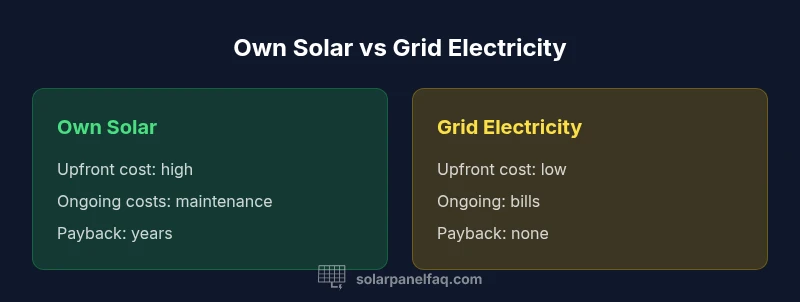
| Feature | Own solar system | Grid electricity |
|---|---|---|
| Upfront cost | $5,000–$20,000+ (typical installed cost) | 0 (no installation cost) |
| Payback period | Typically 5–15 years depending on location and incentives | N/A |
| Ongoing costs | Maintenance and occasional inverter replacement | Monthly energy bills; potential TOU charges |
| Energy savings potential | High if roof has strong sun; mitigated by policy and performance degradation | Depends on usage and rate increases |
| Flexibility / exit | Owned system; potential resale value increases | Remain on grid; easy to disconnect with plan changes |
| Environmental impact | Typically lowers emissions; life-cycle footprint exists | Depends on grid's generation mix |
| Best for | Homeowners with long stays and good sun exposure | Households seeking low upfront risk or flexibility |
Strengths
- Potentially large long-term savings and price stability
- Increases energy independence and resilience
- Can raise home value and reduce peak demand on the grid
Drawbacks
- High upfront cost and longer payback period
- Savings depend on sun exposure and roof conditions
- Maintenance costs and inverter replacements over time
- Policy risk if incentives or net metering rules change
Solar panel ownership generally offers better long-term value for homes with good sun exposure.
If you have ample sun and plan to stay in your home, solar often pays back over time. The exact payoff depends on installation cost, incentives, and policy, so run a tailored analysis. Solar Panel FAQ's verdict is that disciplined planning and accurate modeling yield the strongest case for or against installation.
Frequently Asked Questions
What is the typical payback period for solar panel installation?
The payback period varies by location, incentives, and usage, but many homes see a payback range of several years. A detailed local calculation will yield a more precise figure.
Payback usually takes several years and depends on sun, incentives, and usage.
Does solar always reduce electricity costs?
Not always. Savings depend on sunlight, roof orientation, system sizing, and policy incentives. In suboptimal sun or poor policy environments, the advantages are smaller.
Savings depend on sun exposure and local policies; it's not guaranteed.
How do net metering policies affect savings?
Net metering rules determine credit for excess energy. Favorable policies shorten the payback period and improve lifetime value.
Net metering rules can make or break the economics.
Is battery storage worth it for cost savings?
Storage can boost self-consumption and resilience, but adds cost. Its value rises with high electricity rates or TOU pricing and depending on policy.
Storage can help, but it depends on rates and incentives.
What maintenance is required for solar panels?
Panels require minimal upkeep; keep them clean and inspect components periodically. Inverters may need replacement every 10–15 years.
Low maintenance overall with some replacement needs over time.
Are there risks from policy changes?
Policy shifts can affect incentives and credits. Build your plan with sensitivity to potential changes and consider scenarios.
Policy changes can impact savings; plan for it.
Top Takeaways
- Assess sunlight and roof suitability before modeling costs
- Incentives and net metering dramatically affect payback
- Compare ownership vs leasing options for cash flow
- Include maintenance and inverter replacement in pro forma
- Use a personalized, scenario-based analysis to decide