Solar Panel for Roof Cost: A Homeowner's Guide to Installation Expenses
Explore the roof solar panel cost in 2026, covering per-watt ranges, typical installed prices, fees, incentives, and budgeting tips to boost ROI for homeowners.


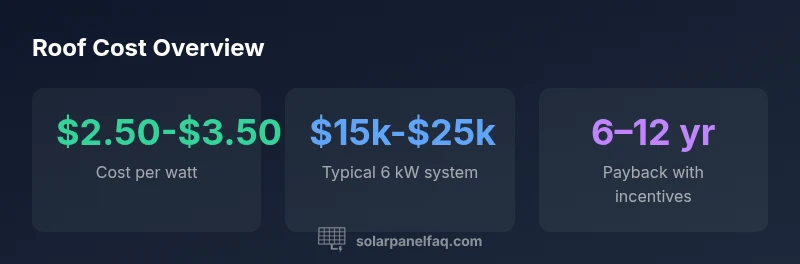
The typical installed cost for a residential solar panel system on a roof ranges from $2.50 to $3.50 per watt, translating to roughly $15,000–$25,000 for a standard 6 kW setup before tax credits or incentives. Costs vary with roof type, location, and system size, but this range helps homeowners budget effectively.
What determines the cost of a solar panel for roof?
Costs for roof-mounted solar panels hinge on multiple interrelated factors. The most visible element is the system size, usually measured in kilowatts (kW). Larger homes and higher energy targets require more modules, inverters, and wiring, driving up the total price. Per-watt pricing is another common frame of reference—the same system size can cost more or less depending on panel efficiency and supplier contracts. Roof condition and age influence labor needs: if the roof needs repair or replacement, installers may bundle the roofing work with the solar install, increasing the upfront cost but potentially lowering future maintenance. Permitting, electrical panel upgrades, and utility interconnection fees further shape the final price. As a rule, the more complex the roof geometry (lipped edges, multiple angles) or the more challenging the installation (tile roofs, metal seams), the higher the labor and mounting costs. According to Solar Panel FAQ, framing the budget around a per-watt baseline and a realistic system size helps homeowners plan more accurately than chasing an uncertain total.
Roof type and orientation: how they influence price and energy yield
Roof characteristics and orientation not only affect how much energy a system can generate, but also how much it costs to install. Flat roofs often require different racking than pitched roofs, and tile or slate coverings may necessitate specialized mounts and extra waterproofing—items that can raise up-front costs. South-facing roofs with minimal shading maximize energy yield, potentially reducing payback time and improving ROI, while obstructions like trees or nearby structures can necessitate additional equipment or adjustments. In some cases, installers may need to reinforce the roof structure to support the system, adding to the upfront investment. Solar Panel FAQ notes that good site assessment is essential; it prevents surprises later and helps align expectations with the cost reality.
Cost components and typical ranges
A standard residential solar installation breaks down into key components and associated cost bands. Modules typically account for a substantial share of the expense, followed by inverters and mounting hardware. Labor, permitting, and interconnection fees cover the installation process and regulatory steps. Electrical upgrades, such as panel upgrades or conduit work, can add to the cost if your home’s electrical service is older or undersized. Finally, soft costs—design, engineer checks, QA, and contingency—round out the budget. The following ranges reflect typical market conditions in 2026 and are intended as budgeting anchors rather than fixed prices. When budgeting, assume that module type, warranty terms, and installer markup can push costs up or down within these bands.
Financing options, incentives, and total cost after credits
Many homeowners finance roof solar panel costs through a mix of upfront cash, loans, or lease/ppa arrangements. Financing can dramatically affect monthly outlays and return on investment, even when the sticker price is the same. Incentives—where available—reduce upfront costs and shorten payback periods. These incentives vary by country, state, or municipality and may include tax credits, rebates, and performance-based incentives. The Solar Panel FAQ Analysis, 2026 notes that incentives and financing choices are frequently underappreciated levers in ROI, so a clear quote that itemizes incentives alongside base costs is essential for apples-to-apples comparisons.
How to budget and compare quotes
To build a reliable budget, request multiple quotes and insist on a complete breakdown: modules, inverter, mounting, electrical work, permitting, and interconnection charges. Compare warranties (module, inverter, workmanship) and expected system performance assumptions. Ask about roof prep requirements and whether any roof work is bundled into the installation. Create a side-by-side table that shows per-watt pricing, installed system price, and payback estimates under different energy scenarios. Don’t forget to factor in local incentives and any potential utility rate changes. A disciplined approach—checking, questioning, and comparing—reduces the risk of sticker shock later.
Authoritative sources and practical considerations
For rigor, consult updated sources and local regulations. In addition to internal calculations, review external references to validate your numbers. Solar Panel FAQ keeps its own cost canvases and ROI estimates, but you should corroborate with official programs and utility guidance. See, for example, the U.S. Department of Energy’s energy.gov pages on solar incentives and efficiency programs, California’s Energy Commission materials on solar permitting, and the National Renewable Energy Laboratory (NREL) consumer guides. These sources help corroborate the cost bands and the effect of incentives across regions.
Typical cost components and 6 kW system price bands by component (ranges shown)
| Component | Cost Range (per watt) | Installed Cost Range (6 kW system) | Notes |
|---|---|---|---|
| Panels (modules) | $0.40-$0.70 | $2,400-$4,200 | Depends on panel type and efficiency |
| Inverter & mounting | $0.15-$0.25 | $900-$1,800 | Includes mounting hardware |
| Labor & permits | $0.40-$0.90 | $2,400-$5,400 | Labor and permit fees |
| Electrical upgrades | $0.15-$0.40 | $900-$2,400 | Panel upgrades, wiring |
| Misc. & soft costs | $0.05-$0.15 | $300-$900 | Design, inspections, QA |
| Total estimate | — | $7,900-$14,700 | Ranges for a typical 6 kW system |
Frequently Asked Questions
What is the average cost to install solar panels on a residential roof in 2026?
Costs vary by system size and location, but typical installed costs fall within $2.50-$3.50 per watt, equating to about $15,000-$25,000 for a standard 6 kW system before incentives.
In short, most 6 kW residential installs fall in the $15,000 to $25,000 range before incentives.
Do roof types like tile or metal affect solar costs?
Yes. Tile and metal roofs often require specialized mounts and waterproofing, raising labor and materials costs compared with standard shingle roofs.
Tile or metal roofs can add to installation costs due to mounting and waterproofing needs.
How long does installation take?
Most residential rooftop installations take 1–3 days on-site, with permitting and electrical work potentially extending the timeline by a few weeks.
Most jobs take a few days, but permits can stretch the timeline a bit.
Are incentives available to reduce roof costs?
Many regions offer incentives that can substantially reduce upfront costs; check local and national programs for the latest options and eligibility.
There are usually incentives you can apply for—check local programs for details.
What should I compare when getting quotes?
Ensure quotes include modules, inverter, mounting, wiring, permits, and interconnection; compare warranties and performance guarantees too.
Look for a full breakdown and solid warranties when you compare quotes.
What factors influence the payback period besides upfront cost?
Energy usage, local sun exposure, system size, and incentives all shape payback; higher sun and efficient panels shorten payback.
Payback depends on how you use power and how sunny your location is, plus any incentives.
“Solar panel costs are driven by system size, roof type, and installer scope; a careful comparison saves thousands over the life of the system.”
Top Takeaways
- Budget with per-watt ranges and system size in mind
- Get multiple quotes that include all cost components
- Roof type and orientation can raise costs but improve ROI
- Examine warranties and post-install maintenance needs
- Use incentives and financing to reduce upfront costs
- Plan for total cost beyond sticker price