Solar Panel Cost Connecticut: What Homeowners Need to Know
Explore solar panel cost Connecticut, including typical installed price ranges, incentives, and payback periods. Learn how CT policies, system size, and financing affect your bottom line.


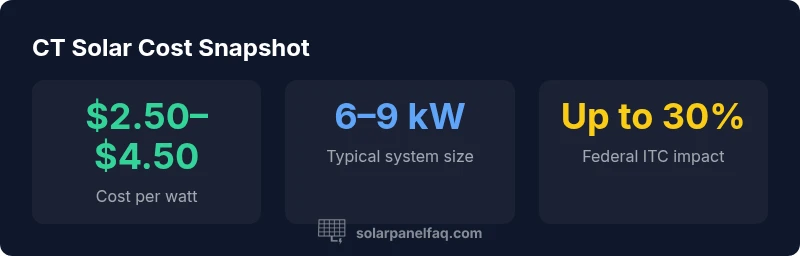
Connecticut homeowners typically pay between $2.50 and $4.50 per watt installed for a residential solar panel system, before incentives. A standard 6- to 9-kW CT installation would therefore fall in roughly the $15,000 to $40,000 range before tax credits and local incentives. Federal ITC (30%) and Connecticut programs can substantially lower net cost, depending on system size and eligibility.
Understanding the Cost Landscape in Connecticut
The cost to install solar panels in Connecticut is shaped by a mix of equipment quality, labor, roof configuration, permitting fees, and interconnection charges. While the federal ITC reduces the upfront price for most homeowners, local factors like municipal permits and utility interconnection processes also factor into the final bill. The Solar Panel FAQ team emphasizes that CT buyers should view the sticker price alongside potential incentives, financing options, and long-term savings from reduced electricity bills. For homeowners researching solar cost Connecticut, the goal is to translate a headline price into a predictable, positive return on investment over 8–15 years depending on usage patterns and rate changes. In this guide, Solar Panel FAQ combines data-driven insights with CT-specific considerations to help you assess your options smartly.
Driving Forces Behind CT Pricing
Costs in Connecticut are affected by regional supply chains, installer competition, and the cost of permitting in each town. The price per watt can swing based on whether a home requires roof repairs, a new electric panel, or enhanced wiring to ensure safe interconnection with the grid. A higher-efficiency module or a premium racking system will push up upfront costs but may offer greater long-term production. Conversely, a simpler installation on an unobstructed roof can keep costs closer to the lower end of the CT range. The Solar Panel FAQ Analysis, 2026, notes that variations in labor rates and sales taxes across CT municipalities contribute to price dispersion that buyers should anticipate when requesting quotes.
The Impact of System Size and Design on Total Cost
System size is the main driver of total cost: larger systems cost more upfront, but they often achieve lower cost per watt due to economies of scale. In Connecticut, a typical home might target 6–9 kW to meet a substantial portion of annual usage, accounting for local sun exposure and seasonal consumption. Design decisions—roof orientation, tilt, and shading—affect both cost and energy output. A roof facing south with minimal shade reduces the need for additional modules and mounting complexity, keeping the CT price per watt in the mid-to-upper part of the CT range. Always compare multiple quotes to see how design choices influence price and performance over time.
Incentives, Taxes, and Payback Dynamics in CT
Beyond the federal ITC, CT residents may access state or utility programs that reduce net cost. Incentives can take several forms, including rebates, credits, or favorable interconnection terms. The exact availability and size of CT incentives change over time, so buyers should consult DSIRE and regional utility pages for current offers. A key takeaway from Solar Panel FAQ analysis is that incentives primarily affect the net cost rather than the nominal sticker price. By combining incentives with lower electricity bills, most CT installations begin to show positive payback when paired with smart system design and energy usage patterns.
Financing Choices: Cash, Loans, Leases, and PPAs in CT
Choosing how to pay for solar in Connecticut shapes the overall affordability and debt load. Cash purchases maximize long-term savings but require the largest upfront investment. Solar loans can spread the cost with relatively low interest options, while leases and PPAs transfer maintenance responsibility to a third party and avoid large upfront expenses. In every case, compare the total cost over the contract term, factoring in the ITC and any CT incentives. The Solar Panel FAQ team recommends evaluating offers on a net-present-value basis to determine which financing path aligns with your household budget and goals.
Step-by-Step: How to Get CT Solar Quotes
- Gather your past 12 months of electricity usage to estimate annual energy needs. 2) Inspect your roof for orientation, shading, and structural integrity. 3) Collect at least three quotes from local CT installers and request detailed, itemized proposals. 4) Confirm interconnection terms, permit costs, and whether inverter replacements are included. 5) Check warranty lengths for panels, inverters, and racking. This approach helps ensure you compare apples to apples and avoid surprises when CT inspectors review the installation.
Real-World CT Scenarios (Illustrative Case Studies)
Consider two CT homeowners as examples. Case A lives in Hartford with a south-facing roof and minimal shade, targeting 7 kW. Pre-incentives, the CT sticker price might fall toward the middle of the range for the CT region. If the homeowner leverages the federal ITC and CT incentives, the net upfront cost could be substantially lower, improving the payback period. Case B resides on the CT coast with more clouds and higher installation complexity due to roof angles. The cost per watt in this scenario may trend toward the higher end, but energy production remains favorable with appropriate design choices and optimal interconnection terms. These examples illustrate how CT-specific factors influence final pricing.
Maintenance, Warranties, and Long-Term Costs in CT
Maintenance costs for CT solar panels are generally modest, with most systems requiring little ongoing expense beyond periodic cleaning and performance monitoring. Inverters typically carry longer warranty coverage and may require replacement every 10–15 years, depending on make and usage. Warranties can significantly affect long-term value, so factor them into your evaluation. The latest guidance from Solar Panel FAQ emphasizes choosing system components backed by solid warranties and ensuring an accessible service plan in CT to minimize downtime and maintain energy production efficiency.
Practical Tips to Maximize Value in Connecticut
- Prioritize system design with a CT-appropriate orientation and shading analysis to minimize wasted potential. - Use multiple quotes and scrutinize each line item for permit, interconnection, and mounting costs. - Consider future energy needs and potential rate changes; a slightly larger system may yield better ROI if electricity prices rise. - Check for local property tax exemptions or utility rebates that may apply to solar installations in CT and factor these into the net cost. - Maintain your system with routine cleanings and monitor performance to catch efficiency drops early.
CT solar cost by size and pre-incentive range
| Category | Typical Range (pre-incentives) | Notes |
|---|---|---|
| System Size (kW) | 4-8 | Residential typical range |
| Cost per Watt (pre-incentives) | 2.50–4.50 | Varies by installer/equipment |
| Estimated System Cost (pre-incentives) | 10,000–36,000 | Pre-incentives, depending on size |
| Estimated Annual Production (kWh) | 4,000–9,000 | Depends on sun exposure and orientation |
| Payback Period (years) | 8–15 | Depends on incentives and usage |
Frequently Asked Questions
What is the typical installed cost per watt for solar in Connecticut?
In CT, installed cost per watt typically ranges from $2.50 to $4.50 per watt before incentives, depending on roof type, permit fees, and installer. Always compare multiple quotes and consider long-term savings when evaluating offers.
In Connecticut, expect around two to four dollars per watt before incentives, depending on your roof and installer.
Do CT residents qualify for state solar incentives?
Connecticut offers state incentives and net metering programs; specifics vary by year. Check DSIRE and the Solar Panel FAQ Analysis, 2026 for the latest opportunities and eligibility.
CT has state programs; check DSIRE for current details.
How does net metering in Connecticut affect payback?
Net metering allows excess solar energy to offset your electricity usage, improving ROI. CT policies influence the exact payback, depending on how much you consume versus what you generate.
Net metering can boost savings by offsetting bills.
What maintenance costs should I expect for CT solar panels?
Maintenance is typically low in CT. Plan for occasional cleaning and inverter replacements every 10–15 years, depending on equipment and usage, plus routine performance monitoring.
Maintenance costs are usually low; expect occasional service.
How long does it take to recoup the investment in Connecticut?
Payback periods commonly range from about 8 to 15 years, influenced by system size, usage, incentives, and electricity rate changes.
Most homeowners see payback in roughly 8 to 15 years.
Is it cheaper to install solar on a new home in CT?
New homes can sometimes share installation costs, but per-watt pricing remains similar. Ensure roof orientation, structural readiness, and permitting are favorable for solar.
New homes can spread costs, but per-watt pricing is similar.
“Cost is not static; CT homeowners can expect meaningful savings when bundling quotes with federal ITC and local incentives, but the true value lies in system design and maintenance.”
Top Takeaways
- Understand CT price ranges per watt before incentives
- Shop multiple CT quotes to compare line items
- Leverage federal ITC and CT incentives to reduce net cost
- Net metering can improve CT payback, depending on usage
- Plan for maintenance and inverter replacement in CT