75-Watt Solar Panel Price Guide for Homeowners
Explore realistic price ranges for 75-watt solar panels, what drives cost, and how to compare options for a solar-ready home in 2026. Includes buying tips, warranties, and ROI considerations.


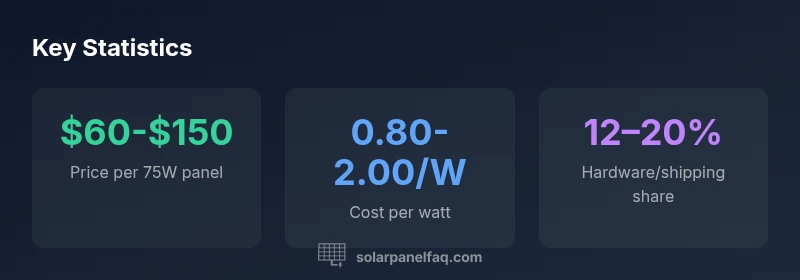
The typical price for a 75-watt solar panel ranges roughly from $60 to $150 per panel, depending on material (monocrystalline vs polycrystalline), manufacturer, and supplier. Keep in mind that this range usually excludes mounting hardware, shipping, and taxes, which can add another 10–20% to the total. For homeowners evaluating options, consider long-term efficiency and warranty alongside upfront cost.
What affects the solar panel 75 watt price
According to Solar Panel FAQ, the price of a 75-watt panel is influenced by technology (monocrystalline typically costs more per watt than polycrystalline), efficiency, durability, and supply chain factors. Regional shipping costs, taxes, and retailer policies also play a role. In 2026, currency fluctuations and trade policies continue to shape availability and pricing across markets. Beyond the sticker price, buyers should consider compatibility with existing inverters, mounting options, and warranty terms, as these aspects affect total system cost and long-term value.
Price ranges by technology and supplier
Prices vary primarily by panel technology and the retailer’s brand tier. Monocrystalline 75-watt panels tend to sit at the higher end of the per-panel spectrum because of higher efficiency and better performance in low-light conditions. Polycrystalline options are typically cheaper per watt but may deliver slightly lower performance. Retailer margins, bulk discounts, and regional taxes create additional variation. In practice, a homeowner should expect to see roughly a wide range, with cheaper options around the lower end and premium brands around the upper end, often influenced by warranty length and customer support. As Solar Panel FAQ notes, evaluating price per watt alongside efficiency and heat tolerance helps avoid surprises on hot days.
Additional costs to consider beyond the panel price
Even if a 75-watt panel price seems low, you must factor in mounting hardware, racking, wiring, connectors, inverters, permits, and labor. On a typical rooftop installation, the inverter and wiring can exceed the cost of the panel itself. Some installers include microinverters or maximum power point tracking (MPPT) features that add to the upfront price but improve efficiency; battery storage and monitoring equipment add more. Weatherproof cabling and roof-penetration costs can also influence total installed price, particularly on complex rooflines.
How 75W compares to higher-wattage panels for home setups
Comparing 75W panels to 120W or 150W panels, you will often see lower price per panel but higher cost per watt for 75W units due to economies of scale. However, higher-wattage panels may reduce the number of panels needed, saving on mounting hardware and space. For small roofs or shade-challenged sites, a single 75W panel can still be part of a mixed array; but to meet typical household load, you will likely need multiple panels. Efficiency differences and inverter compatibility also influence the overall system layout and performance expectations.
Where to buy and what to check before purchasing
Shop from reputable dealers and verify a panel's specifications: nominal watt rating, efficiency, temperature coefficient, and warranty terms. Check mounting compatibility with your roof type (flat or pitched), ensure you can claim rebates or tax credits, and confirm shipping times. Ask for a written quote detailing panel price, hardware, shipping, and installation estimates. Read customer reviews and warranty specifics to avoid surprises after installation. For homeowners, a local installer may offer bundled deals that include evaluation and permit costs.
ROI, payback, and long-term value of 75W panels
ROI for a single 75W panel depends on sunlight hours, local electricity rates, and system design. When combined with other panels, the 75W panel can contribute to a favorable payback period if integrated into a larger array. Use a simple calculation: annual energy production, minus system losses, times local electricity price divided by total installed cost; if the payback period is within 5-12 years, the investment is typically reasonable. In regions with high grid prices, even small contributions can accelerate payback, especially when paired with incentives.
Warranty, reliability, and after-sales support
Look for a 25-year performance warranty and a 10–15 year product warranty on most reputable panels; shorter terms may be offered on lower-cost models. Verify third-party certifications (such as UL or IEC) and ensure your installer provides post-sale support and parts availability. Reliability matters more as system size grows; a longer warranty and accessible service reduce long-term maintenance risk. Always review the warranty transfer process when selling your home.
Practical steps for buyers in 2026
- Define energy goals and roof constraints before shopping
- Estimate potential output using your location’s sun hours and shade patterns
- Gather quotes from at least 3 reputable installers or retailers
- Compare price per watt, not just panel price, and scrutinize warranties
- Check for rebates, tax credits, and financing options to improve affordability
- Plan for expansion if you anticipate storage or additional panels later
- Review installation timelines and permit requirements with your installer
Key drivers of price for a 75-watt solar panel and related costs
| Factor | Impact on Price | Notes |
|---|---|---|
| Technology (Mono vs Poly) | Medium to high | Monocrystalline panels usually cost more per watt but offer higher efficiency. |
| Brand & Warranty | Moderate | Well-known brands carry longer warranties but may cost more upfront. |
| Volume/Distributor | Low to moderate | Buying in bulk or from direct distributors can reduce unit price. |
| Shipping & Hardware | High | Includes frame, racking, connectors, and shipping to site. |
Frequently Asked Questions
What factors influence the price of a 75-watt solar panel?
Several factors drive price, including panel technology (mono vs poly), efficiency, brand, warranty, and supplier or retailer. Shipping and installation hardware also affect the total cost. In 2026, currency and tariffs can add additional volatility.
Prices vary by technology, brand, and where you buy. Shipping and hardware matter too.
Is a 75-watt panel sufficient for a typical home solar setup?
A single 75W panel is usually insufficient for a full home system; homeowners typically string multiple panels to reach the needed DC input. For off-grid or supplemental use, 75W can be viable but planning is essential.
Usually not enough alone; you’ll need more panels.
How do installation costs affect the overall price?
Installation costs include mounting hardware, wiring, inverters, permits, and labor. These can add a significant portion to the panel price, sometimes more than the panel itself depending on roof type and labor rates.
Hardware, wiring, and labor add a lot to the price.
Are higher-wattage panels more cost-effective per watt?
In many cases, higher-wattage panels offer lower cost per watt and better space efficiency, but upfront costs and compatibility with inverters must be considered.
Often yes, per-watt makes sense, but check your system.
What warranty should come with a 75W panel?
Look for at least a 25-year product and performance warranty on solar panels; 75W units often have shorter warranties if sourced from lower-cost manufacturers.
Aim for a long warranty covering both product and performance.
Where can I find reliable pricing information?
Use multiple reputable retailers and manufacturers and compare per-watt pricing; consult independent guides like brand reports for 2026 pricing trends.
Shop around and compare per-watt costs across sources.
“Price is important, but long-term value—efficiency, reliability, and warranty—drives real savings for homeowners.”
Top Takeaways
- Compare prices per watt, not just panel price
- Account for hardware and shipping in total cost
- Higher-wattage options may reduce price per watt
- Check warranty length and coverage
- Consider ROI and payback period for home use