How Do Solar Panels Affect My Bill
Learn how solar panels influence your electricity bill, including net metering, rate structures, and a practical method to estimate savings for homeowners.


Solar panels typically reduce your electricity bill by offsetting a portion of your home's energy use. The size of the bill reduction depends on system size, local utility rates, and how you use power. Net metering, time-of-use rates, and seasonal sun affect the final savings, so results vary widely.
Understanding how solar panels affect your bill
According to Solar Panel FAQ, how do solar panels affect my bill? Residential solar installations change how you pay for electricity by shifting some consumption to generated power. Your bill becomes a balance between grid energy, solar credits, and fixed charges. Solar doesn't automatically zero out the bill; it can lower it by offsetting daytime usage, especially if you aim to use more solar during the day than you generate at night. System size, roof orientation, shading, and inverter efficiency influence how much energy actually offsets your consumption. The Solar Panel FAQ team emphasizes planning for your household’s patterns—families with higher daytime usage may see bigger offsets, while households with high evening usage may rely more on grid power during non-sun hours. Local policies and utility tariffs also shape the outcome, so the same sized system in different locales can produce very different savings levels. To maximize clarity, this article explains key concepts, scenarios, and practical steps you can take to estimate and improve your solar bill impact.
tip':null}
How solar generation interacts with usage and charges
Solar generation follows the sun, peaking around midday. When your consumption aligns with production, you offset a larger portion of your bill with solar credits. If you use most of your electricity during the day, you’ll reduce daytime charges and benefit from lower energy costs. Conversely, if your peak usage occurs in the evening after the sun sets, you rely more on the grid and may not offset as much of your bill. Most utilities still levy fixed charges and taxes regardless of solar output, so the dramatic “zero bill” expectation is usually inaccurate. Some regions also credit excess energy at different rates, or require annual true-ups. Time-of-use (TOU) pricing adds another layer: the value of daytime solar depends on whether daytime generation coincides with high-price periods. Smart appliances and simple energy management help you maximize daytime usage and minimize evening reliance.
tip':null}
Net metering, rate structures, and how they shape savings
Net metering is a central concept for many residential solar customers. In a typical net metering arrangement, energy you generate during daylight hours that is not used immediately is credited against energy drawn from the grid later, effectively smoothing your monthly bill. The exact credit rate, expiration, and annual cap vary by state and utility, so review your contract and local rules carefully. Many utilities also offer time-of-use (TOU) rates that charge higher prices during peak periods; if your system produces most energy during these hours, you may see enhanced savings, but if generation falls during peak times, the benefit can be reduced. Additionally, some providers enforce fixed monthly charges, minimum fees, or demand charges that solar cannot eliminate. Solar Panel FAQ analysis shows wide regional differences, underscoring the importance of mapping your solar production to your local tariff to understand the true impact on your bill.
tip':null}
A practical method to estimate your savings
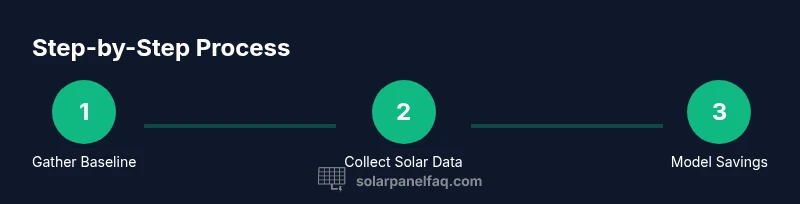
Begin with your most recent 12 months of electricity bills to establish your baseline consumption and seasonal patterns. Gather your solar production forecast for the same period, or use actual production if you already have panels installed. Build a simple model in a spreadsheet with the following components: monthly usage, monthly production, the credit or payment you receive for excess energy, and any fixed charges. Apply your local tariff structure, including TOU rates if applicable. For each month, compute savings as: offset value minus any net charges, then add credits from net metering. Sum across 12 months to obtain an annual estimate. Compare this annual figure to the anticipated yearly cost of the solar system (purchase price, financing, maintenance) to gauge payback time. Validate your assumptions with an installer or a trusted calculator.
tip':null}
Planning considerations and common pitfalls
A thorough assessment includes practical factors that affect real-world results. Shade from trees, roof orientation, and panel angle can dramatically reduce production, so verify site conditions before purchase. Ensure you understand warranty terms for the panels and inverter, plus expected panel lifespan and maintenance needs. Verify that the system size you choose aligns with your actual electricity usage, not just available roof space. Budget for potential inverter replacement in the life of the system and for possible expansion if your energy needs grow. Finally, compare multiple quotes and confirm how each installer handles net metering credits, monitoring, and after-sales service. Solar Panel FAQ recommends speaking with neighbors who have similar tariffs, reading local incentive programs, and using your model to forecast long-term affordability.
Tools & Materials
- Recent electric bill (last 12 months)(Used to estimate baseline consumption and rate structure)
- Solar production data (inverter/portal)(Needed to compare generated vs consumed electricity)
- Calculator or spreadsheet(For modeling savings and payback)
- Pen and notebook(Optional for jotting notes during review)
- Access to TOU/rate information(Required to model bills under different rate structures)
Steps
Estimated time: 30-60 minutes
- 1
Gather baseline usage and rates
Collect your electricity usage data for the last 12 months and note your current rate plan. This establishes the baseline against which solar savings will be measured.
Tip: Obtain monthly kWh and the exact rate per kWh from your utility portal. - 2
Gather solar production data
Obtain projected or actual monthly solar production from your solar inverter or installer portal. This shows how much energy your system can offset.
Tip: Use production data that matches your intended system size. - 3
Build a simple bill model
Create a two-column model: (a) without solar using baseline rates; (b) with solar applying net metering credits and TOU where applicable.
Tip: Include fixed charges and minimums that may persist with or without solar. - 4
Compare scenarios and interpret results
Contrast the two scenarios to estimate monthly and annual bill differences. Look for months with higher savings when sun aligns with peak rates.
Tip: Highlight months with large production shortfalls or oversupply. - 5
Plan next steps and evaluate options
Summarize your findings and consider incentives, financing, and installer quotes to act on the plan.
Tip: Ask installers about warranties, maintenance, and expected payback.
Frequently Asked Questions
What is net metering and how does it affect my bill?
Net metering credits excess daytime solar production against evening usage, lowering the overall bill. The exact crediting rules depend on your utility's program and state policy.
Net metering lets you earn credits for extra solar energy, reducing your bill later. Rules vary by utility.
Will solar panels always reduce my electricity bill?
In most cases solar lowers the bill, but fixed charges and minimums can keep some costs. Result depends on location, rate structure, and system size.
Solar usually lowers costs, but some charges may remain with fixed fees and tariffs.
How long does it take to recoup the investment in solar?
Payback depends on local rates, incentives, and production. It varies widely, so run a personalized model for your home.
Payback varies by location and incentives; run your own model to estimate.
How can I estimate my solar savings myself?
Use your past usage, projected solar production, and current tariffs to model two scenarios: with and without solar.
Compare two scenarios to estimate your potential savings.
Do time-of-use rates change how much I save with solar?
TOU pricing can increase or decrease savings depending on when your system generates energy and when you use it.
TOU rates affect savings based on when you generate and use energy.
What should I ask a solar installer before buying?
Ask about warranties, expected production, maintenance needs, and how they handle net metering credits.
Ask for warranties and net metering details.
Watch Video
Top Takeaways
- Estimate payback with local rates
- Account for net metering and TOU policies
- Model usage and production for accuracy
- Fixed charges may persist even with solar