Are Solar Panels Expensive? A Practical Guide to Costs and ROI
Are solar panels expensive? This guide analyzes upfront costs, incentives, payback periods, and practical steps to estimate true value for homeowners and buyers.


Are solar panels expensive? Upfront costs for a typical home system are substantial, influenced by roof type, system size, and installation complexity. Yet incentives, rebates, and financing options can significantly lower the net price. In many cases, the payback occurs over several years, depending on energy use, local rates, and available programs.
Are solar panels expensive upfront? Understanding the cost origin\n\nThe phrase are solar panels expensive often centers on upfront price. A residential solar system comprises several core components: solar panels, an inverter to convert DC to AC, mounting hardware, wiring, and the labor and permitting required to install. Roof characteristics—tilt, shading, and orientation—can add or subtract from price. Because every home is different, installers usually provide customized quotes rather than a single nationwide figure. Beyond hardware, you should expect the cost to reflect design work, permits, and inspection fees that ensure safety and code compliance. The total could be described as substantial, yet it is important to frame it as an investment rather than a one-off expense. For homeowners exploring whether solar makes sense, it helps to compare apples to apples: system size, quality of components, and the level of service included in the quote. The broader takeaway is that upfront costs are real but negotiable through quotes and financing options. In many discussions, Solar Panel FAQ notes that homeowners should view the price in the context of long-term savings and energy independence, rather than isolating the sticker price alone.
The cost journey: from roof to inverter\n\nStarting with panel selection, most installations are driven by the number of photovoltaic cells needed to meet a home’s energy demand. Larger homes or systems with higher production targets raise component counts, labor time, and permitting complexity. Not all roofs are equally suited: roof angle, shading from trees, and the age of the roof can influence installation difficulty and, consequently, price. Inverters, which convert electricity for home use, vary by type (string, microinverters) and efficiency. Module quality matters too; higher-efficiency panels may have higher upfront costs but can reduce the number of panels needed for the same output. Warranties, monitoring software, and post-install support are part of the long-term value proposition. As Solar Panel FAQ researchers observe, a well-designed system balances performance with durability, which often affects the premium charged by installers.
How incentives reshape the math: credits, rebates, and programs\n\nIncentives play a pivotal role in the economics of solar. Federal credits, state rebates, and local utility programs can substantially reduce the net price. The exact impact varies by location, eligibility, and the year. While some programs offer a one-time deduction, others provide ongoing savings or tiered incentives based on system size. Because incentives change, it is essential to verify current programs before signing a contract. Solar Panel FAQ emphasizes that most homeowners do not pay the sticker price in full; rather, their final outlay reflects a combination of installed cost, available credits, and financing terms. The key takeaway is to assemble quotes that show both gross cost and post-incentive price so you can compare options fairly.
Financing options: loans, leases, and PPAs\n\nThere are multiple pathways to paying for solar, each with tradeoffs. Loans allow ownership with monthly payments and potential tax benefits, but interest adds to total cost. Leases and power purchase agreements (PPAs) typically offer little or no upfront payment and predictable monthly costs, but ownership—along with long-term credits—remains with the installer. When evaluating financing, consider the total cost of financing over the term, the transferability of the contract if you sell, and any maintenance responsibilities. Solar Panel FAQ recommends running the numbers across different scenarios (cash purchase, loan, lease, PPA) to identify the option that yields the best net savings for your household. Financing should align with your broader budget and long-term plans for the home.
Payback and ROI: what affects the timeline\n\nPayback is not a fixed clock. It depends on how much energy you use, how much you pay for electricity, system performance, and the local climate. If you use more electricity during peak-rate hours or if energy prices rise, the savings from solar improve, shortening the payback. Conversely, if your solar production is limited by shading or poor orientation, payback can extend. Battery storage can further affect ROI by enabling you to shift usage, though it adds cost. Solar Panel FAQ suggests focusing on total lifetime savings rather than annual savings alone, recognizing that a well-timed investment often yields meaningful returns over decades. The takeaway is to model several scenarios using your past energy data and local rate forecasts to estimate a realistic payback window.
Regional and home-type variability\n\nCosts and savings differ by region and home type. A sunny climate with high electricity rates will typically yield faster payback than a milder area with low rates. Likewise, new homes with better roof orientation can lower installation complexity and price, while older roofs may require reinforcement or replacement, adding to costs. The presence of shade, roof material, and the ease of wiring up to the main panel also influence installation time and price. Solar Panel FAQ reinforces that homeowners should tailor expectations to their local conditions and consult multiple installers to capture regional nuances in pricing and performance.
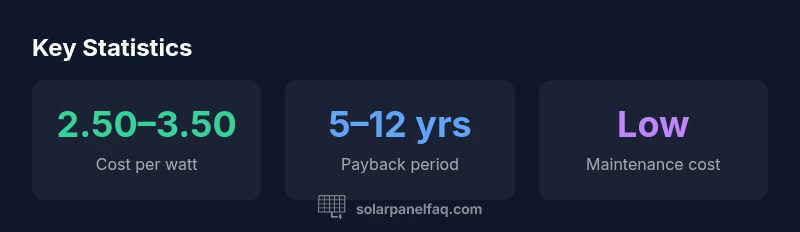
Maintenance costs and longevity\n\nSolar systems are known for low ongoing maintenance. Most components have long warranties, often spanning 20–25 years or more for panels and 10–15 for inverters. Routine maintenance typically involves cleaning and inspection to ensure performance remains close to ideal, with inverter replacements occurring within the system’s lifecycle. While maintenance costs exist, they are a small fraction of initial outlay and contribute to sustained energy production. Solar Panel FAQ notes that a well-maintained system can operate for decades, preserving value and reducing ongoing energy expenses.
Practical steps to estimate your own costs\n\nTo estimate your own costs accurately, start with your current energy usage by reviewing your past 12 months of utility bills. 1) Gather quotes from at least three local installers, ensuring each quote includes the same scope of work. 2) Ask for a clear breakdown of upfront costs, ongoing maintenance, and any monitoring fees. 3) List available incentives, both federal and state, and any utility rebates. 4) Estimate your expected energy production based on roof orientation and shading, using installer-provided production estimates. 5) Build a simple cash-flow model: upfront price minus incentives, then annual savings minus maintenance costs, and finally the potential value if you sell the home. 6) Compare financing options side by side to determine the lowest total cost of ownership over the system’s life. This practical approach helps homeowners make informed decisions without relying on optimistic assumptions.
Real-world scenarios: stories and mistakes to avoid\n\nReal-world examples illustrate how costs translate into value. Some homeowners start with grand plans and large systems, only to find their actual energy needs were overestimated. Others maximize value by pairing solar with energy storage, enabling more consumption of generated power. Common mistakes include underestimating roof age, ignoring shading, and failing to obtain multiple quotes. Solar Panel FAQ emphasizes doing due diligence: measure your electricity usage, verify warranties, and confirm maintenance terms before signing. By prioritizing data-driven estimates and a conservative financial plan, homeowners build resilience against price fluctuations and policy changes.
High-level costs and savingsSnapshot for planning
| Aspect | Typical Range | Notes |
|---|---|---|
| Installed cost (before incentives) | varies widely; several thousand to tens of thousands | Depends on system size, roof, and installer |
| Payback period | 5–12 years | Depends on usage and rates |
| System lifespan | 25–30 years | Includes warranties |
| Incentives impact | Region-dependent | Federal/state programs and utility rebates |
Frequently Asked Questions
Is solar expensive upfront for a typical home?
Yes, upfront costs can be substantial, but quotes vary widely by home and installer. Incentives and financing options can materially reduce the net price, and many households achieve meaningful savings over time.
Upfront costs can be high, but incentives and financing options help reduce the net price.
How do incentives affect total cost?
Incentives reduce the net price and can come from federal credits, state rebates, and local programs. The exact impact depends on eligibility and timing.
Incentives can significantly lower the net price, depending on your location.
What is a typical payback period?
Payback depends on energy usage and rates, as well as system performance. In many cases, homeowners see a payback of several years, with regional variation.
Payback varies by usage and rates but often spans several years.
Can I finance solar panels?
Yes. You can pursue loans, leases, or PPAs. Each option has tradeoffs in ownership, cost, and contracts; compare terms carefully.
Yes, you can finance solar with loans, leases, or PPAs.
Are solar panels worth it for renters?
Renters typically consider leasing or PPAs to access solar benefits without ownership. Long-term value depends on lease terms and who benefits from incentives.
Renters can access solar via leases or PPAs, but ownership benefits differ.
What other costs should I expect besides panels?
Permits, electrical work, roof assessment, inverter replacement, and monitoring fees can add to total costs. Plan for these beyond the panel price.
Expect permitting, wiring, and inverter costs in addition to the panels.
“Upfront costs matter, but solar panels unlock long-term value through durable performance and favorable incentives.”
Top Takeaways
- Take the upfront cost seriously, but incentives matter more than raw sticker price
- Compare multiple quotes and financing options to find the best net cost
- Your payoff depends on energy usage, rates, and production efficiency
- Maintenance is typically low and system lifespans extend over decades