Solar Panel with Battery Bank: A Practical Home Guide
Learn how to pair solar panels with a battery bank for reliable home energy. This guide covers sizing, battery choices, safety, wiring, and cost considerations for homeowners and buyers.


Learn how to design and implement a practical solar panel with battery bank system for home use. This guide covers sizing, battery types, charging safety, and installation basics. You’ll need a sunny location, a capable inverter, a charge controller, and a plan for battery storage.
What is a solar panel with battery bank?
A solar panel with battery bank combines photovoltaic panels with a bank of rechargeable batteries and an energy management system. The solar array generates DC electricity during daylight, and the battery bank stores surplus energy for later use. An inverter converts stored DC power into AC power suitable for home appliances. The configuration is designed to provide energy when the sun isn’t shining, increasing resilience and reducing grid dependence. For homeowners, the core idea is to balance generation, storage, and load so essential circuits stay powered during outages. The phrase solar panel with battery bank is a helpful shorthand for this integrated approach, and it becomes especially valuable in telework setups, garages, or off-grid adventures where reliability matters. According to Solar Panel FAQ, thoughtful sizing and proper safety practices make these systems practical for everyday living.
Why use a battery bank with solar panels?
Adding a battery bank to a solar setup offers several tangible benefits. First, it smooths out the variability of solar production, storing excess midday energy for evening or cloudy-day use. This improves self-consumption of solar energy and can reduce grid export losses. Second, a battery bank enhances resilience during grid outages, letting you power essential devices even when the utility is down. Third, storage enables peak-shifting, allowing you to use cheaper or more available solar energy when it’s most effective for your home. For many homeowners, a battery-backed system delivers greater energy independence and greater control over electricity costs. Solar Panel FAQ’s analysis shows that effective planning and safety considerations maximize value and performance for typical households.
Sizing your system: panels, batteries, and inverter
Sizing is the first critical step to a successful solar panel with battery bank installation. Start with your daily energy use in kilowatt-hours (kWh) and identify the number of days of autonomy you want (how long you want to power essential loads without solar input). Choose a battery chemistry that fits your budget and maintenance tolerance—lithium technologies offer high energy density and longer cycle life, while lead-acid options can be more affordable upfront. Then determine the inverter size based on the highest simultaneous load you expect, plus a safety margin. The charge controller must match the array’s voltage and current with the battery bank. Remember to plan for future expansion by leaving room in the racks and wiring paths, and consider local code requirements and safety clearances for installation. The goal is a balanced system that charges efficiently, stores enough energy, and delivers reliable power when needed.
Battery chemistry basics: lead-acid vs lithium
Battery chemistry determines durability, maintenance, and cost. Lead-acid batteries, including flooded and AGM types, are usually cheaper upfront but require regular maintenance and have shorter cycle life. Lithium-ion batteries, such as lithium iron phosphate (LFP), offer higher energy density, longer lifespan, and lower weight, but come with higher upfront costs. In both cases, you should size the bank to meet your autonomy needs and ensure the chemistry supports your cycling profile. Temperature sensitivity matters; batteries perform best within recommended ranges, so consider a climate-controlled enclosure or venting for flooded designs. For most homeowners seeking long-term reliability, lithium-based options are increasingly favored, but the final choice depends on budget, space, and maintenance capacity.
Inverter, charge controller, and safety devices
The inverter is the bridge between DC storage and AC home loads. Select an inverter with enough continuous power for your peak load plus a margin; many households benefit from a slightly oversized unit to avoid overloading. The charge controller protects the battery bank from overcharging and may offer MPPT (maximum power point tracking) to maximize solar harvest. Safety devices such as DC fuses, AC breakers, proper grounding, and a dedicated disconnect switch are essential. Install all components per manufacturer guidelines and local electrical codes. Proper cable sizing and secure mounting reduce losses and improve safety and reliability. A well-designed control strategy ensures the correct sequencing of charging and discharging operations.
Wiring and safety considerations
Wiring a solar panel with battery bank involves several layers: wiring from panels to the charge controller, from the controller to the battery bank, and from the inverter to the house. Use appropriately rated conductors, weatherproof enclosures, and professional-grade connectors. Keep DC wiring separate from AC wiring to minimize interference and safety risks. Install fuses or breakers close to the battery bank to protect against fault currents, and route cables away from heat sources and sharp edges. Grounding and bonding are critical to prevent shock hazards and equipment damage. Always follow local electrical codes and manufacturer instructions; when in doubt, consult a licensed electrician.
Operating costs, maintenance, and payback
A solar panel with battery bank incurs upfront costs for panels, battery storage, inverters, and installation, followed by ongoing maintenance and occasional battery replacements. Maintenance generally involves inspecting connections, cleaning panels, and monitoring performance, rather than heavy routine labor. Battery health degrades over time and is the single biggest ongoing cost in the system; lithium chemistries tend to last longer, reducing replacement frequency. Payback depends on local electricity rates, solar yields, and the battery’s usable life. While exact numbers vary, a well-sized system can deliver meaningful reductions in electricity bills and provide resilience during outages. Solar Panel FAQ emphasizes planning and quality components to maximize value over time.
Choosing professional installation vs DIY considerations
Deciding between professional installation and a DIY approach hinges on safety, local codes, and comfort with electrical work. A licensed installer can navigate permitting, grid interconnection, and warranty protection more smoothly while ensuring compliance with safety standards. For homeowners who pursue DIY, start with smaller, non-critical subsystems or a modular battery solution and proceed cautiously, ensuring you have a solid understanding of wiring practices and local regulations. In both cases, document every component, rating, and warranty to simplify future maintenance or upgrades. Solar Panel FAQ recommends transparency about skill level and adherence to safety rules to protect your home and investment.
Common misconceptions and troubleshooting basics
Common myths include the belief that more panels automatically equal better performance or that all battery banks are interchangeable. Actual performance depends on matching the panel output with the battery bank’s charging needs and the inverter’s capacity. If you notice rapid voltage drops, unexpected shutdowns, or reduced storage, check the battery health, wiring connections, and controller settings. Regular cleaning of panels and verification of seal integrity around enclosures help sustain efficiency. By understanding load profiles and weather patterns, you can optimize performance and avoid unnecessary wear.
Tools & Materials
- Solar panels (appropriate wattage for your needs)(Consider a modular layout for expansion; include mounting hardware)
- Battery bank (lithium or lead-acid)(Choose chemistry based on budget, maintenance, and lifecycle)
- Inverter (sized for peak load + margin)(Pure sine wave preferred for sensitive electronics)
- Charge controller (MPPT recommended)(Match voltage/current to panel array and battery bank)
- Racking and mounting hardware(Secure mounting with proper weatherproofing)
- DC disconnects and AC breakers(Critical for safety and serviceability)
- Appropriate gauge cabling and interconnects(Sizing depends on current and distance)
- Fuse blocks, bus bars, and enclosure(Prevent fault currents and enclosure for batteries)
- Grounding equipment and bonding strap(Essential for electrical safety)
- Battery enclosure or rack(Ventilation for certain chemistries; lockable if kids/pets nearby)
- Monitoring hardware (optional but recommended)(Monitor battery health, charge state, and output remotely)
Steps
Estimated time: 6-12 hours
- 1
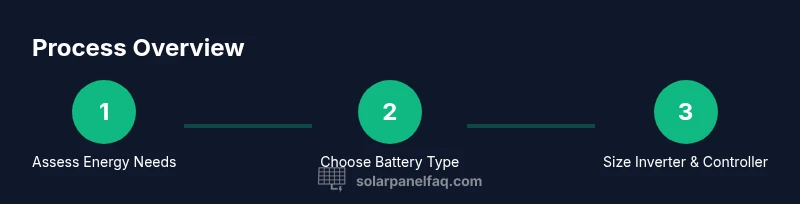
Assess energy needs and site
Determine daily energy consumption, essential loads, and desired autonomy. Use utility bills or a home energy monitor to quantify kWh. Plan for future needs and confirm a sunny location with minimal shading for solar exposure.
Tip: Document your peak usage times to optimize battery charging cycles. - 2
Select battery chemistry and capacity
Choose lithium for longevity or lead-acid for lower upfront costs. Size the bank to meet your autonomy goal and consider temperature tolerance and maintenance requirements.
Tip: Estimate depth of discharge limits to maximize lifecycle, and factor temperature into capacity planning. - 3
Size panels, inverter, and controller
Match panel output to controller and battery charging needs. Size the inverter to cover the maximum planned load with a safety margin. Plan wiring routes and cable gauges early.
Tip: Choose an MPPT controller to maximize harvest in variable light conditions. - 4
Install battery bank and safety devices
Mount the battery bank in a ventilated, secure enclosure. Install fuses, disconnects, and bonding as required by code. Verify grounding and moisture protection.
Tip: Keep batteries upright and secure; avoid stacking heavy units without proper racks. - 5
Wire inverter, charge controller, and panels
Connect the battery bank to the controller, then to the inverter. Route solar cables from panels to the controller with appropriate seals and strain relief. Use color-coded wiring and labeled components.
Tip: Double-check polarity and torque specs before final power-up. - 6
Test, monitor, and optimize
Power-on and verify charging, discharging, and regulation. Use monitoring software to track voltage, SOC, and temperature. Adjust timers and loads to optimize efficiency.
Tip: Run a full-load test and confirm safety interlocks and alarms are functioning.
Frequently Asked Questions
What sizes do I need for a solar panel with a battery bank?
System size depends on daily energy use, desired autonomy, and local sun hours. Start by calculating daily kWh needs, then choose panel wattage and battery capacity to meet that demand with a comfortable safety margin.
First, estimate your daily energy use and desired backup days, then pick panels and batteries that cover that demand with some headroom.
Can I install a solar panel with a battery bank myself?
DIY is possible for small, modular systems, but grid-tied or large off-grid setups involve electrical work and permitting. A licensed installer ensures safety, code compliance, and warranty protection.
DIY can work for simple setups, but for safety and codes, consider a licensed installer for larger systems.
What battery chemistries are common in these systems?
Common options include lithium-based chemistries like LFP for longevity and higher cycles, and lead-acid variants for lower upfront costs. Your choice affects price, maintenance, and lifecycle.
Lithium options last longer and are lighter, while lead-acid batteries are usually cheaper upfront but require more maintenance.
What safety concerns should I know?
Battery storage requires proper enclosure, ventilation (for certain chemistries), and protective disconnects. Always follow manufacturer instructions and local electrical codes to prevent shocks, fires, or gas buildup.
Ventilate where needed, use disconnects, and follow codes to avoid shocks or fires.
How much does a system with battery storage typically cost?
Costs vary with battery chemistry, inverter size, and installation complexity. Budget for components, permitting, and professional services. Prices can range widely, so a detailed quote is essential.
Prices vary a lot; get a detailed quote that covers components and installation.
How does a battery bank affect home energy use?
A battery bank shifts energy use from daylight hours to times of higher demand or outages. It can increase energy independence and reduce peak-grid consumption when paired with smart controls.
It helps you use stored energy when you need it, reducing peak grid use.
Watch Video
Top Takeaways
- Define exact energy needs before selecting components
- Choose battery chemistry based on budget and maintenance tolerance
- Size is king: balance panels, controller, battery, and inverter
- Prioritize safety devices and proper enclosure
- Warranty and professional installation improve long-term reliability