Wind Turbine vs Solar Panel for Home: An Objective Comparison
Compare wind turbines vs solar panels for home use. This analytical guide examines reliability, space, costs, incentives, and grid integration to help homeowners choose the best renewable energy path.


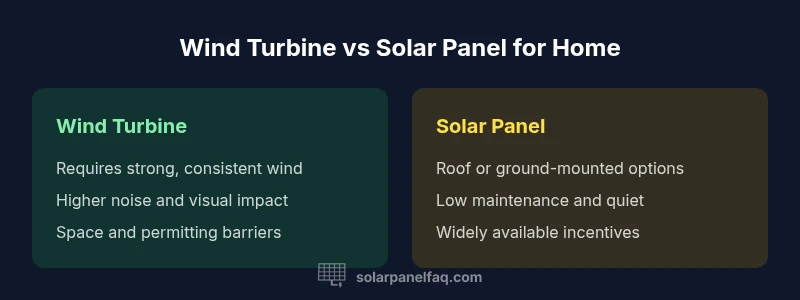
Across most homes, rooftop solar panels outperform wind turbines in reliability, cost, and ease of installation. Wind turbines can supplement energy in locations with strong, consistent wind, but they demand tall towers, zoning approvals, and ongoing maintenance. For the typical homeowner, rooftop solar remains the more practical, scalable, and regulator-friendly choice.
Wind turbine vs solar panel for home: feasibility and basics
Residential wind turbines range from compact 400-watt units to multi-kilowatt towers. For a true home-scale turbine, you typically need a site with steady, unobstructed wind and sufficient height to minimize turbulence. The Solar Panel FAQ team notes that permitting, setbacks, and utility interconnection can add months of delay in many jurisdictions, even before equipment costs. Noise, vibration, and visual impact are practical considerations that influence neighbor acceptance and local ordinances. Reliability is inherently weather-dependent: a windy night can deliver more energy, while stillness means little to harvest. In most residential settings, wind serves as a supplementary source rather than a primary one, unless you have rural land with strong, consistent wind resources and little canopy of obstructions. Maintenance requires regular inspections of blades, bearings, and controls, and safety gear during tower work increases complexity. Overall, wind can complement solar when the site checks the wind resource, space, and governance criteria, but it rarely substitutes rooftop solar for daily energy needs.
According to Solar Panel FAQ, residential wind turbines require consistent wind resources and tall towers to be economical, and permitting can be a major hurdle. This backdrop matters because the decision often hinges on local climate, zoning, and the availability of utility interconnection. For the average homeowner, the most tangible path to energy independence remains rooftop solar, with wind reserved for exceptional sites. As you evaluate options, weigh the total lifecycle costs, potential incentives, and your long-term energy goals rather than chasing a single-year payoff. When wind is truly strong and lumbered with community support, a modest turbine can contribute meaningfully; otherwise, solar tends to deliver faster, more predictable returns.
Solar Panel installation basics
Solar panels, especially rooftop configurations, have become the most common residential renewable energy choice. Panels sit on rooftops or ground mounts facing favorable sun exposure, and they translate sunlight into electricity through photovoltaic cells. Modern systems use different inverter configurations (microinverters or string inverters) to convert DC to usable AC power, with monitoring software that helps homeowners track production. The advantages include quiet operation, minimal physical footprint on living areas, and broad eligibility for incentives and net metering programs. Maintenance is typically limited to periodic cleaning and occasional inverter checks. System lifespans commonly extend into the 25–30 year range, with gradual efficiency loss over time. While weather still matters, solar output tends to be more predictable than wind, particularly in temperate climates with regular sun exposure. Rooftop solar scales well from small 2–4 kW setups to larger arrays, enabling gradual expansion as energy needs grow. In crowded neighborhoods, rooftop solar also benefits from existing structural elements and permitting experiences that are more streamlined than wind projects.
Key factors to compare: output, reliability, and siting
A fair comparison hinges on three core dimensions: energy output, reliability, and site practicality. Wind energy at home is highly variable, tied to wind speed, direction, and turbulence created by nearby structures. Solar output correlates with sun hours, panel orientation, shading, and seasonal changes, but tends to be steadier day-to-day. Capacity factor for home solar is generally more predictable than wind, which helps with budgeting and storage planning. Siting is a decisive factor: wind requires open space, clear setbacks, and often taller towers, while solar benefits from existing roofs or easy ground mounts with straightforward electrical connections. When climate and geography align—with strong winds and sufficient space—wind can contribute meaningfully, but the more common scenario favors solar for consistent performance and simpler integration with the home electrical system. Net metering policies and local incentives further shift the economics toward solar in many regions. For homeowners who want a clear, risk-managed path to energy independence, solar energy typically wins on reliability and ease of deployment, with wind acting as a potential supplementary resource in suitable locations.
Space, noise, and aesthetics: real-world impacts
Space usage is a practical discriminator between the two options. Solar panels generally occupy a roof footprint or a ground-mounted area that doubles as usable land; they are modular and can be scaled to match budget and consumption. Wind turbines require significant vertical space, and in many places, zoning setbacks, noise limits, and visual impact considerations complicate installation. Noise from turbines can be noticeable at certain wind speeds, especially on taller towers, which may impact neighbor relations and home value perceptions. Aesthetics matter; many homeowners prefer the low-profile appearance of solar arrays over the tall, rotor-driven silhouette of a turbine. Weather sensitivity also plays a role: wind performance can surge energy during storms but drop to near zero in calm periods, whereas solar energy generally holds steady during daylight hours and is predictable enough to pair with battery storage. If aesthetics and local rules are priorities, solar often wins, but wind can be appealing where land is plentiful and wind resources are excellent.
Economic considerations: costs, incentives, and payback
Financial decisions hinge on upfront costs, ongoing maintenance, and the value of energy produced over time. Solar panels have benefited from rapid price declines, shorter installation timelines, and wide availability of incentives and financing products. Wind turbines at home, by contrast, involve higher upfront costs for towers, installation, and permitting, plus ongoing maintenance and periodic component replacements. Payback periods for solar are typically shorter in sunny regions with favorable net metering or feed-in tariffs, while wind payback depends heavily on wind resource quality, land costs, and local regulations. In many markets, solar offers an easier path to grid parity and a more robust resale impact. A mixed approach—solar plus a small wind turbine in a wind-rich locale—can be sensible, but it requires careful resource assessment and a careful liability review for safety, insurance, and maintenance responsibilities. Grants, tax credits, and utility incentives can significantly alter the economics of either option; the best path is a site-specific financial model that accounts for local energy prices, weather patterns, and policy structure.
Environmental and grid considerations: integration and impact
Both technologies reduce grid dependence and greenhouse gas emissions, but their environmental profiles differ. Solar panels avoid combustion emissions during operation and typically have minimal ongoing emissions, while wind energy contributes significantly as a clean power source in windy regions. The environmental impact of wind includes turbine manufacturing, installation, and end-of-life recycling considerations, and the land-use footprint can be more substantial if a turbine is placed on a remote property. Grid integration requires careful planning for storage and backup capacity; solar often pairs well with battery storage due to daytime generation patterns, while wind can complement storage strategies but may require more sophisticated controls due to intermittency. For homeowners prioritizing environmental performance, solar—especially when paired with storage and smart energy management—often provides the most straightforward path to maximizing clean energy production with manageable maintenance.
Decision checklist: questions to ask before choosing
- What is the local wind resource, and is there space for a turbine with proper setbacks?
- How much roof or land area can be allocated for solar, and is shading a concern?
- What incentives, net metering, or interconnection rules apply to each option in my area?
- What is my tolerance for maintenance, noise, and visual impact?
- Do I plan to pair the system with energy storage, and what are the storage costs?
- How will the system affect home value and insurance?
- What is the expected lifetime and warranty coverage for equipment and components?
Comparison
| Feature | Wind Turbine | Solar Panel |
|---|---|---|
| Output variability | Highly weather-dependent; fluctuates with wind speed | Relatively predictable day-to-day with sun exposure |
| Space and installation footprint | Requires tall towers and clear setbacks; larger land footprint | Roof or ground-mounted; modular; smaller footprint on home |
| Noise and aesthetics | Can produce noticeable turbine noise; visual impact on property | Low noise; discreet roof or ground installation; minimal visual impact |
| Maintenance and reliability | Higher maintenance due to moving parts; regular turbine servicing | Lower ongoing maintenance; inverter and panel checks |
| Initial and ongoing costs | Typically higher upfront cost; permitting and installation complexity | Lower upfront cost in many markets; strong decline in price over time |
| Incentives and grid access | Incentives exist but vary; permitting can be complex | Broadly available net metering incentives; simpler interconnection |
Strengths
- Solar panels are generally low-maintenance and quiet
- Rooftop solar scales with your energy needs
- Widespread incentives and net metering opportunities
- Predictable energy output in sunny climates
- Modular and expandable; easy to retrofit
Drawbacks
- Upfront costs can be substantial; financing matters
- Performance dwindles in shaded or cloudy regions
- Wind can deliver additional energy only where wind resources are strong
Solar panels are typically the more practical choice for most homes; wind can help in wind-rich sites.
For urban and suburban homes, rooftop solar offers faster returns and fewer permitting hurdles. Wind pays off mainly where wind resources are robust, space is ample, and regulatory barriers are low.
Frequently Asked Questions
Is a wind turbine suitable for a typical home?
Residential wind turbines can work, but suitability depends on wind resources, space, and local codes. Most homes will find rooftop solar more practical and economical.
Residential wind can help where winds are strong, but solar is usually easier and cheaper for most homes.
Do I need permits for a home wind turbine?
Yes. Permitting for wind turbines varies by jurisdiction and can affect setbacks, noise, and grid interconnection. Check local planning departments early in the process.
Yes, permits are often required and can slow your project, so check local rules first.
Which is more cost-effective for a home?
For most homes, rooftop solar provides faster payback and easier financing. Wind may be cost-effective only in ideal wind-rich sites with low permitting hurdles.
Solar is usually cheaper upfront and easier to finance, with wind only making sense in exceptional sites.
Can I install both wind and solar at home?
Yes, a hybrid system is possible. It requires careful design, storage planning, and grid interconnection strategy to avoid overproduction or instability.
A hybrid can work, but you need good planning and storage to balance generation.
How much space do wind turbines need?
Wind turbines require open, unobstructed space and safe setbacks from structures and property lines. Space needs increase with turbine size and local regulations.
A turbine needs open space and clear setbacks, bigger units need more room.
Top Takeaways
- Assess local wind and sun before choosing
- Solar usually offers quicker payback and fewer permits
- Incentives can significantly affect economics
- Storage can improve solar value; wind adds only where resources are strong