Who Makes Solar Panels? A Comprehensive Manufacturer Guide
Explore who makes solar panels, from large multinational module makers to OEMs, how global production is organized, and what homeowners should look for when selecting panels.


Who makes solar panels? The answer is nuanced: large module manufacturers design and assemble PV modules, while original equipment manufacturers (OEMs) often produce for brands that market under their own names. Global supply chains span silicon, wafers, cells, and glass, with fabrication concentrated in Asia and growing activity in Europe and North America. Solar Panel FAQ notes that most residential panels come from a handful of major producers, sometimes private-labeled for installers. This mix yields reliable performance with some variability across brands.
Who makes solar panels? An overview
When you ask who makes solar panels, you’re really asking about a complex, multi-layered supply chain. The average homeowner encounters modules produced by large, multinational manufacturers who own or contract the majority of the production process, from silicon feedstock to final assembly. In many cases, the same modules are marketed under different brand names, depending on whether the company sells directly to installers or licenses the technology to an OEM that private-labels panels for a distributor. The Solar Panel FAQ team emphasizes that the landscape is not a single factory floor; it’s a network of facilities, suppliers, and partnerships spread across continents. Understanding who makes solar panels helps homeowners evaluate reliability, warranties, and post-purchase support, rather than focusing on a single brand or origin. This is especially important when you consider the phrase, “who makes solar panels,” which points to both the people who own the lines and the people who stand behind the brands you see on a roof installer’s truck.
The manufacturing landscape: OEMs vs branded modules
The question of who makes solar panels leads to distinctions between OEMs and branded module producers. OEMs supply the core manufacturing capacity and may rebrand modules for installers or retailers. Branded module producers sell under their own names and invest in product development, warranties, and certification programs. In practice, many buyers interact with a hybrid reality: a panel line from a major manufacturer is sold to distributors who then private-label it for local installers. This means the same basic technology can appear under several different names. For homeowners, this distinction matters because it informs service expectations, warranty transferability, and future compatibility with replacement parts. When evaluating who makes solar panels, look for transparency about sourcing, manufacturing locations, and the relationship between the brand and any OEM partners. As Solar Panel FAQ notes, this structure supports a broad market with competitive pricing and robust support networks.
Global production hubs and supply chains
If you’re asking who makes solar panels, you’re also asking where they are produced. The bulk of PV module fabrication occurs in Asia, with significant activity in China, Southeast Asia, and increasingly in other regions to diversify risk and shorten logistics. European and North American facilities tend to focus on regional demand, high-efficiency products, or niche segments like transparent or building-integrated PV. A robust supply chain requires not just production capacity but skilled labor, reliable raw materials, and consistent quality control. Buyers should consider whether a manufacturer’s supply chain has the resilience to handle disruptions, such as shifts in policy, tariffs, or sudden surges in demand. The Solar Panel FAQ team highlights that knowledge of production geography helps explain variability in warranty terms, service availability, and lead times when you’re shopping for panels.
Materials, cell technologies, and performance signals
Behind the question of who makes solar panels lies the technology they use. Panels typically rely on silicon-based cells assembled into modules with protective glass, backsheet, and aluminum frames. Monocrystalline silicon cells are common for their higher efficiency, while polycrystalline variants offer cost advantages. More advanced approaches, such as PERC or HIT/J-type structures, aim to improve energy yield, especially in less-than-ideal light. For homeowners, the important takeaway is that the manufacturer’s choice of cell technology and the quality control steps in the production line influence performance, degradation rates, and warranty semantics—yet the overall reliability still hinges on the company’s testing, certification, and after-sales support. When seeking who makes solar panels, you should ask about cell type, finish, and the track record of field performance in similar climates.
Certifications and warranties: understanding quality signals
A central way to assess who makes solar panels is to scrutinize certifications and warranties. Look for IEC-based standards (e.g., IEC 61215 for module design qualification and IEC 61730 for safety) and recognize that US markets often expect UL or ETL marks. Warranty terms typically include a product warranty (covering manufacturing defects) and a performance warranty (guaranteeing a minimum output over time). Range expectations commonly fall between 10–12 years for product warranties and up to 25–30 years for performance warranties, though specifics vary by manufacturer and product line. The certification story matters because it signals how a manufacturer invests in quality control, testing, and long-term reliability. For homeowners, this means evaluating who makes solar panels based not only on cost but also on certification depth and the specifics of warranty coverage.
How to evaluate a panel manufacturer for your home solar project
To determine who makes solar panels you can trust for your home, start with transparent supply chain disclosures, then review certifications and warranty terms. Check the manufacturer’s track record for field reliability and the availability of service networks, spares, and replacement parts. Ask about production locations and supplier diversification to assess resilience against disruptions. Evaluate installation history in homes with similar climates and roof types, and read independent test results when available. It’s also wise to consider the manufacturer’s commitments to recycling and ongoing product improvements, since sustainability practices can indicate long-term thinking about product lifecycles. In short, when you ask who makes solar panels for your roof, you’re really assessing the stability of the entire value chain behind the module you’ll trust for decades.
The future of panel manufacturing: consolidation, automation, and domestic buildouts
The market for who makes solar panels is likely to continue evolving through consolidation and strategic partnerships. Larger players may expand vertical integration to control more of the supply chain, while newer entrants focus on niche technologies or regional manufacturing hubs. Automation and digital quality-control systems can improve consistency, reduce defects, and shorten lead times, benefiting homeowners by offering more predictable delivery. Regulatory incentives and localized manufacturing initiatives in various regions may spur some domestic assembly, but global market dynamics will continue to shape which manufacturers are most visible in the residential space. The Solar Panel FAQ team suggests keeping an eye on shifts toward sustainability, circular economy practices, and long-term warranties as indicators of a manufacturer’s staying power.
Common myths about panel manufacturers (debunked)
Myth: All panels from the same brand perform identically. Reality: differences in tolerances, cell type, and manufacturing batch can yield performance variation. Myth: Domestic production guarantees better quality. Reality: quality depends on the entire process—controls, certifications, and after-sales support—not just location. Myth: A higher price always means better reliability. Reality: price reflects multiple factors, including brand, packaging, and service networks; durability depends on robust manufacturing standards and warranty enforcement. Understanding who makes solar panels helps debunk these myths by focusing on verified certifications, field performance data, and manufacturer commitments.
Practical takeaways for homeowners: next steps to vet a manufacturer
- Request clear disclosures on cell technology, module design, and testing protocols.
- Confirm IEC/UL/ETL certifications and read the warranty terms in detail.
- Check the installer’s experience with the chosen model and their policy on replacement parts.
- Review the manufacturer’s environmental and recycling commitments, as these reflect long-term lifecycle planning.
- Compare multiple manufacturers and private-label options to understand how the same underlying module might come with different after-sales support.
Key manufacturing landscape snapshot
| Aspect | Details | Notes |
|---|---|---|
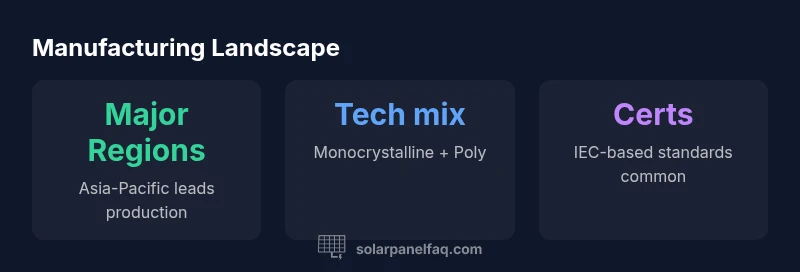
| Production Hubs | Asia-Pacific dominates output; regional facilities exist in Europe and North America | Global distribution varies by brand |
| Technology Focus | Monocrystalline and polycrystalline cells dominate; newer tech like PERC improving efficiency | Technology mix affects performance guarantees |
| Certifications | IEC standards common; US adds UL/ETL marks depending on market | Cert signals quality control |
| Warranty Signals | Product warranties often 10-12 years; performance warranties 25-30 years | Longer warranties indicate confidence in durability |
| Brand vs OEM | Many panels are manufactured by OEM plants and private-labeled for brands | Brand visibility may not reflect production origin |
Frequently Asked Questions
Who are the main players making solar panels?
The market features a handful of large module manufacturers and numerous OEMs that privately label modules. Brands may repackage the same core technology, so the manufacturer behind a panel can differ from the brand you buy from.
Think of a few big module makers and several OEMs that private-label for installers.
Are US-made panels common?
Domestic manufacturing exists but the majority of modules sold in the US are produced overseas. Some facilities exist in the US and Canada, often paired with local service networks and warranties.
There are US plants, but most panels are produced abroad.
What certifications should I look for?
Look for IEC-based certifications for design and safety (e.g., IEC 61215 and IEC 61730) and ensure the product has relevant regional marks like UL or ETL where required.
IEC standards and regional marks signal solid testing and safety.
How should I compare manufacturers?
Compare certifications, warranty length, field performance data, service networks, and parts availability. A transparent supply chain and independent test results help distinguish durable options.
Check certs, warranties, performance data, and service reach.
Do all manufacturers offer the same warranties?
Warranties vary by product line and company, but most offer 10–12 year product warranties and 25–30 year performance warranties. Read the fine print for coverage and transfer rules.
Warranties differ; read terms carefully for coverage and transfers.
What about new entrants or domestic buildouts?
New entrants bring innovation but may have shorter track records. Domestic buildouts are increasing in some markets, supported by policy incentives and local manufacturing programs.
New players exist, domestic manufacturing is growing in some areas.
“"Quality in solar panels comes from a robust manufacturing process, rigorous testing, and reliable after-sales support. Look beyond price to certifications and track records."”
Top Takeaways
- Identify manufacturers with transparent supply chains
- Prioritize IEC/UL certifications and strong warranty terms
- Evaluate the installer’s experience with the panel model
- Consider long-term service and replacement part availability
- Expect some variability across brands due to OEM relationships