What You Need to Make a Solar Panel: A Complete DIY Guide
Learn what you need to make a solar panel, from essential components and tools to a safe, step-by-step workflow for homeowners exploring DIY solar projects.


By the end, you’ll understand what you need to make a solar panel, whether you choose a kit or raw cells, and the practical steps to assemble, encapsulate, and test a small panel. This guide covers essential materials, a safe workflow, and common pitfalls for homeowners exploring DIY solar projects.
What do you need to make a solar panel: overview
If you're asking what do you need to make a solar panel, the straightforward answer is that most homeowners start with a prepared kit or pre-cut cells rather than trying to fabricate cells from scratch. According to Solar Panel FAQ, beginners should focus on safety, reliability, and modest performance goals. A DIY solar panel kit typically provides pre-cut solar cells, bus wires, encapsulation material, a cover glass, back sheet, and a frame, plus connectors and a junction box. If you choose to work from raw cells, be prepared for more challenging assembly, precise alignment, and careful handling of fragile photovoltaic cells. In either path, the core requirements are a clean workspace, protective PPE, a reliable wiring plan, and an enclosure capable of withstanding sunlight and weather. This section outlines the essential decision points and sets expectations for a practical, hands-on learning experience. By the end, you'll have a clear sense of which approach matches your skills and goals, and you'll know the major components you will work with before you begin assembling any panel.
Core components you can assemble yourself
A solar panel is a compact electrical device that relies on carefully arranged cells and protective layers. If you are asking what you need to make a solar panel, start with two categories: the cells themselves and the protective module that holds them. Key components include:
- Photovoltaic cells: typically crystalline silicon cells (mono- or polycrystalline). Prefer pre-cut, tabbed cells to simplify wiring and reduce breakage.
- Tabbing and bus wires: copper ribbons to connect cells in series or parallel.
- Encapsulant material: UV-stable polymers (like EVA) that seal cells from moisture and mechanical stress.
- Front cover: tempered glass or clear polycarbonate to protect while letting light pass.
- Back sheet: durable, weather-resistant layer providing electrical isolation.
- Junction box and connectors: weatherproof box for safe external wiring.
- Sealing and mounting hardware: sealants, edge clips, and a frame to hold the panel together.
- Electrical safety gear: insulated tools, gloves, and eye protection for handling ribbons and soldering.
- Testing equipment: a multimeter or solar simulator to verify voltage and current before final assembly.
Collectively, these items form the structural and electrical foundation for a functional prototype. Handle cells carefully and align components precisely to maximize output and longevity.
Two pathways: kit-based vs raw-cell approach
There are two common routes to a DIY solar panel. The kit-based approach emphasizes safety, consistency, and faster results, while the raw-cell approach teaches deeper technical understanding but requires precise handling and more time. In a kit, you’ll typically receive pre-cut cells, encapsulant, cover glass, a back sheet, and a frame, with clear wiring diagrams. In a raw-cell project, you’ll buy individual cells and assemble them into strings, then encapsulate and seal. Both paths require attention to layout (series vs. parallel connections) and a robust enclosure to withstand weather. Beginners often start with a kit to learn the basics and gradually move to a semi-custom build if they want to experiment with panel size or cell types. Regardless of path, the goal is to balance safety, reliability, and learning outcomes while producing a usable, small-scale power source.
Tools and workspace setup
Before you touch a single cell, prepare a dedicated workspace that is dry, well-ventilated, and free from dust. You’ll need a sturdy workbench, good lighting, and a place to lay out cells without risking damage. Gather essential tools and PPE: insulated pliers, a desoldering tool, a fine-tip soldering iron, flux, a utility knife, a ruler or calipers for precise cutting, and safety glasses. Have cleaning supplies on hand to wipe surfaces and remove residues, plus a small fan or ventilation for fumes when encapsulating. A non-slip mat, clamps, and tape will help hold components steady during wiring. Finally, plan cable routing and drainage so the final panel can be mounted securely and weatherproofed effectively.
Wiring basics and safety concepts
Wiring a solar panel involves connecting cells in a deliberate configuration to achieve the desired voltage and current. Decide early whether you want a series connection (higher voltage, lower current) or a parallel connection (lower voltage, higher current). Use appropriate connectors and termination methods, and consider bypass diodes to protect cells from shading. Always work with the system de-energized, and verify that all connections are secure and insulated. Label all leads and keep a simple wiring diagram handy during assembly. For safety, avoid metal jewelry, keep liquids away from wiring areas, and use insulated tools throughout the process.
Encapsulation, protection, and durability
Encapsulation is critical for long-term durability. The encapsulant (often EVA) seals cells from moisture and mechanical stress, while a front cover of tempered glass or polycarbonate protects against impacts and UV exposure. Ensure proper lamination pressure and uniform curing to prevent air pockets. The back sheet provides insulation and helps prevent electrical faults. Proper sealing around edges and junction boxes reduces the risk of water intrusion. A well-sealed panel performs better in harsh climates and lasts longer, which matters for homeowners who plan to install and maintain their own solar setups.
Testing, performance checks, and labeling
Once assembled, test the panel under sunlight using a multimeter to measure open-circuit voltage and short-circuit current. Compare readings against your intended configuration to confirm consistency across strings. Check for hotspots, loose connections, and any optically hazy areas in the cover. Affix clear labels with safety information, electrical ratings, and installation date. If possible, test the completed panel with a small load to verify practical output. Document results for future maintenance and potential improvements. Regular maintenance includes cleaning the cover and inspecting seals for signs of wear.
DIY vs commercial panels: expectations and trade-offs
DIY panels offer a practical, educational path but may not match the efficiency, durability, and warranty of commercial modules. They are excellent for learning concepts, experimenting with cell types, and powering small, low-demand devices. Commercial panels typically deliver consistent performance, robust warranties, and tested durability. When deciding, balance your learning objectives, budget, expected lifespan, and how you’ll install and maintain the panel. If you plan a roof installation, factor in local building codes, permits, and potential safety requirements. A well-planned DIY project can be rewarding, especially when approached with safety and ongoing learning in mind.
Common mistakes to avoid and maintenance notes
Common pitfalls include mishandling fragile cells, miswiring strings, insufficient encapsulation, and neglecting weatherproofing around edges or junction boxes. Plan for contingencies, such as recalibrating connections after shading changes or seasons. Regular maintenance is simple but essential: clean the cover, inspect seals annually, and check for corrosion on connectors. If you observe a drop in performance, recheck wiring continuity, seals, and laminate integrity. Remember that a DIY panel is a learning tool first and a power source second, so set realistic expectations and use protective gear at every step.
AUTHORITY SOURCES
For further reading and validation, refer to authoritative sources:
- https://www.energy.gov/eere/solar
- https://www.nrel.gov/
- https://iea.org/reports/solar-pv
Tools & Materials
- Photovoltaic cells (pre-cut, tabbed recommended)(Prefer mono- or polycrystalline cells with standard tabbing to simplify wiring.)
- Tabbing/bus wires(Copper ribbons for connecting cells in series/parallel.)
- Encapsulant material (EVA or alternative)(UV-stable and moisture-resistant.)
- Front cover (tempered glass or polycarbonate)(Protects cells while allowing light transmission.)
- Back sheet(Insulates and protects the rear side.)
- Junction box with weatherproof seals(Include entries for external wiring.)
- Frame (aluminum or robust plastic)(Supports rigidity and mounting.)
- Soldering iron and flux(Used for wiring connections between cells.)
- Multimeter or solar simulator(For testing voltage and current output.)
- Safety gear (gloves, safety glasses)(Protects against cuts, burns, and chemical exposure.)
- Silicone sealant and edge gasket(Waterproof sealing around edges.)
- Workbench, cutting tools, measuring devices(Precise cuts and alignment improve yield.)
Steps
Estimated time: Estimated total time: 6-12 hours
- 1
Plan panel size and layout
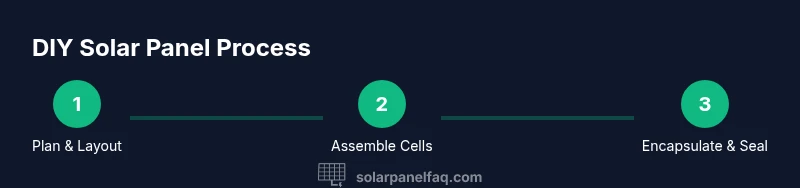
Define your target voltage and current based on the cells you have. Create a simple diagram showing how many cells will be in series and how many strings will be wired in parallel. This upfront planning reduces misalignment and wasted materials.
Tip: Draft a rough layout on paper before touching components to minimize handling of fragile cells. - 2
Set up a safe workspace
Prepare a clean, dry, well-lit area with a non-slip surface. Gather PPE, organize the components, and ensure good ventilation if you’ll be using encapsulants or adhesives. A dedicated space helps prevent accidental damage or injuries.
Tip: Keep a dedicated off-cut bin and a small shield to protect surfaces from electrical residues. - 3
Layout and connect cell strings
Place cells in your planned arrangement and begin connecting them with tabbing wires. Work slowly to avoid cracking cells and ensure each connection is soldered cleanly and insulated. Verify continuity with the multimeter as you go.
Tip: Work on a padded mat to cushion delicate cells and prevent breakage. - 4
Seal cells with encapsulant
Lay encapsulant over the cell array and apply even pressure to remove air pockets. This step protects cells from moisture and mechanical stress. Allow adequate curing time according to material guidelines.
Tip: Use a flat, smooth roller to minimize air voids during encapsulation. - 5
Attach front cover and back sheet
Place the encapsulated stack between the front cover and back sheet, aligning edges precisely. Seal the edges to prevent moisture ingress. Check for gaps that could allow air or water in.
Tip: Ensure edge seals are complete and free of wrinkles that could trap moisture. - 6
Mount frame and junction box
Secure the laminated stack into the frame and attach the junction box. Route external wiring through weatherproof grommets. Double-check that all connectors are rated for outdoor exposure.
Tip: Leave a small slack in wires to accommodate expansion and vibration without stressing connections. - 7
Make electrical connections and test continuity
Finish all external connections and perform a continuity check with a multimeter. Confirm expected open-circuit voltage for your series string and expected current for parallel configurations. Address any shorts immediately.
Tip: Power down the system before any further testing or disassembly. - 8
Perform initial functional test in sunlight
Place the panel in bright sun and measure voltage/current with the multimeter. Compare readings to your predicted values from the wiring plan. If results are significantly off, inspect wiring, connections, and encapsulation for issues.
Tip: Test under consistent sunlight conditions for repeatable results. - 9
Label, document, and plan deployment
Label the panel with safety information and electrical ratings, and log the build details for future maintenance. If you plan to install on a roof, prepare installation documentation and check local codes.
Tip: Keep a maintenance log to track performance over time. - 10
Review safety and long-term care
Review all safety steps, inspect seals, and store spare parts. Regularly inspect the panel for delamination or moisture ingress and plan periodic maintenance.
Tip: Set reminders for annual inspections and cleaning.
Frequently Asked Questions
Is it cost-effective to make your own solar panel?
DIY panels can be educational and enjoyable for hobbyists, but they are typically not cheaper per watt than commercial options when you account for time, effort, and potential inefficiencies. They’re most valuable for learning and small, low-demand applications rather than substantial energy production.
DIY solar panels are great for learning, but you should not expect the lowest possible cost per watt compared with commercial options.
Can I legally install a DIY solar panel on my roof?
Roof installations must comply with local building codes, electrical codes, and homeowner regulations. In many places, permits and inspections are required. Always consult local authorities or a licensed professional before installing a DIY panel.
Check local codes and obtain any necessary permits before installation.
What types of solar cells are best for DIY projects?
Monocrystalline cells offer higher efficiency and space efficiency, but polycrystalline cells are typically cheaper. For DIY projects, the choice depends on budget, space, and how much learning you want from handling different cell types.
Monocrystalline cells are more efficient, while polycrystalline offer lower cost for larger, hobby-scale builds.
What safety precautions should I take?
Always wear PPE, work in a dry, ventilated area, and disconnect power during testing. Be cautious with sharp edges, hot soldering work, and encapsulant materials. If unsure, seek guidance from a neutral expert or a local workshop.
Wear PPE, keep the workspace dry, and disconnect power when testing.
What is the expected output of a small DIY panel?
Output varies with cell type, size, and wiring configuration. A small, hobby-scale panel will produce measurable DC power suitable for experiments or charging small devices, but don’t expect industrial-scale performance without specialized components and expertise.
Output depends on size and configuration; use it for experiments or small devices.
Watch Video
Top Takeaways
- Plan layout before handling cells to minimize breakage.
- Kit-based builds are safer for beginners; raw-cell builds teach deeper wiring concepts.
- Encapsulation and sealing are critical for durability and weatherproofing.
- Test in bright sun and document results for future maintenance.
- Always prioritize safety and adhere to local codes when mounting.