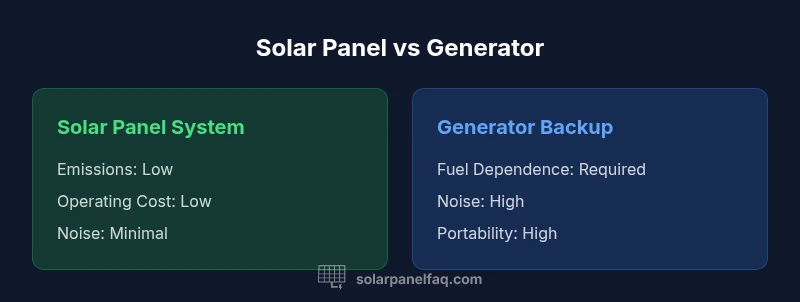
Solar Panel or Generator: Home Backup Comparison
Compare solar panel systems and generators for home backup power. Explore costs, reliability, maintenance, and environmental impact to choose the best solution for your home.


TL;DR: For most homes, solar panel or generator decisions favor solar panels due to lower operating costs, longer lifespans, and emissions-free generation when paired with storage and a smart inverter. Generators still shine for peak power surges, outages, and off-grid reliability when sun is scarce. A hybrid setup often offers the best balance.
Context and Core Considerations
Choosing between a solar panel or generator for home backup begins with clarifying what you expect from a reliable power source. At a high level, a solar panel system—especially when paired with storage and a smart inverter—offers renewable power that reduces operating costs and emissions over time. A generator, by contrast, provides immediate, controllable power on demand, independent of weather but dependent on fuel. The Solar Panel FAQ team notes that many homeowners pursue a hybrid approach: a solar array for daily needs and a generator to cover peak demands or extended outages. To decide, start by mapping your household energy profile: how many kilowatt-hours do you consume on weekdays versus weekends? Do you have high-energy appliances that run during outages, or a heat pump that needs a steady supply in winter? Sun exposure matters: if your roof faces south or west and you have space for batteries, solar can meet a large share of daytime load and cut grid reliance. If your lot is shaded, has limited roof area, or you frequently lose access to fuel during outages, a generator may offer more practical coverage. Consider the whole-life costs, not just the sticker price. Solar panels generally incur higher upfront costs but much lower operating costs, particularly when paired with storage and time-of-use optimization. A generator typically costs less upfront but carries ongoing fuel, maintenance, and noise considerations. In either case, you should factor in local incentives, permitting requirements, and the impact on home values. Finally, think about resilience: a well-designed, combined approach can provide continuous power for essential circuits even during long outages.
Cost and Value: Upfront, Operating, and Life-Cycle
Costs are the most tangible part of choosing between a solar panel or generator for home backup, but they are not the whole story. Solar panels involve a larger upfront investment, especially when you add energy storage like a battery and a modern inverter. Generator setups, by comparison, typically require less initial capital, but fuel, regular maintenance, and occasional replacement parts add up over time. When you broaden the lens to life-cycle value, solar often earns back its premium through lower operating costs, eligible incentives, and the potential to reduce grid energy use during peak pricing periods. A well-planned system can also increase home value and market appeal. In practice, expect solar-only configurations to fall in the mid-to-high upfront range, with year-by-year savings that grow as electricity prices rise and storage use expands. Generators tend to be cheaper to install initially, but ongoing fuel and maintenance costs must be budgeted. Hybrid configurations—combining solar with a generator—straddle both worlds: higher upfront than a standalone generator, but with the possibility of lower ongoing costs and greater resilience. Regional incentives, tariffs, and permitting rules can materially affect total cost, so a careful local estimate is essential. Remember that storage adds value but also complexity and cost; ensure your electrical panel and service capacity can support a larger inverter and battery storage, if you choose to pursue solar.
Reliability and Performance in Real-World Scenarios
Reliability is a core consideration when evaluating solar panel or generator options. A solar array’s reliability hinges on weather, daylight hours, and storage strategy. On bright days, a well-designed solar system with adequate storage can power common loads, run critical systems, and reduce or eliminate daytime grid purchases. In cloudy periods or at night, battery storage becomes the bridge that maintains essential services, provided the storage is sized appropriately for the home’s needs. Generators excel in reliability when fuel is readily available and maintenance is kept up to date; they deliver predictable output on demand, independent of sun. However, fuel supply, storage space, and maintenance cadence influence whether a generator is truly reliable, especially during long outages or in harsh climates. Hybrid approaches leverage the strengths of both: solar provides clean daytime energy, while a generator can cover extended outages or unexpected demand spikes when storage is insufficient. The right balance depends on the home’s energy profile, climate, and risk tolerance. In practice, many families design a defense-in-depth strategy—prioritizing critical loads and creating a graceful fallback using a generator for non-daytime periods or extreme events. Finally, integration with smart controls and load management reduces peak demand and protects battery life, increasing overall system resilience.
Environmental Impact and Sustainability
Environmental considerations are central to the solar panel vs generator conversation. Solar panels produce electricity without on-site emissions, reduce dependency on fossil fuels, and help households lower their carbon footprint over the system’s lifetime. The environmental benefits increase when storage is used to shift consumption to times of abundant solar generation, reducing peak demand on the grid. Generators emit pollutants and consume fossil fuels, which contribute to local air quality concerns and greenhouse gas emissions. Modern generators with higher efficiency engines and cleaner fuels can mitigate some impact, but they do not reach the zero-emission profile of solar when paired with storage and a clean grid. A hybrid approach can further optimize emissions by maximizing solar use while limiting generator runtime. It is also important to consider the environmental footprint of battery production and end-of-life recycling, which adds nuance to the long-term sustainability picture. In evaluating options, homeowners should weigh both operational emissions and the broader lifecycle impact to choose the most responsible path for their home and community. Solar Panel FAQ emphasizes that long-term environmental gains are most pronounced when solar is paired with energy storage and smart energy management.
Space, Installation, and Maintenance
Space considerations shape the feasibility of solar panel versus generator setups. Solar installations require suitable roof orientation and racking space for panels, plus an area for inverters and possibly a battery storage system. Ground-mounted options are viable if roof space is limited or shading is a concern, but they demand more yard space and additional safety clearances. In contrast, generators require physical footprint for the engine and exhaust, fuel storage, and sound attenuation components. Installation complexity also differs: solar installations depend on electrical work, permits, and interconnection agreements with the utility, while generators involve fuel handling, exhaust routing, and potential noise considerations. Maintenance demands diverge as well: solar systems demand periodic cleaning of panels and regular checks of storage and inverters, while generators require routine engine maintenance, oil changes, air filter replacements, and fuel management. Battery health degrades over time and may require replacement after several years, contributing to lifecycle costs and disposal considerations. For homeowners, a well-planned layout that minimizes shade on solar panels and segregates fuel storage for a generator will improve aesthetics and safety while supporting long-term reliability. Solar panels also benefit from a professional assessment of roof integrity and structural load, ensuring the system remains secure across seasons.
The Smart Hybrid Approach: Combining Solar Panels with Generators
A hybrid approach blends the best of both worlds: solar panels deliver daytime energy and daily reductions in grid use, while a generator provides dependable backup during outages or extended cloudy spells. An automatic transfer switch (ATS) and a smart hybrid inverter allow seamless switching between solar power, battery storage, and generator power without user intervention. This setup can optimize energy costs, improve resilience, and reduce generator runtime, leading to lower emissions and noise. Planning a hybrid system starts with a clear load analysis: identify essential circuits (like refrigeration, heating, medical devices) and estimate their cumulative demand. Size the solar array to meet daytime electricity needs and charge the battery to cover typical evening usage; add a generator rated for longer outage scenarios or peak loads. Regular maintenance remains essential for both systems, particularly the generator’s fuel system and the battery’s health. A hybrid system also opens the door to advanced controls such as time-of-use optimization and demand response, enabling further savings in energy costs while maintaining comfort and safety in the home. From a planning perspective, a hybrid approach usually represents a higher upfront investment but can deliver superior reliability, lower long-term operating costs, and strong environmental benefits when implemented with high-quality components and professional installation.
Decision Framework: When to Choose Each Option
When faced with the solar panel or generator decision, use a simple decision framework: assess your sun exposure and roof space, determine your critical loads, and evaluate your tolerance for maintenance and noise. If you have ample sun, a south-facing roof, and budget for storage, solar with storage typically offers the strongest balance of long-term savings and sustainability. If outages are frequent and sun is unreliable (e.g., long winters with limited daylight), a generator adds a reliable fallback that preserves essential comfort. For households seeking the most resilience and the best of both worlds, a hybrid system—solar plus a generator—often proves the most robust solution. Consider the total cost of ownership, including upfront installation, ongoing fuel or electricity costs, maintenance, battery replacement, and potential incentives or rebates. Also factor in local regulations, permitted interconnection, and grid reliability in your area. Finally, ensure you work with a qualified installer who can perform load analysis, system design, and code-compliant wiring and safety measures. A thoughtful, well-planned system aligns technology with your family’s routines and power needs, delivering comfort and peace of mind during outages and daily life alike.
Practical Scenarios and Case Studies
Consider three typical scenarios that illustrate how the solar panel vs generator decision plays out. Scenario A involves a sunny climate with moderate energy needs and a good roof; solar with storage can cover daytime usage, reduce grid dependence, and provide reliable evening power with a well-sized battery. Scenario B occurs in a region with frequent outages and variable sun; a hybrid system may deliver the strongest balance, using solar to meet most loads and a generator for extended outages or peak demand periods. Scenario C represents limited roof space or significant shading; a generator might be the simplest, lowest-cost solution for essential backup needs, though a limited solar contribution could still boost resilience if spot solar charging is possible during daylight. Across these scenarios, the role of storage, smart controls, and load management emerges as a recurring theme. Clean energy incentives and grid connections also influence the decision, often tipping the balance toward solar when available. Remember that every home’s energy profile is unique: perform a professional assessment to determine the optimal mix of solar, storage, and generator capacity tailored to your daily routines, outage risk, and budget. The Solar Panel FAQ team emphasizes that a thoughtful approach, not a knee-jerk choice, yields the best long-term outcomes for homeowners and the environment.
Feature Comparison
| Feature | Solar panel system | Generator backup | Hybrid system |
|---|---|---|---|
| Upfront cost | Higher upfront for solar + storage | Lower upfront for generator(s) | Medium upfront for mixed setup |
| Operating cost | Low (fuel-free once stored) | High (fuel, maintenance) | Low to moderate (partially fuel-free with solar input) |
| Reliability during outages | High with sufficient storage | Very high with fuel availability | Very high with proper sizing and controls |
| Noise | Low (silent during day) | High during operation | Moderate (depends on system components) |
| Emissions | Low to zero on use with storage | Emissions from combustion | Low emissions with optimized operation |
| Space and installation | Roof/ground space for panels + battery | Fuel storage and exhaust space | Requires both components and integration |
| Maintenance | Regular panel cleaning, battery checks | Oil changes, fuel management | Balanced maintenance across both subsystems |
Strengths
- Significant long-term savings with solar + storage
- Zero on-site emissions during operation
- Enhanced energy independence and resilience
- Scalable with additional storage and capacity
- Potential eligibility for incentives and rebates
Drawbacks
- Higher upfront investment and potential permitting complexity
- Battery lifecycle adds replacement considerations
- Solar performance relies on daylight and weather
- Generator fuel logistics and noise can be drawbacks
Solar with storage wins for most homes; generators fill critical gaps, hybrids balance both.
For everyday reliability, solar with storage offers lower long-term costs and sustainability. Use a generator when outages are frequent or sun is limited. A hybrid setup often provides the best balance of resilience and efficiency.
Frequently Asked Questions
What is the main difference between a solar panel system and a generator for home backup?
The core distinction lies in energy source and continuity: solar panels supply renewable energy with storage, reducing ongoing costs and emissions, while a generator provides immediate power on demand using fuel. Storage and smart controls can bridge gaps for solar, but generators offer a guaranteed backup when sun is unavailable.
Solar uses daylight to generate power and can store energy for later use, reducing emissions. A generator runs on fuel and provides instant backup, especially when sun isn’t available.
Can solar panels completely replace a generator for home backup?
Solar can replace a generator for many daily needs when paired with sufficient storage and load management. However, for long outages or high-demand events, a generator still adds reliability by delivering power when solar energy is insufficient.
Solar can cover most daily needs with storage, but a generator offers guaranteed backup during extended outages.
What maintenance is required for solar panels with storage versus a generator?
Solar panels require periodic cleaning and regular checks of inverters and batteries. Generators need routine engine maintenance, oil changes, and fuel management. Hybrid systems combine these maintenance schedules, so plan for both.
Keep panels clean and battery healthy; run and service the generator as recommended by the manufacturer.
How do upfront costs and payback periods compare between solar and generator options?
Solar plus storage typically involves a higher upfront cost but offers longer-term operating savings and potential incentives. Generators cost less upfront but accrue ongoing fuel and maintenance expenses. Payback periods vary by energy price, incentives, and usage patterns.
Solar costs more up front but saves on fuel and maintenance later; generators are cheaper to start but cost more over time.
Do solar panels provide backup power during outages without storage?
Without storage, solar panels alone cannot provide power during a nighttime outage. Storage and an intelligent controller are required to bridge the gap and supply critical loads when the sun isn’t shining.
Solar needs batteries to back up power during outages; panels alone don’t run at night.
Top Takeaways
- Assess sun exposure and roof space early.
- Weigh upfront costs against long-term operating savings.
- Prioritize storage to maximize solar value.
- Account for noise, maintenance, and fuel logistics.
- Hybrid systems can offer robust resilience and efficiency.