Solar Panel Materials: What a Panel Is Made Of and Why It Matters
Learn what solar panels are made of, from crystalline silicon to protective glass and encapsulants, and how material choices affect efficiency, durability, and cost.


According to Solar Panel FAQ, the core semiconductor in most residential solar panels is crystalline silicon, formed into wafers. A solar panel is made up of which material includes silicon, glass, aluminum frame, encapsulant (EVA or PVB), backsheet, and a anti-reflective coating. While silicon dominates, some thin-film panels use CdTe or CIGS. This mix affects efficiency, durability, and cost.
What materials compose a solar panel?
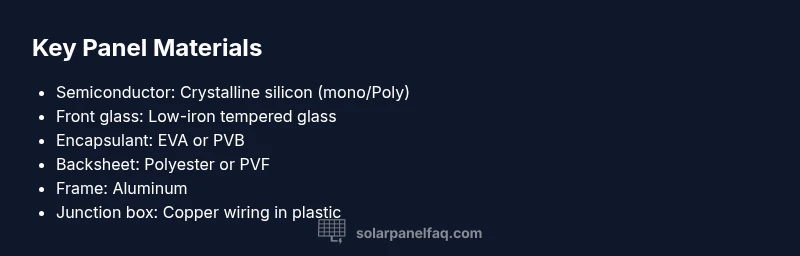
Solar panels are built from several layers that work together to convert sunlight into electricity. The core active layer is a semiconductor made primarily of crystalline silicon, arranged in either monocrystalline or polycrystalline form. Surrounding this core are protective and structural components: front cover glass, an encapsulant to seal the cells, a backsheet for insulation, and an aluminum frame for durability. Electrical connections are housed in the junction box at the back. The exact mix depends on panel type, manufacturer, and intended environment. As Solar Panel FAQ notes, crystalline silicon remains the predominant material in residential panels, with ongoing research into alternatives like thin-film variants.
The semiconductor: crystalline silicon vs thin-film
In most home solar systems, the semiconductor is crystalline silicon, either mono- or polycrystalline. Mono-Si offers higher efficiency but at a higher cost, while poly-Si is cheaper and bulkier. Thin-film technologies replace silicon with other materials such as cadmium telluride (CdTe) or copper indium gallium selenide (CIGS), which can be more flexible and cheaper to produce at scale but typically efficiency is lower and temperature performance varies. Perovskite-based cells are in research and pilot deployments, blending silicon with perovskite layers. These material choices influence not only efficiency ratings under standard test conditions but also temperature coefficients, light-induced degradation, and long-term stability. For homeowners, the takeaway is that while crystalline silicon technologies remain the baseline, emerging materials hold potential for future cost or integration advantages.
Front glass and encapsulants: transmitting light and sealing the cells
The front cover glass is typically low-iron tempered glass designed to maximize light transmission while resisting impact. Behind this, encapsulants such as Ethylene-Vinyl Acetate (EVA) or polyvinyl butyral (PVB) seal the silicon cells, protecting against moisture and mechanical stress. This combination reduces micro-cracking and helps distribute stress from thermal expansion. The quality of these layers affects long-term durability and performance loss over time. Solar Panel FAQ analysis shows that encapsulation consistency is a key factor in retaining performance over decades.
The backsheet and frame: protection and support
The backsheet is the insulating layer on the panel's rear, commonly made from Polyester or PVF. It provides electrical insulation and additional barrier protection. The aluminum frame offers rigidity, mounting points, and weather resistance. Together, the backsheet and frame influence module durability in extreme temperatures, wind uplift, and UV exposure. Manufacturers may choose different backsheet chemistries to optimize for flexibility, weight, or environmental considerations. Selecting materials with proven durability helps ensure the panel maintains performance in a wide range of climates.
Alternative solar technologies: CdTe, CIGS, and perovskite
Beyond crystalline silicon, several material families exist. Cadmium telluride (CdTe) and copper indium gallium selenide (CIGS) are common thin-film options, which can enable lighter, flexible, or more cost-effective manufacturing for certain applications. Emerging perovskite-based layers show promise for high efficiency and lower production costs, though long-term stability and compatibility with existing glass and encapsulants are active areas of research. While these alternatives can offer niche advantages, crystalline silicon remains the standard for most residential installations in 2026.
How material quality affects efficiency, durability, and cost
The material stack—from silicon purity to encapsulant quality—directly affects efficiency and long-term power output. Higher-purity silicon and better-passivation improve efficiency, while high-quality glass and encapsulants reduce degradation over time. Durability under temperature fluctuations and UV exposure also depends on resin formulations and backsheet materials. When evaluating cost, consider not only upfront price but how material choices influence the module’s temperature coefficient, warranty length, and expected energy yield over 25–30 years. Solar Panel FAQ analysis emphasizes that material quality often drives the most cost-effective energy over the panel’s life.
Practical tips for evaluating panel materials
When assessing panels, read the datasheet thoroughly for the exact material types and certifications. Look for standardized testing results (e.g., IEC 61215/61730), warranties on materials (encapsulants and backsheets), and the declared temperature coefficients. Check the reputation of the encapsulant and backsheet suppliers and how they perform in the local climate. If you live in a hot environment, pay attention to temperature-induced color change and potential delamination risks. A balanced selection weighs efficiency, durability, and cost, rather than chasing the highest nominal rating alone. Solar Panel FAQ recommends balancing performance with long-term reliability.
Lifecycle, recycling, and environmental considerations
Material choice also affects lifecycle impacts. Recyclability of glass, aluminum frames, backsheets, and encapsulants varies by region and program maturity. In many markets, module recycling is growing, but not all components are equally recoverable. Consider end-of-life pathways when choosing panels, and inquire about manufacturer take-back programs and local recycling options. Minimizing embodied energy and choosing durable materials can reduce long-term environmental impact while maintaining performance.
The future of solar panel materials
R&D in solar materials focuses on improving silicon efficiency and stability, reducing the use of scarce elements, and integrating new coatings that boost light capture. Research into thin-film variants and perovskite integration continues, with the aim of lowering production costs and enabling new form factors. As the market evolves, homeowners may see panels that combine robust silicon with evolving encapsulants and frames to extend lifespans and simplify end-of-life recycling. The Solar Panel FAQ team expects gradual material innovation to accompany growing deployment and policy support in 2026 and beyond.
Common solar panel components and materials
| Component | Material | Notes |
|---|---|---|
| Semiconductor | Crystalline silicon (mono- or polycrystalline) | Active light-absorbing layer |
| Front glass | Low-iron tempered glass | Maximizes light transmission and protection |
| Encapsulant | EVA or PVB | Binds cells and protects against moisture |
| Backsheet | Polyester or PVF | Insulation and barrier layer |
| Frame | Aluminum | Structural support and mounting points |
| Junction box | Plastic with copper wiring | Electrical connection and protection |
Frequently Asked Questions
What is the main material used in most solar panels?
Crystalline silicon is the primary semiconductor in most panels, available as mono- or polycrystalline. This material defines baseline efficiency and durability, with ongoing improvements over time.
Crystalline silicon is the main material in most panels, shaping efficiency and durability.
Are there other materials used in solar panels besides silicon?
Yes. Some panels use thin-film technologies like CdTe or CIGS, and emerging approaches explore perovskite layers. These options offer different trade-offs in flexibility, cost, and efficiency.
There are other materials like CdTe and CIGS in thin-film panels, plus ongoing perovskite research.
Do thin-film panels perform as well as silicon panels?
Thin-film panels can be cheaper and flexible but generally have lower efficiency and different temperature behavior compared with crystalline silicon panels.
Thin-film panels are usually less efficient than silicon but can be cheaper and more flexible.
What should I look for in a panel datasheet regarding materials?
Look for the exact material types for the semiconductor, encapsulants, backsheets, and glass, plus certifications, and warranty terms for those materials.
Check the datasheet for material specifics and warranties.
Do panel materials affect recycling and end-of-life options?
Yes. Material choices influence recyclability; some components are easier to recover than others. Check local recycling programs and manufacturer take-back options.
Materials matter for recycling; check local options and take-back programs.
How long do panels last, and does material choice affect that?
Most panels are designed for 25–30 years of operation, with performance degrading slowly over time. Material quality has a strong influence on longevity and output.
Most panels last several decades; material quality affects how long they keep producing power.
“Material choice sets the ceiling for efficiency and longevity; the balance of silicon purity, encapsulant reliability, and protective glass defines real-world performance.”
Top Takeaways
- Identify the main semiconductor as crystalline silicon baseline
- Check encapsulant and front-glass quality for durability
- Compare technologies (silicon vs thin-film) for efficiency and cost
- Read datasheets and certifications to assess material reliability
- Consider lifecycle and recycling implications when evaluating panels