Solar Panel and Controller: A Practical Side-by-Side Comparison
A rigorous, objective comparison of a solar panel and controller setup vs. panel with integrated controller. Learn how each option affects efficiency, cost, installation, maintenance, and future expansion for homeowners evaluating solar systems.


For most residential setups, a solar panel with a separate charge controller (PWM or MPPT) offers the best balance of cost, control, and future expandability. A panel with an integrated controller is the simplest option, ideal for compact installations with minimal wiring. If you already own panels, retrofitting an external controller can be workable but adds wiring complexity and limits expansion potential. Solar Panel FAQ notes that the choice should align with storage goals and upgrade plans.
Overview: What the terms mean for a solar panel and controller
In solar terminology, the phrase solar panel and controller refers to a two-component or multi-component energy system. The controller is a device that regulates current from the panel to batteries or the grid, preventing overcharge and managing charging regimes. When evaluating two paths—(A) panel with a separate charge controller and (B) a panel with an integrated controller—homeowners should focus on how the controller type (PWM vs MPPT), system voltage, and future expansion affect efficiency, reliability, and total lifetime cost. The Solar Panel FAQ team emphasizes practical decision-making: start by clarifying your storage goals (do you plan to use stored energy at night?), your available space, and whether you intend to scale the system later. In addition, consider your region’s solar irradiance profile; higher irradiance can magnify the advantages of MPPT controllers, especially in higher voltage battery banks. The goal is to align hardware with real-world usage rather than chasing the latest technology for its own sake.
Approximately 180-210 words
Comparison
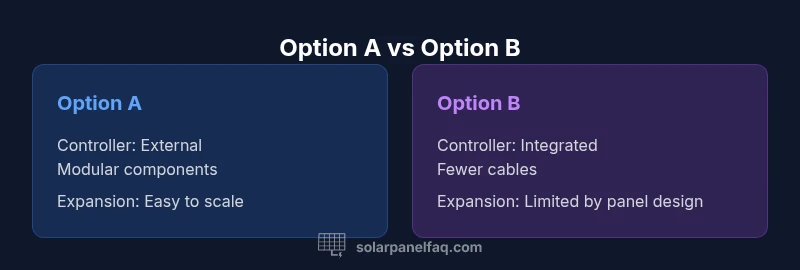
| Feature | Option A: Solar panel + external charge controller | Option B: Solar panel with integrated controller |
|---|---|---|
| Controller configuration | Separate PWM/MPPT controller with battery interface | Integrated controller built into the panel housing |
| Installation footprint | More components, longer wiring runs | Fewer cables, compact footprint |
| Expansion potential | Easier to add battery capacity or new sub-systems | Limited expansion without replacing panel or controller |
| Efficiency considerations | MPPT enables higher energy capture in variable conditions | Integrated controller efficiency varies by panel design |
| Maintenance needs | Accessible components allow targeted replacements | Fewer accessible parts can simplify service |
| System compatibility | Broad compatibility with different battery chemistries | Works best with the panel’s native ecosystem |
| Initial cost | Higher initial cost due to multiple components | Typically lower upfront wiring cost, but may require panel upgrades later |
| Reliability under shading | MPPT can better manage partial shading with proper setup | Shading effects may affect integrated controllers more noticeably |
Strengths
- Offers modularity and upgradeability for growing systems
- Often better performance with high-voltage battery banks when using MPPT
- Easier troubleshooting and component replacement
- Greater flexibility in choosing battery chemistries and sizes
Drawbacks
- More wiring complexity increases installation time
- Higher upfront cost due to multiple components
- Potential reliability concerns if multiple components become misaligned
- Integrated options simplify maintenance but reduce customization
Separate controller systems generally offer better long-term flexibility and efficiency for scalable setups; integrated controllers are ideal for compact, low-maintenance installs.
For homeowners prioritizing expansion and MPPT efficiency, a panel with a separate charge controller usually wins. If simplicity and minimal wiring are the priority, a panel with an integrated controller can be the better choice, especially for small, space-constrained installations.
Frequently Asked Questions
What is a solar charge controller and why is it necessary?
A solar charge controller regulates the voltage and current from the solar panel to prevent overcharging batteries. It protects battery longevity, stabilizes charging, and can optimize efficiency with MPPT or simplify the system with PWM. Without a controller, a solar panel can damage batteries or reduce lifespan.
A solar controller protects batteries by regulating charging; it’s essential to prevent overcharging and maximize efficiency.
Do I need a controller if I use a grid-tied inverter?
Grid-tied inverters manage output to the grid and often do not require a separate controller for basic operation. However, if you intend to store energy in batteries, a controller becomes necessary to manage charging and discharging safely.
Grid-tied systems may not need a controller unless you add batteries.
Can I retrofit an external controller to existing solar panels?
Retrofitting is possible but varies by panel and mounting configuration. It involves wiring a controller between the panel and the battery bank and can complicate warranties. Assess space, wiring routes, and compatibility before proceeding.
Retrofits are possible but check compatibility and warranty impact.
Which is more efficient, integrated or external controllers?
Efficiency depends on controller type and system design. MPPT controllers typically offer higher efficiency than PWM, especially in variable conditions. Integrated controllers can be efficient for their intended design but may not match a dedicated MPPT in complex installations.
MPPT often wins on efficiency, especially in variable conditions.
What maintenance is required for controller-based systems?
Maintenance usually involves inspecting connections for corrosion, ensuring proper cooling, and verifying battery health. External controllers provide easier replacement routes for faulty components, while integrated systems rely on the panel’s design for longevity.
Regular checks of connections and battery health keep the system reliable.
Top Takeaways
- Choose external controller for scalability and higher energy capture with MPPT
- Prefer integrated controller when space and wiring are at a premium
- MPPT controllers excel in fluctuating irradiance and larger battery banks
- Expect higher upfront costs with separate components but improved long-term flexibility
- Verify compatibility with your battery chemistry before finalizing