How is Solar Panel Wattage Calculated
Learn how solar panel wattage is calculated—from rated panel power to derates, shading, and system efficiency. A practical guide for homeowners sizing a solar array.


According to Solar Panel FAQ, wattage is calculated as the panel's rated power under standard test conditions, then adjusted for real-world factors. To size a system, estimate your daily energy use in kWh, divide by the average daily sun hours, and apply a derate factor to account for losses. This quick answer introduces the method you’ll apply in detail.
What wattage means for solar panels
Wattage is a measure of electrical power, not energy. In solar panels, the wattage rating (for example, 320 W) indicates the maximum amount of DC power a panel can produce under standard test conditions (STC)—a fixed, laboratory-based scenario with 1000 watts per square meter of sunlight and cell temperature at 25°C. This rating is sometimes labeled as watts-peak (Wp). It's the ceiling, not a guarantee for every hour of sun.
In practice, you won't achieve the rating for most of the day. Real-world output depends on sun angle, panel temperature, shading, cleanliness, wiring losses, and inverter efficiency. So, while a single 320 W panel can deliver up to 320 W under ideal conditions, average daily energy production is lower and varies by location and time of year. When homeowners ask, “how is wattage calculated?” the answer starts with the panel's rating and ends with a derate that accounts for what happens after installation.
According to Solar Panel FAQ, understanding wattage begins with recognizing the difference between watts (instant power) and kilowatt-hours (energy over time). A single panel's wattage helps predict how many watts can be generated at any moment, but the total daily energy you recover depends on weather, orientation, and system design. This distinction matters for correctly sizing an array and avoiding over- or under-provisioning.
- heading 1吗],
toolsMaterials":{"items":[{"name":"Electricity bill or energy usage records","required":true,"note":"Look for daily kWh or monthly kWh; convert to daily if needed"},{"name":"Spreadsheet or calculator (online or offline)","required":true,"note":"Use to compute Wdc and panel count"},{"name":"Sun-hours data for your location","required":true,"note":"Average daily sun hours from PVWatts or local weather"},{"name":"Panel datasheet or rating information","required":true,"note":"Needed to compare against Wdc and P rating"},{"name":"Notepad or digital note-taking app","required":false,"note":"To track calculations and assumptions"},{"name":"Safety gear (if handling wiring)","required":false,"note":"Gloves, eye protection for hands-on tasks"}]},
stepByStep":{"steps":[{"number":1,"title":"Gather your daily energy use","description":"Collect your recent electricity bills or use an average daily kWh value. Convert monthly kWh to daily if needed by dividing by 30. This gives you E_d, the daily energy demand in kWh/day.","tip":"Use several months of data to smooth out seasonal fluctuations."},{"number":2,"title":"Find your location’s average sun hours","description":"Look up the average peak sun hours per day for your location. This value, S, represents how many hours per day the system operates near optimal irradiance." ,"tip":"If you’re in a mixed climate, use a conservative estimate to avoid over-sizing."},{"number":3,"title":"Choose a derate factor to account for losses","description":"Select a derate factor, d, that represents system losses from wiring, temperature, dirt, and inverter efficiency. A reasonable planning value is a factor less than 1 (e.g., 0.75–0.85), reflecting real-world performance.","tip":"Document your chosen derate and explain why it’s chosen for transparency."},{"number":4,"title":"Compute required DC system wattage","description":"Calculate the DC wattage needed: Wdc = (E_d * 1000) / (S * d). This converts daily energy needs into an instantaneous power requirement." ,"tip":"Keep units consistent; Wh/day divided by hours yields watts."},{"number":5,"title":"Select panel wattage and estimate panel count","description":"Choose a panel rating P (in watts). Estimate the number of panels N = ceiling(Wdc / P). This gives you a baseline DC array size." ,"tip":"Allow a small margin for future growth or shading."},{"number":6,"title":"Check inverter and system design","description":"Ensure the inverter capacity matches or exceeds the DC array in watts, with headroom for efficiency losses and potential expansion. Plan wiring, Permits, and safety considerations before installation.","tip":"Inverter sizing is critical; under-sizing can throttle production while over-sizing adds cost."},{"number":7,"title":"Validate with a professional installer","description":"Have a local installer confirm assumptions (sun hours, derate, shading) and adjust the design for your home’s roof and electrical panel constraints.","tip":"Professional verification helps catch location-specific factors you might miss."}],"estimatedTime":"2-4 hours"},
tipsList
keyTakeaways
videoEmbed
faqSection
mainTopicQuery
Tools & Materials
- Electricity bill or energy usage records(Look for daily kWh or monthly kWh; convert to daily if needed)
- Spreadsheet or calculator (online or offline)(Use to compute Wdc and panel count)
- Sun-hours data for location(From PVWatts or local weather data)
- Panel datasheet or rating information(Needed to compare against Wdc and P rating)
- Notepad or digital note-taking app(To track calculations and assumptions)
- Safety gear (if handling wiring)(Gloves, eye protection for hands-on tasks)
Steps
Estimated time: 2-4 hours
- 1
Gather daily energy use
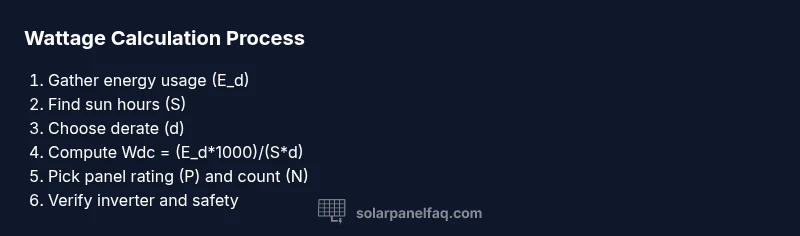
Collect your recent electricity bills or use an average daily kWh value. Convert monthly kWh to daily if needed by dividing by 30. This gives you E_d, the daily energy demand in kWh/day.
Tip: Use several months of data to smooth out seasonal fluctuations. - 2
Find sun hours for your location
Look up the average sun hours per day for your location. This value, S, represents how many hours per day the system operates near optimal irradiance.
Tip: If you’re in a mixed climate, use a conservative estimate to avoid over-sizing. - 3
Choose a derate factor
Select a derate factor, d, that accounts for losses from wiring, temperature, dirt, and inverter efficiency. A common planning value is 0.75–0.85.
Tip: Document your chosen derate and explain why it’s chosen for transparency. - 4
Compute required DC wattage
Calculate the DC wattage needed: Wdc = (E_d * 1000) / (S * d). This converts daily energy needs into an instantaneous power requirement.
Tip: Keep units consistent; Wh/day divided by hours yields watts. - 5
Select panel rating and estimate count
Choose a panel rating P (in watts). Estimate panels N = ceiling(Wdc / P). This gives you a baseline DC array size.
Tip: Allow a small margin for future growth or shading. - 6
Check inverter and system design
Ensure the inverter capacity matches or exceeds the DC array in watts, with headroom for efficiency losses and potential expansion. Plan wiring, permits, and safety considerations before installation.
Tip: Professional verification helps catch location-specific factors you might miss. - 7
Validate with a professional installer
Have a local installer confirm assumptions (sun hours, derate, shading) and adjust the design for your home’s roof and electrical panel constraints.
Tip: Getting a pro’s input reduces the risk of over- or under-sizing.
Frequently Asked Questions
What is wattage in solar panels?
Wattage is the panel’s maximum power output under ideal conditions (STC). It’s the ceiling for what the panel can produce, not the energy you’ll get every day. Real output depends on sun, temperature, and system losses.
Wattage is the panel’s maximum power output under ideal conditions, not daily energy. Real output varies with sun and losses.
How do STC and NOCT ratings affect wattage?
STC (standard test conditions) defines the peak wattage under ideal lab conditions. NOCT is more realistic for outdoor operation and usually yields a lower expected wattage. Designers use STC for labeling and NOCT for real-world planning.
STC gives peak wattage in labs; NOCT gives a more realistic outdoor expectation.
How many watts do I need for my home?
Wattage needs depend on daily energy use, sun hours, and system losses. Use Wdc = (E_d*1000)/(S*d) to estimate the required DC power, then pick panel ratings to reach or exceed that value, with inverter headroom.
Estimate daily use, sun hours, and losses to compute needed DC wattage, then size panels accordingly.
How do shading and orientation affect wattage?
Shading reduces output regardless of wattage rating. Orientation and tilt influence how much sun your panels receive. Include a derate factor to reflect these conditions in your sizing.
Shade and angle change actual output; plan for losses with a derate factor.
Should I rely on wattage alone to size a system?
Wattage is essential but not sufficient alone. You must also consider daily usage, sun hours, panel efficiency, inverter capacity, and future expansion. A holistic sizing approach avoids under- or over-sizing.
Wattage matters, but include usage, sun, and losses for proper sizing.
What tools help calculate wattage?
Use your electricity bills for energy use, solar calculators (like PVWatts), and a simple Wdc formula. For accuracy, validate results with a professional installer.
Use bills, solar calculators, and the Wdc formula, then verify with a pro.
Watch Video
Top Takeaways
- Wattage is panel-rated power, not guaranteed daily output.
- Convert daily energy use to watts via Wdc = (E_d1000)/(Sd).
- Add headroom for shading, temperature, and inverter losses.
- Panel count depends on Wdc and chosen panel rating; expect some margin.
- Involve a professional to verify roof, wiring, and safety constraints.